

Fact-checked by the onlinepaydaynews.com editorial team
Quick Answer
After a loan default, creditors can garnish your wages, but federal law caps most garnishments at 25% of disposable earnings or the amount above 30 times the federal minimum wage, whichever is less. Federal student loan garnishment is capped at 15%. To stop or prevent garnishment, request a hearing within 30 days of notice, pursue loan rehabilitation, negotiate a settlement, or file a bankruptcy stay.
Wage garnishment after a loan default is one of the most financially disruptive consequences a borrower can face, yet the rules governing it are widely misunderstood. Under Title III of the Consumer Credit Protection Act (CCPA), ordinary consumer debt garnishments are capped at the lesser of 25% of disposable earnings or the amount by which those earnings exceed 30 times the federal minimum wage per week, providing a meaningful floor of protection. The critical distinction most borrowers miss is that private lenders must first sue and win a court judgment before touching your paycheck, while federal agencies like the Department of Education can garnish administratively without ever going to court.
That distinction is unusually urgent right now. The Department of Education resumed Administrative Wage Garnishment for defaulted federal student loan borrowers on January 7, 2026, ending a pause that had been in place since March 2020. Approximately 5.3 million borrowers received garnishment-related notices as collections restarted, and the Department projects up to 10 million borrowers could eventually be affected as enforcement scales through 2026. For millions of people, this is the first time wage garnishment has been a real and immediate threat.
This guide is for anyone who has defaulted or is nearing default on a federal or private loan and wants to understand exactly how much can be taken, what income is protected, and which concrete steps can slow or stop a garnishment. By the end, you will know how the CCPA limits work in practice, which states offer stronger protections, and what to do first if a notice has already arrived.
Key Takeaways
- Federal law caps most consumer debt garnishments at 25% of disposable earnings per week, per the U.S. Department of Labor’s Wage and Hour Division.
- Defaulted federal student loans can be garnished at up to 15% of disposable earnings without a court order, a lower cap than private creditors but with no lawsuit required, according to DOL Fact Sheet #30.
- 5.3 million federal student loan borrowers received wage-garnishment-related notices after collections resumed in January 2026, as reported by ACA International.
- Four states, Texas, Pennsylvania, North Carolina, and South Carolina, prohibit private creditors from garnishing wages for consumer debts entirely, changing the threat calculus for residents there.
- Social Security and VA benefits are generally exempt from private creditor garnishment, but the federal government can garnish up to 15% of Social Security benefits for defaulted student loans, with a $750/month floor protected, per the Consumer Financial Protection Bureau.
- The CCPA’s anti-termination protection shields workers from being fired for one garnishment, but explicitly does not protect workers facing garnishments for two or more separate debts simultaneously, per the DOL Employment Law Guide.
In This Guide
- What actually triggers wage garnishment after a loan default?
- How much of my paycheck can actually be garnished?
- Which states offer stronger protections against wage garnishment?
- What happens with wage garnishment if I’m self-employed or a 1099 contractor?
- What are my rights before and after a garnishment order is issued?
- What income and benefits are completely protected from garnishment?
- How do I stop or reduce a wage garnishment that’s already started?
- Frequently Asked Questions
Step 1: What Actually Triggers Wage Garnishment After a Loan Default?
The path to wage garnishment differs dramatically depending on whether your loan is a private consumer debt or a federal government loan, and conflating the two is one of the most common and costly mistakes borrowers make.
How to Understand the Two Separate Paths
With private loans (personal loans, auto loans, private student loans, credit cards), the creditor cannot touch your paycheck simply because you stopped paying. They must first file a lawsuit, serve you with a summons, and obtain a court judgment. Only after winning in court can they apply for a garnishment order. This process often takes months. The Federal Trade Commission warns that ignoring a lawsuit results in a default judgment, which can enable garnishment just as effectively as losing at trial, so never assume that not responding protects you.
Federal student loans operate under entirely different rules. The Department of Education, through a process called Administrative Wage Garnishment (AWG), can begin deducting from your paycheck without filing a lawsuit or obtaining a court order. Federal law authorizes this once a borrower reaches 270 days of non-payment, the legal threshold for default. Delinquency (missing payments but under 270 days) does not trigger garnishment, and many borrowers miss this window to act because they confuse delinquency with default.
What to Watch Out For
The IRS operates under an entirely separate framework. Federal tax levies are not governed by the CCPA at all. The IRS calculates its own exempt amount based on your filing status and number of dependents and can seize everything above that floor, with no 25% ceiling. This makes a tax levy structurally more aggressive than any private loan or student loan garnishment, and that distinction matters when you are trying to prioritize which debt to address first.
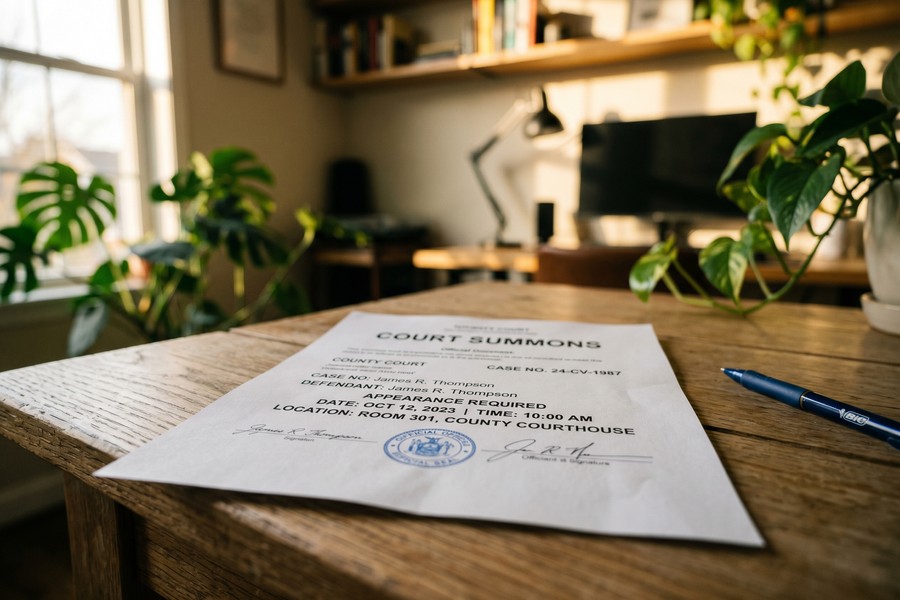
If you receive a summons from a court regarding a private debt, do not ignore it. A default judgment entered because you failed to respond gives the creditor the same garnishment rights as a judgment won after a full trial. Respond to every lawsuit notice, even if you cannot afford an attorney immediately.
Step 2: How Much of My Paycheck Can Actually Be Garnished?
Federal law limits how much a creditor can take from your paycheck each week using a two-part test, and the lower of the two amounts is the maximum that can be withheld.
How the CCPA’s “Lesser Of” Test Works
Ordinary consumer debt garnishments (including those following a private loan default) are capped at the lesser of: (1) 25% of disposable earnings for that week, or (2) the amount by which disposable earnings exceed 30 times the federal hourly minimum wage per week, currently $217.50 per week protected. Say your weekly disposable earnings are $400. Twenty-five percent of that is $100. The amount above $217.50 is $182.50. The lower figure, $100, is the maximum that can be garnished that week.
Here is where borrowers consistently miscalculate: disposable earnings for CCPA purposes means gross pay minus mandatory deductions only, federal and state income taxes, Social Security, Medicare, and legally required retirement contributions. Voluntary deductions like 401(k) contributions and health insurance premiums are NOT subtracted before calculating the garnishable base. This keeps your garnishable income higher than your actual take-home pay, meaning the amount withheld can feel larger than the 25% figure suggests.
Federal student loans carry a lower cap of 15% of disposable pay under Administrative Wage Garnishment, per the DOL’s Wage and Hour Division Fact Sheet #30. Child support and alimony operate under much higher allowances, up to 50–65% of disposable earnings, and those obligations take priority when stacked with other garnishment orders.
What to Watch Out For
Multiple creditors can hold active garnishment orders simultaneously, but the total withheld cannot exceed the federal or applicable state cap. Orders queue by the date each was served on your employer, with the earliest order paid first. The second creditor waits until the first order is satisfied before collecting. Borrowers managing both a private loan judgment and federal student loan AWG at the same time need to understand this queue, because both orders draw from the same capped amount.

As of Q3 2025, 4.5% of all outstanding household debt was in some stage of delinquency, according to the Federal Reserve Bank of New York’s Household Debt and Credit Report, representing millions of borrowers at potential risk of collection actions including wage garnishment.
Step 3: Which States Offer Stronger Protections Against Wage Garnishment?
State law can give you significantly more protection than the federal baseline, or, in rare cases, less. When state and federal limits conflict, whichever law leaves you with more money in your pocket controls, at least for private creditor garnishments.
States With the Strongest Protections
Four states stand out as offering near-complete protection for workers facing private creditor wage garnishment. Texas, Pennsylvania, North Carolina, and South Carolina prohibit private creditors from garnishing wages for consumer debts under state law. A creditor who wins a judgment in those states cannot touch your paycheck and must pursue bank account levies or other asset seizures instead. For borrowers in those states, the threat profile of a defaulted personal loan is materially different than elsewhere in the country.
Other states use a more generous multiplier than the federal 30x minimum wage floor. Connecticut, for example, uses a 40x multiplier, protecting more of each paycheck. Florida offers a powerful “head of household” exemption: borrowers who provide more than half the financial support for a dependent may have their wages shielded entirely from private creditor garnishment, a protection that has no federal equivalent. Several other states, including Iowa and South Dakota, extend head-of-family protections that can dramatically reduce or eliminate garnishment for primary earners supporting families.
These state protections generally apply to private creditors only. Federal administrative garnishments for student loans or taxes operate under federal authority and are not blocked by state wage exemption laws, a distinction that catches many borrowers by surprise.
What to Watch Out For
Even in protective states like Texas and Florida, creditors who cannot garnish wages can still pursue bank account levies. Once your paycheck is deposited into a checking account, it may lose wage-garnishment protections unless you are in a state that explicitly extends those protections to deposited wages. Some states, like Florida, have head-of-household tracing rules that follow the funds into the bank account for a limited period, but this is the exception, not the rule.
| State / Jurisdiction | Private Creditor Wage Garnishment | Key Protection Detail |
|---|---|---|
| Federal (default) | Allowed, up to 25% of disposable pay | 30x minimum wage floor ($217.50/week) protected |
| Texas | Prohibited for consumer debts | Creditor must pursue bank levy or property lien instead |
| Pennsylvania | Prohibited for consumer debts | Wages exempt; bank accounts may still be levied |
| North Carolina | Prohibited for consumer debts | Wage garnishment only allowed for taxes, support, student loans |
| South Carolina | Prohibited for consumer debts | Among the broadest state wage exemptions in the U.S. |
| Florida | Allowed, but head-of-household exempt | Head-of-household earning under $750/week fully exempt |
| Connecticut | Allowed, with higher floor | 40x minimum wage protected (vs. federal 30x) |
Residents of Texas, Pennsylvania, North Carolina, or South Carolina who receive a wage garnishment threat from a private debt collector for a personal loan default should request written documentation of the collector’s legal authority. A private creditor in those states legally cannot garnish your paycheck, and that threat may itself be a violation of the Fair Debt Collection Practices Act (FDCPA). You can file a complaint with the Consumer Financial Protection Bureau.
Step 4: What Happens With Wage Garnishment If I’m Self-Employed or a 1099 Contractor?
Freelancers, gig workers, and independent contractors sit outside the standard wage garnishment rules in ways that most people assume are protective. They are not, at least not reliably.
Why the CCPA Does Not Protect 1099 Workers the Way It Protects Employees
The CCPA’s Title III limits apply specifically to wages paid by an employer to an employee. Workers receiving 1099 income rather than a W-2 are not covered by the 25% cap. A creditor with a court judgment cannot serve a garnishment order on a client the way they would serve one on a traditional employer. This sounds like good news, but the alternative is often worse.
Judgment creditors can instead pursue non-earnings garnishment, a one-time seizure of funds held by a third party, such as a client who owes you a contract payment. Unlike the 25% wage cap, non-earnings garnishment has no such ceiling. A single contract payment, commission, or invoice can be seized in full, 100% of it, in a single court action. Some states, including Colorado and Virginia, explicitly require that employers withhold from independent contractor payments under certain conditions, further narrowing the gap between employee and contractor protections.
Tax debts create the most exposure. The IRS can levy 1099 payments directly from your clients without going through you at all, instructing the paying party to remit funds directly to the IRS. This bypasses the contractor entirely and applies without the CCPA cap as a backstop.
What to Watch Out For
Some freelancers assume that having no traditional employer makes their income untouchable by garnishment. That assumption is wrong and potentially dangerous. A judgment creditor’s options against a contractor are fewer but less restricted, which means a single large invoice can disappear entirely in one enforcement action. Resolving the debt through negotiation before a judgment is entered is especially important for self-employed borrowers. The window to negotiate or dispute is almost always wider before a court order exists than after.
For more on understanding your borrower rights before a dispute escalates, see our guide on what most borrowers get wrong about their right to dispute a loan.
A creditor can pursue a wage garnishment and a bank account levy simultaneously because they target different assets. Your paycheck in transit is covered by the CCPA cap (for employees), but the moment it lands in your bank account, it may lose that protection, unless you are in a state with extended tracing rules. This concurrent levy risk is rarely explained in standard wage garnishment articles.
Step 5: What Are My Rights Before and After a Garnishment Order Is Issued?
You have meaningful procedural rights at every stage of the wage garnishment process, and exercising them at the right moment can mean the difference between garnishment starting and never starting at all.
Your Procedural Rights Checklist
Federal student loan AWG requires the Department of Education to provide at least 30 days’ written notice before garnishment begins. Within that window, you can request a hearing. Valid grounds to object include financial hardship, involuntary unemployment lasting at least 12 months, eligibility for a loan discharge (such as Total and Permanent Disability, Borrower Defense to Repayment, or Closed School Discharge), and errors in the amount claimed. Submitting a hearing request before the deadline pauses garnishment until the hearing is resolved.
Private creditor garnishments carry more variation by state, but in general you can file a “claim of exemption” with the court that issued the garnishment order. This document identifies which federal or state exemption applies to your income (for example, the Florida head-of-household exemption or the Texas wage exemption) and asks the court to modify or quash the order.
According to the National Consumer Law Center, borrowers objecting to an AWG must clearly explain the basis for their objection and provide supporting evidence. A vague or unsupported hearing request is unlikely to pause garnishment effectively.
The Anti-Retaliation Protection, and Its Hard Limit
The CCPA prohibits an employer from firing, suspending, demoting, or disciplining an employee because of a garnishment tied to a single debt. Employers who willfully violate this rule face potential criminal prosecution, fines, or imprisonment under the DOL’s Employment Law Guide.
That protection explicitly disappears when garnishments for two or more separate debts are active at the same time. Federal law removes the protection entirely in that scenario. Some states fill this gap with broader anti-retaliation laws, but the federal floor is weaker than almost universally assumed. Given that millions of borrowers now face federal student loan garnishment restarting in 2026 while potentially still carrying private loan judgments from earlier years, this gap is not theoretical.
There is also a practical limit that most guides skip over entirely: the procedural rights described here require you to act on time. A hearing request submitted one day after the 30-day AWG deadline will almost certainly be rejected. Knowing your rights matters only if you respond within the window.
What to Watch Out For
Receiving a court summons for a private debt demands a written response, even if only to request more time. Failing to respond results in a default judgment, giving the creditor the same garnishment authority as a contested case. Our article on common borrower mistakes when disputing a loan covers this in detail.
Step 6: What Income and Benefits Are Completely Protected From Garnishment?
Several categories of income carry federal protection from private creditor garnishment, but the protections are not absolute, and the federal government itself can reach some of them under specific circumstances.
Federally Protected Income Sources
Social Security retirement and disability benefits, Supplemental Security Income (SSI), Veterans Affairs (VA) benefits, and federal pension payments are generally exempt from garnishment by private creditors, as the CFPB confirms. These protections exist regardless of whether the money is sitting in your bank account, provided the funds are clearly identifiable as the protected source.
The federal government itself operates under different rules. The Department of Education can garnish up to 15% of Social Security benefits to repay defaulted federal student loans, but a $750 per month floor is always protected, meaning the government cannot reduce your Social Security below $750 per month regardless of the debt owed. This concrete dollar figure is almost never cited in general consumer articles, but it directly affects retirees and disabled borrowers who may be managing student debt from decades past.
The Bank Account Complication
Once exempt income is deposited into a general bank account, protections can weaken. Federal banking rules require banks to automatically protect two months’ worth of directly deposited federal benefits from freezing or garnishment. So if you receive $1,200 per month in Social Security, a bank must protect $2,400 in your account. Funds beyond that cushion, or funds mixed with non-exempt deposits, become more vulnerable.
Some states extend this protection further. Florida’s head-of-household rules can trace wage funds into bank accounts and shield them, but these state-level extensions require you to actively assert the exemption. They are not automatic.
A debt collector who attempts to seize protected funds can be challenged directly. The CFPB provides a sample letter you can use to assert those protections, along with guidance on filing a complaint, at their consumer resource page.
The CFPB complaint database is a powerful tool for borrowers facing illegal collection tactics. Filing a complaint creates a formal record if a collector has threatened or attempted garnishment without proper legal authority. Our beginner’s guide to the CFPB complaint database walks through the process step by step.
Step 7: How Do I Stop or Reduce a Wage Garnishment That’s Already Started?
Garnishment is not a permanent sentence. Concrete options exist to slow, stop, or eliminate it, and the fastest one depends on whether the debt is federal or private.
For Federal Student Loans: Rehabilitation and the 30-Day Window
Loan rehabilitation is the most direct path out of federal student loan garnishment. Here is the timing mechanic that most guides omit: submit a rehabilitation application and make your first payment within 30 days of receiving the AWG notice, and garnishment never starts. Miss that window and garnishment begins, but it must legally stop after your 5th consecutive on-time rehabilitation payment.
As Bruce McClary, Senior Vice President at the National Foundation for Credit Counseling (NFCC), has stated: “Wages may still be garnished while you rehabilitate your loans, but it is legally required to stop after five monthly payments.”
Rehabilitation requires 9 consecutive monthly payments at an income-based amount to fully exit default and restore loan eligibility. Consolidation into a Direct Consolidation Loan is an alternative that can resolve the default faster but does not carry the same post-rehabilitation credit benefit, the default notation remains on your credit report longer. The National Consumer Law Center’s Kyra Taylor puts it plainly: “the first thing [you] should immediately do is try to get [your] loans out of default.”
For Private Loan Garnishments: Negotiation, Exemptions, and Bankruptcy
Once a private creditor has a judgment, your clearest options are: negotiate a payment plan or lump-sum settlement directly with the judgment creditor (many will accept significantly less than the full balance to avoid the administrative burden of ongoing garnishment), file a claim of exemption with the issuing court if your income qualifies under a state or federal exemption, or challenge the underlying judgment if there were procedural errors in how it was obtained.
Bankruptcy deserves honest mention here, along with its real costs. Filing for Chapter 7 or Chapter 13 triggers an automatic stay that immediately halts most garnishments, including private loan garnishments. Chapter 7 can discharge eligible personal loan debt entirely within 3 to 4 months for borrowers who qualify through the means test. Chapter 13 allows repayment of non-dischargeable debts on a structured plan over 3 to 5 years, with payments going directly to a trustee rather than through your employer. Federal student loans are generally not dischargeable in bankruptcy except under very narrow hardship standards, so bankruptcy is a stronger tool for private debt than for student loan debt.
The tradeoff is significant: Chapter 7 stays on your credit report for 10 years, Chapter 13 for 7. During that period, qualifying for housing, new credit, or certain jobs becomes meaningfully harder. Bankruptcy is the right call when debt is genuinely unmanageable across multiple creditors, not as a first response to a single garnishment order from one lender. Many borrowers who file primarily to stop one garnishment later report that the long-term credit consequences outweighed the short-term relief, particularly when negotiated settlement was available and not fully explored.
An emergency that compounds your debt situation is also worth planning around. Our breakdown of how fast emergency money is available by funding source covers the realistic timelines for each option.
What to Watch Out For
Research from the JPMorgan Chase Institute found that historically, most federal student loan garnishment spells ended within 4 months when borrowers actively engaged with rehabilitation or income-driven repayment. That is an honest, evidence-based reason for cautious optimism: the financial disruption is more acute than it is permanent for borrowers who act promptly. For borrowers who ignore the situation, garnishment can continue for years. Proactive engagement with whatever repayment or dispute process applies to your loan type is the clearest differentiator between short-term disruption and prolonged hardship.

Exploring settlement on a defaulted private loan? Get any agreement in writing before sending a single payment. Verbal agreements are nearly impossible to enforce. The written agreement should specify the settled amount, confirm the balance will be considered paid in full, and state that the creditor will release the garnishment order upon receipt of payment. Our guide on catching illegal lending fees and getting a refund shows what recourse looks like in practice when a lender behaves deceptively during this process.
Frequently Asked Questions
Can a debt collector garnish my wages without taking me to court first?
For most private debts, no, a debt collector must first sue you and obtain a court judgment before garnishing wages, as confirmed by the Federal Trade Commission. The exception is federal student loans, where the Department of Education can garnish administratively without a lawsuit under Administrative Wage Garnishment authority. The IRS also can garnish or levy income without a court order for tax debts.
How do I calculate how much of my paycheck will be garnished?
Use the CCPA’s two-part test: calculate 25% of your disposable earnings for the week, then calculate the amount by which your disposable earnings exceed $217.50 (30 times the $7.25 federal minimum wage). The lower of those two figures is the maximum that can be taken. Disposable earnings means your gross pay minus mandatory taxes and legally required deductions, voluntary deductions like 401(k) contributions do not reduce the garnishable base.
What happens if I live in a state that bans wage garnishment but the creditor is in another state?
The wage exemption laws of the state where you work and are paid generally govern, not where the creditor is located. Workers in Texas, Pennsylvania, North Carolina, or South Carolina are covered by those states’ consumer debt exemptions even when the creditor obtained its judgment elsewhere. The creditor may attempt to domesticate the foreign judgment locally, but the state exemption remains a shield against wage garnishment specifically.
Can my employer fire me because my wages are being garnished?
The CCPA prohibits your employer from firing, suspending, or disciplining you because your wages are garnished for a single debt. This protection disappears if you have active garnishments for two or more separate debts simultaneously, federal law explicitly removes the protection in that scenario. Some states provide broader anti-retaliation coverage regardless of the number of garnishments, so check your state’s specific employment laws if you face multiple orders.
Are my Social Security benefits protected if I default on a personal loan?
Yes, Social Security benefits are generally exempt from garnishment by private creditors, per the CFPB. However, once those funds are mixed with non-exempt money in a bank account, protections can become more complicated. Federal banking rules require your bank to automatically protect two months’ worth of directly deposited federal benefits from seizure. When the government (not a private creditor) is the creditor, for student loans or taxes, Social Security can be garnished up to 15%, with $750 per month always protected.
Should I file bankruptcy to stop a wage garnishment or try to negotiate first?
Negotiating first is almost always worth attempting because it is faster, cheaper, and avoids the long-term credit consequences of bankruptcy. For private loan garnishments, many judgment creditors will accept a reduced settlement or structured payment plan to end the garnishment. Bankruptcy’s automatic stay is a stronger and more immediate tool if negotiation fails or if you have multiple judgments active simultaneously, but Chapter 7 stays on your credit report for 10 years and Chapter 13 for 7. Consider bankruptcy when debt is genuinely unmanageable across multiple creditors, not as a first response to a single garnishment order.
I’m a freelancer and I just got sued by a creditor for a defaulted loan. Can they garnish my income?
Not in the traditional wage-garnishment sense. The CCPA’s 25% cap applies only to wages paid by an employer to an employee, it does not cover 1099 income. However, a creditor with a judgment can pursue non-earnings garnishment, seizing up to 100% of a single contract payment or invoice. This is often more financially damaging than a capped wage garnishment. Resolving the debt through negotiation before a judgment is entered is especially important for self-employed borrowers. Our guide on legal protections for different types of debt covers how personal loan debt stacks up against other obligations.
What is the fastest way to stop student loan wage garnishment once it has started?
Submit a loan rehabilitation application to your loan servicer and make the first income-based payment as quickly as possible. Once you have made 5 consecutive monthly rehabilitation payments, the Department of Education is legally required to stop the garnishment, even though rehabilitation itself requires 9 payments total to fully exit default. Submitting the application and making the first payment within 30 days of the original AWG notice may prevent garnishment from starting at all. Act on the notice immediately rather than waiting to see what happens.
What happens if I owe both federal student loans and a private loan and both are in default?
You could face two simultaneous garnishment actions drawing from the same paycheck: Administrative Wage Garnishment for the student loan (up to 15% of disposable pay) and a court-ordered garnishment for the private loan (up to 25%). The combined total cannot exceed the federal cap applicable to each, they are treated as separate orders stacked in priority order. You would also lose CCPA anti-termination protection because two separate debts are being garnished simultaneously. Addressing the federal student loan first through rehabilitation is generally the more urgent priority because federal administrative garnishment requires no court action and no judgment to enforce.
Sources
- U.S. Department of Labor, Wage and Hour Division, Fact Sheet #30: Garnishment of Employee’s Wages
- U.S. Department of Labor, Employment Law Guide: Wage Garnishment
- Consumer Financial Protection Bureau, Can a Debt Collector Garnish My Wages or Benefits?
- Consumer Financial Protection Bureau, Can a Debt Collector Take My Social Security or VA Benefits?
- Federal Trade Commission, Debt Collection FAQs
- ACA International, Federal Student Loan Wage Garnishment Resumes January 2026
- Federal Reserve Bank of New York, Household Debt and Credit Report, Q3 2025
- CNBC, What Student Loan Borrowers Can Do If They’re Facing Wage Garnishment (January 2026)