

Fact-checked by the onlinepaydaynews.com editorial team
Quick Answer
Single mothers facing a cash emergency should start with free options first: call 211 for same-day local aid, apply for LIHEAP or TANF cash assistance, then consider a Payday Alternative Loan (PAL) from a federal credit union at a capped 28% APR. Online personal loans can fund in 24 hours for borrowers with scores above 580. Payday loans, which carry APRs averaging 391%, should be a last resort.
Finding emergency loans for single mothers is a real and urgent need for millions of households, but the smartest path through a financial crisis almost always starts before the loan application. The median annual income for single-mother-led families was $41,305 in 2024, compared to $132,959 for married-couple families, according to U.S. Census Bureau data, a gap wide enough that a single car repair or missed shift can tip a household into genuine crisis. That context matters when you’re choosing between options that range from free grants to loans charging 400% APR.
The pressure has tightened recently. USDA Economic Research Service data shows that 36.8% of single-mother-headed households experienced food insecurity in 2024, up from 34.7% in 2023. Proposed federal budget changes for FY2026 would further reduce housing assistance programs that many single mothers depend on. The options that existed two years ago may not all be available in the same form today, which is why this guide addresses both the fastest resources and honest caveats about what is shifting.
This guide is for single mothers who need money quickly, regardless of credit score or employment type. By the end, you will know how to rank your options from cheapest to most expensive, how to find same-day local assistance that most articles skip entirely, which loans are actually designed for people in your situation, and which ones will make the crisis worse.
Key Takeaways
- The official poverty rate for single-mother families was 31.3% in 2024, nearly six times the rate for married-couple families, according to U.S. Census Bureau data, making emergency borrowing a structural reality, not a personal failure.
- Payday Alternative Loans (PALs) from federal credit unions are capped at 28% APR by the National Credit Union Administration (NCUA), compared to a typical payday loan APR of around 391%.
- PAL II, introduced by the NCUA in 2019, requires no waiting period after joining a credit union, meaning a single mother can apply for up to $2,000 the same day she becomes a member.
- LIHEAP crisis grants can resolve utility emergencies within 48 hours (or 18 hours when a shutoff is life-threatening), making them faster than most personal loan products for that specific need.
- Child support, TANF payments, gig income, and unemployment benefits can all count as qualifying income with many lenders, according to CFPB guidance on income verification standards.
- The Earned Income Tax Credit (EITC) can return up to $7,830 annually to qualifying working single mothers with three or more children (2024 tax year), per the IRS EITC tables.
In This Guide
- Why Single Mothers Face a Uniquely Brutal Cash Crunch
- Free Money First: Grants and Government Benefits That Don’t Need to Be Repaid
- How to Find Emergency Cash Through 211 and Local Charities in Under an Hour
- Emergency Loans for Single Mothers: Matching the Right Loan to the Right Crisis
- Which Loans Should Single Mothers Avoid and Why the Math Is Worse Than the Emergency
- How Can I Get an Emergency Loan If I Don’t Have a Regular Paycheck?
- After the Emergency: How to Build a Buffer So You Don’t Have to Borrow Again
- Frequently Asked Questions
Step 1: Why Single Mothers Face a Uniquely Brutal Cash Crunch
Single-mother households are not in financial distress because of poor decisions. The income gap is structural and documented. Understanding it matters practically because it determines which programs you qualify for and helps you frame an application accurately.
The Numbers Behind the Squeeze
The median annual income for single-mother families was $41,305 in 2024, compared to $132,959 for married-couple families, per U.S. Census Bureau data. That gap of roughly $91,000 per year is not closed by budgeting harder. The official poverty rate for single-mother families stood at 31.3% in 2024, nearly six times the 5.5% rate for married-couple families. Those figures represent real people who are working full-time and still falling short.
The wage gap compounds the problem. The female-to-male earnings ratio for full-time, year-round workers was 80.9% in 2024, the second consecutive annual decrease, according to the U.S. Census Bureau’s Income in the United States: 2024 report. For Black and Hispanic single mothers, the income picture is even tighter: median income for Black single mothers runs around $38,000 and for Hispanic single mothers around $34,000, according to Census microdata, both well below the already-strained overall median. Grant and program eligibility thresholds function differently at these income levels, and that is worth knowing when you’re deciding which programs to apply for first.
Why Emergencies Happen So Fast
Center-based infant care nationally averages more than 40% of a single mother’s state median income, and in five states it exceeds 50%, according to the U.S. Department of Labor’s Women’s Bureau. When nearly half of take-home pay is committed before rent, utilities, or food, there is no margin for a blown tire, a medical copay, or a missed shift. Emergencies are structurally inevitable at this income level, not a sign of mismanagement.
36.8% of single-mother households experienced food insecurity in 2024, up from 34.7% in 2023, according to USDA ERS data reported by the Food Research and Action Center.
Step 2: Free Money First: Grants and Government Benefits That Don’t Need to Be Repaid
Before applying for any loan, work through the no-debt options. A $500 grant costs $0 to repay; a $500 payday loan at a typical 400% APR can cost $575 or more if it rolls over once. The grant-first approach is not just ethical advice, the math makes it mandatory.
Government Programs to Contact Immediately
LIHEAP (Low Income Home Energy Assistance Program) covers utility bills and, in true crisis situations, can resolve an emergency within 48 hours. If the shutoff is life-threatening, no heat in winter, medical equipment at risk, federal guidelines call for resolution within 18 hours. Apply through your state’s LIHEAP office; the Administration for Children and Families maintains a state directory.
TANF (Temporary Assistance for Needy Families) provides cash assistance and, in many states, emergency payments separate from the monthly benefit. Processing times vary by state, but emergency TANF funds in some states are available within 72 hours for documented crises. WIC (Women, Infants, and Children) can issue same-day benefits for food needs, bring your child’s birth certificate and proof of income to a WIC office and enrollment can happen in a single visit.
Emergency Housing Vouchers, administered through local Public Housing Authorities, are worth applying for even though wait times are long. One honest caveat: proposed FY2026 federal budget cuts could eliminate this program for roughly 50,000 current recipients and reduce Housing Choice Voucher funding enough to affect 200,000 to 400,000 renters. Apply now and simultaneously pursue state and local alternatives so you are not waiting on a program that may shift.
Private Grants Many Articles Miss
Modest Needs provides one-time Self-Sufficiency Grants of up to $1,000 for working individuals facing a short-term crisis. Applications are reviewed online. Justice Federal Credit Union offers Hardship Grants of $250 to $3,000 to eligible members in financial distress. CORE (Children of Restaurant Employees) and the Restaurant Workers’ Community Foundation serve food-and-beverage workers specifically, two industries that employ large numbers of single mothers.
For military-connected single mothers, the American Legion’s American Spirit of Excellence program and The Fisher House Foundation offer grants and emergency support that most competing articles ignore entirely. Eligibility is broader than many people assume: it often covers families of veterans and current Guard or Reserve members, not just active duty.
Childcare subsidies through the Child Care and Development Fund (CCDF) can be life-changing but often carry waiting lists of 90 days to two years in high-demand states. Apply immediately and treat approval as a future resource, not a same-week solution. For an immediate cash need, use one of the faster options in this guide while your application is pending.

Step 3: How to Find Emergency Cash Through 211 and Local Charities in Under an Hour
Calling 211 is the single fastest way to locate same-day assistance in most U.S. counties, and it works for needs that federal programs do not cover, gas cards, motel vouchers, and small cash stipends that can keep a family safe tonight.
How to Use 211 Effectively
Dial 211 (available in 97% of U.S. counties) and ask specifically for “after-hours emergency funds for single mothers.” That phrase matters. After-hours, 211 operators can connect callers to on-call social workers who have direct relationships with churches and community organizations that distribute small amounts of cash or goods the same night. A generic request for “assistance” often routes to a callback list; a specific request for emergency funds for a single parent tends to move faster.
Have the following documents ready before you call, because every organization you reach will ask for them: a photo ID, proof of address (a utility bill or lease works), proof of income (paystub, benefits letter, or child support order), and the actual bill, shutoff notice, or eviction document that demonstrates the emergency. Having these ready cuts application time in half.
Which Organizations Move Fastest
The Salvation Army typically covers utility reconnection fees and sometimes rent arrears with same-day or next-day turnaround in many areas, call the local corps directly rather than using the national website form. Catholic Charities is open to clients of any faith and often has a small emergency fund for rent and food. United Way local chapters vary widely but many operate emergency cash assistance programs separate from 211 referrals. Community Action Agencies, funded through the federal Community Services Block Grant, are the most consistent source of multi-category emergency aid (rent, utilities, transportation, food) in one place.
Call multiple organizations simultaneously rather than waiting for one to respond before trying the next. Community Action Agencies often have the widest coverage, but Salvation Army and Catholic Charities frequently have faster intake. Contact all three on the same morning and take whichever comes through first.
Step 4: Emergency Loans for Single Mothers: Matching the Right Loan to the Right Crisis
If grants and local aid cannot cover the full emergency, loans become a legitimate tool, but the right loan depends heavily on your credit score, income type, and how fast you need funds. Here is how to match the loan type to your actual situation.
Credit Score Above 580: Personal Loans and Credit Union Loans
For borrowers with credit scores above 580 to 600, online personal loan lenders like LendingClub, Upstart, and OneMain Financial offer $500 to $5,000 with next-day or same-day funding. The key threshold to hold to is 36% APR, the ceiling most financial experts and consumer advocates treat as the boundary between affordable and predatory. If a personal loan offer comes back above 36%, the math on repayment gets dangerous quickly on a thin income.
Credit unions generally offer better rates than online lenders for the same credit profile. If you already belong to a federal credit union, start there. For a thorough comparison of how to evaluate short-term loan offers without being misled by marketing language, see this guide on how to compare short-term loan offers without getting fooled by low APR claims.
The PAL II Workaround Most Articles Miss
Payday Alternative Loans from federal credit unions are the most important fast option that most competing articles either bury or ignore. The NCUA (National Credit Union Administration) caps PAL APRs at 28% and prohibits rollovers, which structurally eliminates the debt trap mechanism built into payday loans. PAL I loans of $200 to $1,000 require one month of credit union membership before applying. But PAL II, introduced by the NCUA in 2019, allows loan amounts up to $2,000 with no membership waiting period, you can join a federal credit union today and apply for a PAL II immediately.
This is the most concrete and underreported fast alternative to a payday loan available to single mothers with limited credit history. The NCUA requires credit unions offering PALs to verify your ability to repay before lending, which payday lenders are not required to do. Look up federally chartered credit unions in your area using the NCUA’s credit union locator.
Cash Advance Apps: Useful Once, Risky Repeatedly
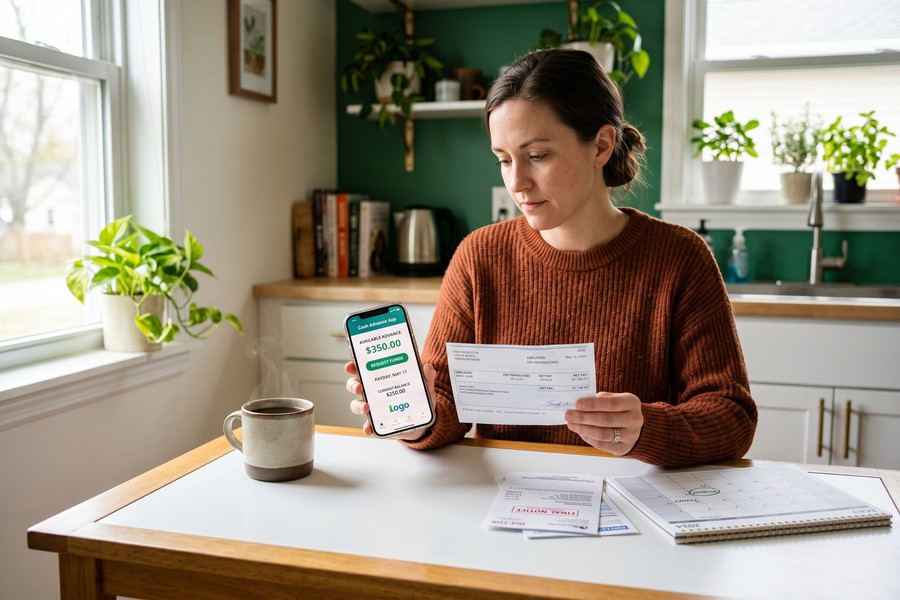
Apps like Earnin, Dave, and Brigit advance $20 to $250 against your next paycheck, typically with no interest but with optional tips and monthly subscription fees. For a one-time shortfall between paychecks, they are a reasonable zero-interest bridge. Used repeatedly, they can create the same paycheck-to-paycheck cycle as payday loans. If you find yourself using a cash advance app every pay period, that is a signal to look at the structural income and expense picture rather than the advance amount. For a direct comparison of these products, see Cash Advance App vs Emergency Personal Loan: Which Makes More Sense for Your Crisis?
| Loan Type | Typical APR | Max Amount | Funding Speed | Credit Score Needed | Rollover Risk |
|---|---|---|---|---|---|
| PAL II (Federal Credit Union) | 28% (NCUA cap) | $2,000 | 1-3 business days | None required | None (prohibited by NCUA) |
| Online Personal Loan | 8%–36% (affordable range) | $500–$50,000 | Same day–24 hours | 580+ | Low (fixed repayment) |
| Cash Advance App | 0% interest (fees apply) | $20–$250 | Instant–same day | None required | Moderate (habit-forming) |
| Payday Loan | ~391% average | $100–$500 | Same day | None required | Very high |
| Title Loan | ~300% average | Up to 25–50% of car value | Same day | None required | Very high (car seizure risk) |
| Credit Union Personal Loan | 8%–18% typical | $500–$30,000 | 1-3 business days | 580–620+ | Low (fixed repayment) |
For readers who want to understand how emergency funding timelines compare across all of these sources, this breakdown of how fast you can actually get emergency money by funding source is worth reviewing before you apply anywhere.
Step 5: Which Loans Should Single Mothers Avoid and Why the Math Is Worse Than the Emergency
Some loan products are marketed aggressively to people in financial distress, and the structure of those products almost guarantees a worse outcome. Knowing which ones to skip is as important as knowing which ones to seek out.
Payday Loans: The APR Math
A two-week payday loan charging $15 per $100 borrowed carries an effective APR of approximately 391%. In states with minimal regulation, Mississippi, Missouri, and Texas among them, documented APRs on single-payment payday loans have reached 572% to 662%. On a $300 loan, the fees alone can exceed the original amount borrowed if the loan rolls over even once or twice.
The rollover mechanism is the actual trap: when a borrower cannot repay by the next paycheck, the lender extends the deadline and charges another fee. The CFPB (Consumer Financial Protection Bureau) has found that many borrowers end up paying more in fees than they originally borrowed. Before assuming a payday lender is your only fast option, check your state, 16 states and Washington D.C. prohibit payday loans entirely, which means alternatives must exist there by necessity.
For context on identifying which lenders operate legitimately versus deceptively, the guide to spotting a fake loan company before you apply covers the specific red flags that target borrowers in financial distress.
Title Loans and Credit Card Cash Advances
Title loans use your car as collateral and typically carry APRs near 300%. The risk is not abstract: if you miss payments, the lender can repossess the vehicle. For a single mother whose car is her only means of getting to work and picking up children from school, that risk is catastrophic, not just financial. Credit card cash advances are less predatory but still carry upfront fees of 3% to 5% plus interest that begins accruing immediately with no grace period.
If a lender guarantees approval before reviewing your income or credit information, requires upfront fees before releasing funds, or pressures you to decide within the hour, those are strong signals of a predatory or fraudulent operation. Learn to identify the red flags most borrowers miss before submitting any personal information.
Step 6: How Can I Get an Emergency Loan If I Don’t Have a Regular Paycheck?
Single mothers who are between jobs, working gig shifts, or receiving benefits rather than wages often assume no lender will approve them. That assumption is wrong for many lenders, but the specifics matter.
What Counts as Qualifying Income
Many lenders, including credit unions offering PALs, will count the following as qualifying income: child support payments, TANF cash assistance, unemployment insurance benefits, Social Security or SSI payments, and gig or freelance income documented through bank statements or tax returns. The key requirement is documentation. A child support order or benefits award letter is often enough; you do not need a W-2.
Less than one-quarter of single-mother families actually receive child support payments, according to U.S. Census data, but for those who do, lenders can count that income, which meaningfully changes the debt-to-income calculation that determines approval. If you receive even partial child support, bring that documentation to any loan application.
The Cosigner Route: What to Discuss Before You Apply
A co-applicant with a stronger credit profile can unlock lower rates and higher loan amounts. The conversation that must happen before the application, though, is the one about what occurs if repayment stalls. A missed payment affects both the primary borrower’s credit and the cosigner’s credit equally. If the relationship, whether a parent, sibling, or close friend, cannot survive that scenario openly, the cosigner arrangement should not be pursued. For a thorough look at when cosigning helps versus when it backfires, see Emergency Borrowing With a Co-Signer: When It Helps, When It Backfires, and How to Decide.
Secured Personal Loans as a Last Resort
Using a savings account or vehicle as collateral can lower the interest rate on a personal loan significantly. For a savings-secured loan, the risk is losing access to those funds if you default, painful but not catastrophic. For a vehicle-secured loan, the risk is the same as a title loan: losing your car. Only use vehicle collateral if you have a concrete repayment plan and the loan amount is genuinely manageable within your monthly budget.
If a lender denies your emergency loan application, you have specific next steps available beyond simply reapplying. Federal law requires lenders to provide an adverse action notice explaining the denial reason, which you can use to address the specific issue before your next application. See the guide on every next step after an emergency loan denial for the full process.

Step 7: After the Emergency: How to Build a Buffer So You Don’t Have to Borrow Again
No emergency loan, regardless of how low the rate, addresses the underlying income gap. The honest purpose of this section is to give you practical actions that reduce the probability of the next crisis requiring borrowing.
A Micro-Savings Framework That Works on Thin Margins
Even $5 to $10 per week into a separate savings account begins to build a buffer. Over a year, $10 per week is $520, not enough for a major emergency, but enough to cover a car co-pay, a utility bill shortfall, or a school supply expense without borrowing. Many federal credit unions will set up automatic transfers from a checking account to a savings account on the same schedule as your paycheck, so the money moves before you see it.
The goal for the first six months is not a large emergency fund. The goal is the habit and the separate account, so that an emergency does not automatically mean a loan application.
The EITC as an Emergency Fund Seed
The Earned Income Tax Credit is one of the most underused financial tools for working single mothers. For a qualifying single mother with three or more children, the EITC can return up to $7,830 for the 2024 tax year, per the IRS EITC tables. Free tax preparation through VITA (Volunteer Income Tax Assistance) sites eliminates the cost barrier of professional tax prep. Find your nearest VITA site through the IRS VITA locator.
Earmarking even half of an EITC refund as an emergency fund would create a $3,000 to $4,000 buffer that covers most household emergencies without any borrowing at all. That is a realistic path out of crisis borrowing for working single mothers who qualify.
The Longer Path: TANF Job Programs, Subsidized Childcare, and Education
Emergency loans are a pressure valve. They do not close the gap between $41,305 and a genuinely stable income. TANF’s job readiness and vocational training programs, subsidized childcare through CCDF, and community college enrollment supported by Pell Grants are the structural path from crisis borrowing to financial stability. They are slower, measured in months and years rather than hours, but they are the options that actually change the income number rather than temporarily covering the gap.
If you are working on rebuilding credit after an emergency, the path from a thin file to a lendable score is documented and replicable. See the guide on how a borrower with no credit history built a lendable score in under a year for a concrete framework you can start immediately.
Frequently Asked Questions
What is the fastest way for a single mom to get emergency money today?
Calling 211 and requesting after-hours emergency funds for single mothers is the fastest zero-cost option, potentially connecting you to gas cards, motel vouchers, or small cash stipends the same day. If you need cash specifically, a cash advance app like Earnin or Dave can advance up to $250 within hours if your paycheck is linked. LIHEAP can resolve utility emergencies within 48 hours and as quickly as 18 hours for life-threatening situations.
Can I get an emergency loan as a single mother with bad credit?
Yes, there are options for borrowers with low or no credit scores. PAL II loans from federal credit unions require no credit score minimum and are capped at 28% APR by the NCUA. Cash advance apps also do not require a credit check. Some online lenders like Upstart use income and employment data alongside credit score, which can help borrowers with limited credit history qualify. Avoid payday lenders, which also skip credit checks but charge APRs that average 391%.
Does child support count as income when applying for an emergency loan?
Yes. Many lenders, including federal credit unions and online personal loan lenders, will count documented child support payments as qualifying income. You will need a child support order or a payment history statement from the state disbursement unit to document it. Bring this paperwork to any loan application, as it can meaningfully change your debt-to-income ratio and improve your approval odds.
What is a PAL loan and how is it different from a payday loan?
A Payday Alternative Loan (PAL) is offered by NCUA-chartered federal credit unions at a maximum APR of 28%, with no rollover permitted. A payday loan is offered by private lenders at APRs averaging 391%, with rollovers that can multiply the original loan cost. PAL II loans allow amounts up to $2,000 with no membership waiting period, making them the most direct and affordable replacement for a payday loan for single mothers with limited credit history.
What emergency financial help is available for single moms who are unemployed?
Unemployed single mothers can access TANF cash assistance, WIC food benefits (same-day enrollment possible), and LIHEAP for utility costs, none of which require employment. Local charities including the Salvation Army and Catholic Charities provide emergency aid without income requirements. For borrowing, some lenders will count unemployment insurance benefits as qualifying income if you can document the benefit amount with an award letter.
Should I use a payday loan or a personal loan for an emergency as a single mother?
A personal loan is almost always the better choice if you qualify. The APR difference is substantial: a personal loan at 36% APR versus a payday loan at 391% APR on a $500 emergency means roughly $35 in interest over six months versus $585 or more if the payday loan rolls over. If your credit score or income makes a personal loan approval difficult, a PAL II from a federal credit union is the next best option at a capped 28% APR, not a payday loan. For a detailed breakdown, see what the numbers actually show when comparing advance apps and payday loans.
What documents do I need to apply for emergency assistance as a single mom?
Most programs and lenders require four core documents: a government-issued photo ID, proof of address (utility bill or lease agreement), proof of income (paystub, benefits letter, child support order, or bank statements), and documentation of the emergency itself (shut-off notice, eviction notice, or medical bill). Having all four ready before you call 211 or start a loan application significantly reduces the time from contact to approval.
Can I get an emergency loan if I only work part-time or gig shifts?
Yes. Gig income, part-time wages, and freelance earnings can all count as qualifying income when documented with bank statements showing deposits or tax returns showing self-employment earnings. Credit unions offering PAL II loans and some online lenders weigh income stability and repayment ability more heavily than employment type. The key is documentation: consistent bank deposit records for three to six months are often sufficient where a W-2 is unavailable. For guidance specific to shift-based and hourly income, see how hourly workers can qualify for short-term loans.
What happens if my emergency loan application is denied?
Federal law requires the lender to provide an adverse action notice explaining the specific reason for denial, typically within 30 days. Common reasons include insufficient income, too-high debt-to-income ratio, or derogatory credit items. Each of these has a concrete response: adding a cosigner addresses income issues, paying down an existing balance helps the debt-to-income calculation, and disputing an error on your credit report can fix a derogatory item. The full list of next steps after a denial is covered at Emergency Loan Application Denied: Every Next Step You Can Take Right Now.
Are there grants specifically for single mothers that don’t need to be repaid?
Yes, several private and government grants are available. Modest Needs offers Self-Sufficiency Grants up to $1,000 for working adults in crisis. Justice Federal Credit Union provides Hardship Grants of $250 to $3,000. LIHEAP and TANF provide government cash and utility assistance that does not require repayment. Occupation-specific grants from CORE (restaurant workers), the American Legion AEF (military-connected families), and state-level emergency assistance programs add further options depending on your background. Applications often require the same four documents described above.
Sources
- Single Mother Guide, Single Mother Statistics (citing U.S. Census Bureau Poverty and Income Data, 2024)
- U.S. Census Bureau, Income in the United States: 2024, Report P60-286
- Food Research and Action Center, USDA Food Security Report 2024 Data
- Administration for Children and Families, LIHEAP Program Information and State Directory
- NCUA, Credit Union Locator
- IRS, Earned Income Tax Credit Tables, 2024 Tax Year
- IRS, Find a VITA Location for Free Tax Preparation
- U.S. Department of Labor Women’s Bureau, Child Care and Employment