

Fact-checked by the onlinepaydaynews.com editorial team
You’re a freelancer, a contractor, a small business owner — and your car just broke down, your roof is leaking, or a medical bill landed in your mailbox at the worst possible moment. You go to apply for an emergency loans self-employed option, and the first thing a lender asks for is pay stubs. You don’t have any. Suddenly, a straightforward financial need turns into a bureaucratic nightmare that feels designed for someone else’s life entirely.
The problem is massive in scale. According to the U.S. Bureau of Labor Statistics, over 16 million Americans are self-employed, representing roughly 10% of the total workforce. An additional 59 million Americans performed freelance work in 2023, according to Upwork’s annual Freelance Forward report. Yet the entire traditional lending infrastructure was built around the W-2 employee model — a model that excludes tens of millions of workers who generate real income, pay real taxes, and face real financial emergencies.
This guide gives you a concrete, step-by-step playbook. You’ll learn exactly which documents substitute for pay stubs, which lenders actively work with self-employed borrowers, what loan amounts and rates you can realistically expect, and how to avoid the predatory traps that target people in your situation. By the time you finish reading, you’ll know more about navigating self-employed emergency borrowing than most loan officers do.
Key Takeaways
- Over 16 million Americans are self-employed, yet most traditional lenders require W-2 pay stubs, locking out a huge portion of the workforce from standard emergency loan access.
- Self-employed borrowers can substitute bank statements (typically 3-24 months), tax returns (Schedule C or 1099s), profit and loss statements, and business invoices as proof of income.
- Personal loans for self-employed borrowers range from $1,000 to $50,000, with APRs spanning 6% to 36% depending on credit score, income stability, and lender type.
- Online lenders like LendingClub, Avant, and Upstart can fund self-employed emergency loans in as little as 24-48 hours after approval, compared to 5-7 business days at traditional banks.
- Borrowers with a credit score below 580 face significantly limited options, but credit unions and community lenders approve self-employed applicants at rates up to 15% higher than large banks.
- Predatory lenders targeting self-employed borrowers frequently advertise “no income verification” loans with effective APRs exceeding 300% — always check the lender’s state license before applying.
In This Guide
- Why Self-Employed Borrowers Struggle to Get Emergency Loans
- Income Documents That Replace Pay Stubs
- Types of Emergency Loans Available to Self-Employed Borrowers
- Lenders That Actually Work With Self-Employed Borrowers
- Credit Score Requirements and How to Work Around Them
- Loan Amounts, Rates, and Terms: What to Realistically Expect
- The Application Process: Step-by-Step for Self-Employed Borrowers
- How to Avoid Predatory Lenders Targeting Self-Employed Borrowers
- Alternative Emergency Funding Sources When Loans Aren’t the Answer
Why Self-Employed Borrowers Struggle to Get Emergency Loans
The mismatch between self-employed income and traditional lending criteria is structural, not accidental. Most lenders built their underwriting systems around one document: the W-2. When that document doesn’t exist, many automated systems simply reject the application before a human ever reviews it.
Self-employed income is also inherently variable. A graphic designer might earn $8,000 in March and $2,000 in April. A contractor might have $40,000 quarters followed by a slow $15,000 quarter. Lenders hate variability — it makes risk modeling harder and default predictions less reliable.
The Tax Deduction Trap
Here’s an irony that catches many self-employed borrowers off guard: the same tax deductions that legally reduce your tax burden also make you look less creditworthy on paper. If you earned $85,000 but wrote off $35,000 in legitimate business expenses, your Schedule C shows $50,000 in net income. Lenders typically use that lower number. You legally paid less in taxes — and accidentally made yourself look like a worse credit risk.
This is why self-employed borrowers are often advised to balance tax minimization with maintaining a borrowable income profile. The IRS and lenders are reading the same return, but through completely different lenses.
The Documentation Burden
Where a W-2 employee might submit two documents to qualify for a loan, a self-employed applicant may need to compile six to ten documents spanning two years. This creates a time and complexity barrier that’s especially painful during an emergency when you need money in days, not weeks.
According to a 2023 Federal Reserve Small Business Credit Survey, 43% of self-employed individuals who applied for financing were denied or received less than they requested — compared to just 31% of employer-owned small businesses with employees.
Understanding why the system is stacked against you is the first step to navigating around it. The next step is knowing exactly which documents can replace the pay stub you don’t have.
Income Documents That Replace Pay Stubs
The good news is that lenders who work with self-employed borrowers have developed robust alternative income verification frameworks. These aren’t workarounds or loopholes — they’re legitimate underwriting tools used by credit unions, online lenders, and even some traditional banks.
Tax Returns: Your Most Powerful Document
Your federal tax return — specifically Schedule C for sole proprietors, Form 1065 for partnerships, and Form 1120-S for S-corps — is the gold standard of self-employed income verification. Most lenders want to see two years of returns. They’ll average your net income across both years to arrive at a monthly income figure.
If your income grew significantly from Year 1 to Year 2, some lenders will use only the most recent year. If it declined, expect them to use the lower figure or the average. Either way, having your last two 1040s with all schedules is non-negotiable for most formal loan applications.
1099 forms — which document income paid to you by clients — also serve as strong supporting evidence. If you received 1099-NEC forms showing $75,000 in total payments, that’s concrete third-party documentation of what clients actually paid you.
Bank Statements: The Real-Time Income Proof
Bank statements are increasingly preferred by online lenders because they show actual cash flow rather than tax-adjusted net income. Most lenders ask for 3 to 12 months of statements. Some bank-statement loan programs use up to 24 months for larger amounts.
Lenders using bank statements will typically calculate your average monthly deposits, then apply a “expense ratio” — often 50% for sole proprietors, 25-40% for businesses with documented lower overhead. If your average monthly deposits are $7,000 and the lender applies a 50% expense ratio, they’ll qualify you on $3,500/month of income.
Keep your business and personal accounts separate if you haven’t already. Commingled accounts create confusion and raise flags during underwriting. Lenders want clean, traceable income deposits — not a mix of Venmo transfers, client payments, and personal savings movements.
Before applying, run a 12-month average of your monthly bank deposits yourself. This is the number lenders will likely use. If it’s lower than expected due to tax season gaps or slow months, wait until you have a stronger 3-month average — or use tax returns instead, which may show a more favorable income picture.
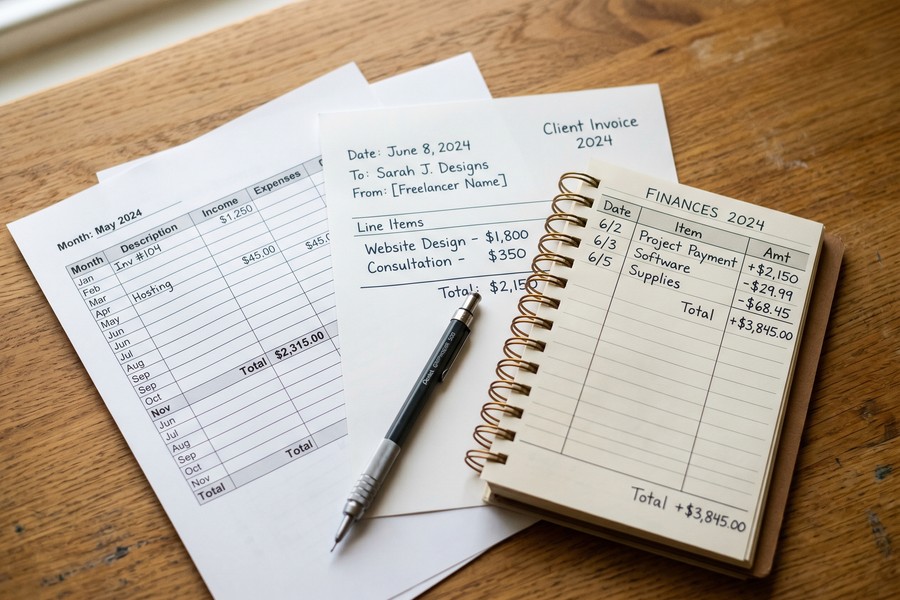
Profit and Loss Statements and Invoices
A profit and loss (P&L) statement — even one you prepare yourself using accounting software like QuickBooks or Wave — can satisfy income verification requirements at many lenders. For larger loans, some lenders require a CPA-prepared or CPA-reviewed P&L. For smaller emergency loans under $10,000, a self-prepared statement is often acceptable.
Outstanding invoices can also supplement your income documentation. If you’re owed $6,000 from active clients, that’s evidence of expected income. Some lenders — particularly those focused on business financing — will factor in receivables when evaluating your repayment capacity.
| Document Type | What It Proves | Lender Acceptance | Time to Prepare |
|---|---|---|---|
| Federal Tax Returns (2 years) | Net annual income after deductions | Very High — most lenders | Immediate if already filed |
| Bank Statements (12 months) | Real cash flow and deposit patterns | High — especially online lenders | 1-2 days to gather |
| 1099-NEC Forms | Third-party confirmed payments | High — supports tax returns | Immediate if on file |
| Profit and Loss Statement | Business revenue minus expenses | Medium — varies by lender | 1-3 days to prepare |
| Client Invoices/Contracts | Ongoing income and business activity | Low-Medium — supplemental only | Immediate |
Types of Emergency Loans Available to Self-Employed Borrowers
Not all emergency loans work the same way for self-employed applicants. Some products are better suited to your income structure than others. Understanding the landscape helps you target the right product for your situation instead of applying broadly and collecting hard inquiry hits on your credit report.
Unsecured Personal Loans
Unsecured personal loans are the most common emergency borrowing tool. They require no collateral, fund quickly, and can be used for any purpose. For self-employed borrowers, online lenders are generally more flexible than traditional banks — many of them have built underwriting systems that accept bank statements and tax returns without demanding W-2s.
Loan amounts typically range from $1,000 to $50,000. Repayment terms run from 12 to 84 months. APRs range from approximately 6% for borrowers with excellent credit to 36% for higher-risk profiles. For self-employed borrowers with solid credit and documented income, rates in the 10-18% range are realistic.
Business Loans and Lines of Credit
If you operate as a registered business — an LLC, sole proprietorship with a DBA, or corporation — you may also qualify for small business loans or a business line of credit. The SBA’s Emergency Bridge Loan program and certain CDFI (Community Development Financial Institution) products are specifically designed for small business owners facing short-term cash needs.
Business lines of credit are particularly useful for self-employed borrowers because you only borrow what you need, repay it, and the credit revolves. This matches the irregular income reality better than a fixed installment loan. Approval typically requires 6-12 months of business bank statements and proof of revenue.
Secured Loans and Home Equity Options
If you own assets, secured loan options can give you access to larger amounts at lower rates regardless of your employment status. A home equity line of credit (HELOC) or home equity loan uses your property as collateral. A secured personal loan might use a savings account or vehicle. The tradeoff: if you default, you lose the collateral. For self-employed borrowers with volatile income, this risk is worth considering carefully before committing.
According to the Federal Reserve’s 2023 Report on the Economic Well-Being of U.S. Households, 37% of Americans could not cover a $400 emergency expense without borrowing or selling something. Among self-employed workers, that figure rises to approximately 45%.
For borrowers facing situations involving natural disasters or community-level emergencies, it’s worth reading about every financial resource available after a crisis hits — many of these programs specifically accommodate non-traditional income verification.
Lenders That Actually Work With Self-Employed Borrowers
Not every lender is equally self-employment-friendly. The difference between a smooth approval and a frustrating rejection often comes down to which institution you approach — not your actual creditworthiness.
Online Lenders: The Fastest Path
Online lenders have the most modern underwriting infrastructure and are generally the most accommodating for self-employed income verification. Platforms like LendingClub, Upstart, Avant, and SoFi all explicitly accommodate self-employed applicants. They accept tax returns and bank statements as income documentation and can make funding decisions within 24 hours.
Upstart uses a proprietary AI model that weighs education, employment history, and income together — which can benefit self-employed borrowers with strong professional backgrounds even if their recent income was irregular. SoFi focuses on high earners and offers some of the lowest rates in the online lending space for qualified borrowers.
Credit Unions: The Underrated Option
Credit unions are nonprofit financial institutions that tend to take a more holistic view of borrower profiles. They’re more likely to consider your full financial picture — savings history, relationship with the institution, community ties — rather than rigidly applying automated W-2 requirements. Their rates are often lower than online lenders, and they frequently offer emergency loan products with amounts up to $5,000 with same-day or next-day funding.
The catch: you need to be a member. But credit union membership is often easier to obtain than people think — many have open membership based on geography, employer, or association membership. Joining typically takes 1-2 business days and a $5-$25 deposit. For a deeper comparison of speed and flexibility, see credit union emergency loans vs. bank personal loans and which pays out faster.
“Self-employed borrowers often have stronger financial profiles than their tax returns suggest. Lenders who look at bank statements and holistic cash flow rather than just W-2 income are making smarter credit decisions — and they’re capturing a market that’s being systematically underserved.”
CDFIs and Community Lenders
Community Development Financial Institutions (CDFIs) are mission-driven lenders certified by the U.S. Treasury Department. They specifically serve underserved borrowers — including self-employed workers, gig economy participants, and micro-business owners. Their loan programs often have flexible income documentation requirements and below-market interest rates.
To find a CDFI near you, use the CDFI Fund’s official certification database. Loan amounts from CDFIs typically range from $500 to $50,000 for personal/business emergency needs.
| Lender Type | Self-Employment Flexibility | Typical APR Range | Funding Speed | Max Loan Amount |
|---|---|---|---|---|
| Online Lenders | High — bank statements/tax returns accepted | 6% – 36% | 24–48 hours | $50,000 |
| Credit Unions | High — holistic review | 5% – 18% | Same day – 2 days | $25,000 |
| CDFIs | Very High — mission-driven | 5% – 24% | 3–7 days | $50,000 |
| Traditional Banks | Low — W-2 often required | 7% – 25% | 5–10 days | $100,000 |
| Payday/High-Cost Lenders | Very High — but at extreme cost | 200% – 400%+ | Same day | $1,500 |
Credit Score Requirements and How to Work Around Them
Your credit score is the second major variable lenders evaluate after income. For self-employed borrowers, a strong credit score can partially offset income documentation gaps. A weak score, combined with irregular income, creates a much harder approval environment.
Score Thresholds by Loan Type
Most online lenders have minimum credit score thresholds around 580-620 for unsecured personal loans. Credit unions often go lower — some approve members with scores as low as 520 if they have a strong savings history or collateral. For business loans, many lenders look at both personal and business credit, with Dun & Bradstreet or Experian business scores factoring in.
Borrowers with scores above 720 typically unlock the best rates — often 6-10% APR — and face the least documentation scrutiny. Borrowers in the 640-720 range will face higher rates and more documentation requests but remain in reasonable approval territory at most online and credit union lenders.
Building Credit as a Self-Employed Borrower
If your credit score needs work, there are strategies specifically relevant to self-employed individuals. Keeping business and personal credit separate protects your personal score from business volatility. Paying yourself a regular “salary” via a transfer to a personal account creates a consistent payment history that can help with future applications.
For borrowers who have encountered credit challenges due to irregular income in the past, understanding the quiet credit score killers most people have never heard of can reveal fixable issues dragging your score down before you apply for an emergency loan.
According to FICO data, a single missed payment can drop a 780 credit score by 90-110 points — and that damage persists for up to 7 years. For self-employed borrowers with seasonal income gaps, setting up autopay on existing accounts is critical insurance against accidental score damage.
If you have collection accounts that are affecting your score, the decision about whether to pay them off or let them age off requires a strategic approach. Our guide on whether to pay off collections or wait for them to age off your credit report walks through the nuanced decision-making process.
Loan Amounts, Rates, and Terms: What to Realistically Expect
Understanding realistic loan parameters helps you plan your emergency borrowing strategy rather than being blindsided by an offer that doesn’t meet your needs — or a rate that makes the loan unaffordable.
How Income Level Affects Loan Amounts
Most lenders cap loan amounts at a debt-to-income (DTI) threshold. If your documented monthly income is $4,000 and you have $1,200 in existing monthly debt payments, your DTI is 30%. Most lenders want total DTI (including the new loan payment) under 40-45%. At that threshold, you’d qualify for a loan with a monthly payment no higher than $600-$600, which translates to roughly $15,000-$20,000 over 36 months at 15% APR.
The key word is “documented” income. If your tax return shows $3,000/month but your bank statements show $5,500/month in deposits, choose the lender who will use bank statements. That difference could double your qualifying loan amount.
Rate Factors Unique to Self-Employed Borrowers
Self-employed borrowers may face a small rate premium relative to equivalent W-2 employees at some lenders — typically 1-3 percentage points — simply due to perceived income volatility. This premium is most pronounced at large banks and least noticeable at online lenders and CDFIs who have purpose-built self-employment underwriting.
LendingTree data from 2023 found that the average personal loan APR for borrowers with good credit (660-719) was 21.59%. Borrowers with excellent credit (720+) received an average rate of 14.09% — a 7.5 percentage point difference that translates to hundreds of dollars in interest savings on a $10,000 loan.
Before accepting any loan offer, compare it carefully. A $10,000 loan at 20% APR over 36 months costs $3,354 in total interest. The same loan at 12% APR costs $1,957 — a $1,397 difference that’s worth shopping for. Use a loan comparison approach that goes beyond the headline rate; our guide on how to compare short-term loan offers without getting fooled by low APR claims is essential reading before you sign anything.
| Credit Score Range | Typical APR Range | Max Loan (Typical) | Documentation Scrutiny |
|---|---|---|---|
| 720+ (Excellent) | 6% – 14% | $50,000 | Low |
| 680-719 (Good) | 14% – 22% | $35,000 | Moderate |
| 640-679 (Fair) | 22% – 30% | $20,000 | High |
| 580-639 (Poor) | 28% – 36% | $10,000 | Very High |
| Below 580 | 36%+ or Denied | $5,000 (credit union/CDFI only) | Extreme — collateral often required |
The Application Process: Step-by-Step for Self-Employed Borrowers
Emergency loan applications move fast — or they can, if you’re prepared. Self-employed applicants who have their documentation organized in advance routinely get funding in 24-48 hours. Those who scramble to gather documents can take a week or longer.
Pre-Application Preparation
Start by pulling your credit reports from all three bureaus via AnnualCreditReport.com. Look for errors, outdated accounts, or collections that might be suppressible. Even small errors — a wrong balance, a duplicate account — can drag your score down and cost you a better rate.
Assemble your document package before you start any application. At minimum, you’ll need: two years of federal tax returns with all schedules, three to twelve months of bank statements, your most recent 1099s, a government-issued ID, and your Social Security number. Have these as PDFs — most online lenders require digital uploads.
Choosing the Right Lender First
Apply strategically, not broadly. Every hard inquiry temporarily lowers your credit score by 5-10 points. Multiple applications in a short period — say, applying to six lenders in a week — can create a pattern that some lenders interpret negatively. Use pre-qualification tools whenever they’re available; these use soft pulls that don’t affect your score.
For self-employed borrowers specifically, start with one online lender with a self-employment-friendly reputation (Upstart, LendingClub, or Avant are good starting points), one credit union if you’re already a member, and one CDFI if your income is on the lower end. That’s three applications maximum, and only if you’re not approved by the first.
Some lenders advertise “soft pull pre-qualification” but convert to a hard pull immediately upon application — even before approval. Read the fine print before entering any personal information. A genuine soft pull pre-qualification will tell you explicitly that it won’t affect your credit score until you formally accept an offer.
What Happens After Submission
After submitting your application and documents, most online lenders will respond within 1-24 hours with either an approval, a request for additional documentation, or a denial. If approved, you’ll receive a loan agreement detailing the exact APR, monthly payment, fees, and total repayment amount. Do not sign this without reading it completely — and specifically verify there are no prepayment penalties, automatic loan renewal clauses, or hidden origination fees not mentioned in the pre-qualification.
For guidance on what to negotiate before signing, the detailed breakdown in how to negotiate repayment terms on a short-term loan before you sign anything covers tactics that can save you money even after approval.

How to Avoid Predatory Lenders Targeting Self-Employed Borrowers
Self-employed borrowers are disproportionately targeted by predatory lenders. The logic is cynical but simple: if traditional lenders turn you away, you may be desperate enough to accept terrible terms. Knowing the warning signs before you’re in a crisis mindset is the best protection.
Red Flags in Loan Advertising
“No income verification required.” “Approval regardless of credit.” “Self-employed? No problem — no documents needed.” These phrases, while appealing in an emergency, almost always signal a predatory product. Legitimate lenders always verify income — what varies is the type of documentation they accept. A lender who skips income verification entirely is planning to charge you enough to cover their risk through interest and fees, not through underwriting.
Watch out for lenders who quote weekly or monthly rates rather than APR. A “3% monthly fee” sounds reasonable until you realize it’s a 36% APR — and that’s among the more benign examples. Some payday-style products aimed at self-employed workers carry effective APRs of 300-400%.
Verifying Lender Legitimacy
Every legitimate lender must be licensed in the states where they operate. Before applying with any unfamiliar lender, verify their license through your state’s financial regulator. You can also check their complaint history on the CFPB complaint database — an underused tool that reveals patterns of abuse before they happen to you.
“Predatory lenders have become sophisticated in targeting self-employed borrowers because they know this population faces documentation barriers. The key red flag is a lender who emphasizes speed and approvals while downplaying rates, fees, and total repayment cost.”
If you’re ever unsure about a lender’s legitimacy or if a loan offer seems unusual, it’s worth also reviewing your rights as a borrower. Our resource on advanced strategies for spotting predatory loan terms covers contract-level analysis that can save you from signing a financially destructive agreement.
Alternative Emergency Funding Sources When Loans Aren’t the Answer
Sometimes the best emergency funding strategy isn’t a loan at all — or it’s a loan combined with other resources that reduce how much you need to borrow.
Cash Advance Apps for Short-Term Gaps
Apps like Dave, Earnin, and Brigit offer small advances — typically $20 to $500 — with no interest. They work by connecting to your bank account and advancing money against your expected deposits. For self-employed borrowers with regular, traceable bank deposits, these apps can provide quick bridge funds for small emergencies without the formality of a loan application.
The limitation is size. If your emergency is $4,000, a $250 cash advance isn’t the solution — but it might cover you for a day or two while a larger loan processes. For a nuanced comparison of these tools, see the breakdown of cash advance apps vs. emergency personal loans and which makes more sense for your crisis.
Negotiating Directly With Service Providers
Before taking on debt for a large bill, call the billing department. Medical providers almost universally offer payment plans — often interest-free — for patients who ask. Utility companies have emergency hardship programs that can defer payments by 30-90 days. Even landlords may prefer a partial payment arrangement over the cost and time of an eviction proceeding.
The Health Resources and Services Administration (HRSA) administers hospital charity care programs that can eliminate or dramatically reduce medical bills for individuals and families below 250% of the federal poverty level — regardless of employment status. Many eligible people never apply because they don’t know the programs exist.
Gig Economy and Freelancer-Specific Resources
Freelancers Union, the Freelancers Hub in New York City, and similar organizations offer emergency assistance funds, low-interest loan programs, and financial counseling specifically for independent workers. These resources are chronically underutilized because most self-employed borrowers default to searching for conventional loans without knowing these alternatives exist.
The U.S. Small Business Administration’s funding programs page lists additional grant and loan options for self-employed individuals and small business owners, including disaster assistance programs that don’t require the same income documentation as commercial lenders.

A 2022 report from the JPMorgan Chase Institute found that self-employed households experience income volatility 30% higher than traditionally employed households — yet hold, on average, only 27 days of liquid cash reserves, compared to 52 days for W-2 households.
“The rise of the gig economy has created millions of people who earn real incomes but are invisible to conventional credit systems. Emergency lending solutions for this population have to evolve — and many are, but borrowers need to know where to find them.”
Real-World Example: Freelance Designer Funds a $7,500 Emergency in 48 Hours
Marcus, a 38-year-old freelance UX designer in Austin, Texas, earned approximately $92,000 in the previous year — but his income arrived in irregular chunks: a $15,000 project payment in February, nothing in March, a $22,000 contract in April. When his HVAC system failed in July, the repair bill came to $7,500. His bank account showed $1,200. He had no emergency fund. He had no W-2. He had three weeks before his next expected client payment.
Marcus had a 698 credit score — good, not excellent. He went to his primary bank first. They asked for two years of W-2s. When he explained he was self-employed, they requested an appointment with a business banker — available in eight days. He couldn’t wait. He tried an online lender, Upstart, which accepted his two most recent 1040s and six months of bank statements. He entered his adjusted gross income from his Schedule C — $64,000 after deductions (his gross revenue had been $92,000). Within four hours, he received a pre-qualified offer: $8,000 at 16.7% APR over 36 months, with a monthly payment of $284. Total interest cost: $2,224.
He accepted, submitted his documents via upload, signed electronically that evening, and received $7,820 (net of a $180 origination fee) in his bank account the following morning — 23 hours after starting his application. The HVAC was repaired that afternoon. He paid the loan off early in 19 months, reducing his total interest paid to $1,106.
The key factors in Marcus’s success: he had two clean years of tax returns, six months of bank statements showing regular deposits, a credit score above 680, and he applied to a lender with purpose-built self-employment underwriting rather than defaulting to his primary bank. His preparation time — gathering documents, running his own income calculation, and pulling his credit report — took about 90 minutes. That preparation saved him days of back-and-forth and possibly a much higher-rate product from a less scrupulous lender.
Your Action Plan
-
Pull your credit reports immediately
Visit AnnualCreditReport.com and pull all three bureau reports. Look for errors, stale accounts, or collections that can be disputed. Even a 20-point score improvement from fixing an error can lower your interest rate by 2-3 percentage points and save you hundreds of dollars.
-
Gather your income documentation package
Compile your last two federal tax returns (with all schedules), the most recent 12 months of bank statements, any 1099-NEC forms you’ve received, and a current profit and loss statement. Save everything as PDFs in one folder. This package will serve you for any lender you approach.
-
Calculate your documentable monthly income
Run two numbers: your average monthly net income from Schedule C (total for two years, divided by 24 months), and your average monthly bank deposits (total deposits over 12 months, divided by 12). Use whichever figure is higher to target lenders who accept that specific documentation type.
-
Use pre-qualification tools to soft-shop rates
Before submitting any formal application, use the pre-qualification or rate-check tools offered by online lenders like Upstart, LendingClub, Avant, and SoFi. These use soft credit pulls. You can compare offers across four or five lenders without affecting your score, then apply formally only to your top choice.
-
Check your local credit union and CDFI options
Search for credit unions you may qualify for based on your location, employer history, or professional associations. Use the CDFI Fund database to find mission-driven lenders in your area. Both types of institution often approve self-employed borrowers at rates 3-8 percentage points lower than online lenders for comparable profiles.
-
Verify the lender’s state license before applying
Search your state’s financial regulatory agency website for the lender’s license. Also run the lender’s name through the CFPB complaint database. If they have a pattern of complaints about hidden fees, aggressive collections, or misleading rate disclosures, move to your next option regardless of how appealing the offer looks.
-
Read the full loan agreement before signing
Confirm the exact APR (not just the interest rate), the origination fee, the total repayment amount, any prepayment penalty, and whether the loan has an auto-renewal clause. Calculate your total out-of-pocket cost, including all fees. If anything in the agreement differs from what you were shown in pre-qualification, ask for a written explanation before signing.
-
Build a buffer for next time
After resolving your current emergency, open a dedicated savings account and set up a recurring automatic transfer — even $50 per week — from your business checking. Self-employed workers who maintain a 90-day cash reserve eliminate the emergency loan need for roughly 70% of common financial crises. Treating savings as a non-negotiable business expense, rather than an optional personal goal, is the single most effective long-term strategy.
Frequently Asked Questions
Can I get an emergency loan self-employed with no tax returns?
Yes, but your options narrow significantly. Some lenders — particularly online lenders offering bank statement loans — will underwrite based solely on 12-24 months of bank statements without requiring tax returns. This is more common in business lending than personal lending. However, you should expect higher rates and lower loan amounts than you’d receive with a full documentation package. If your tax returns simply aren’t ready (for example, you’re in the middle of the current tax year), most lenders will accept your two most recent prior-year returns.
How much can I borrow as a self-employed borrower in an emergency?
This depends on your documented monthly income, credit score, and debt-to-income ratio. A common formula: most lenders will approve a loan with a total monthly payment (including all existing debt) up to 40-45% of your documented monthly income. If your bank statements show $5,000/month in average deposits, and you have $600/month in existing debt payments, you could typically qualify for a loan with a payment up to $1,650/month — which might represent a $40,000-$50,000 loan at a favorable rate over 36 months.
Will my credit score be affected by applying for emergency loans?
A hard inquiry from a formal loan application typically reduces your credit score by 5-10 points temporarily. Multiple hard inquiries within a 14-45 day window (the window varies by scoring model) are often treated as a single inquiry under the rate-shopping exception, as long as they’re for the same loan type. To minimize impact, use soft-pull pre-qualification tools first, then submit only one or two formal applications.
What’s the fastest way to get emergency loans when self-employed?
Online lenders are consistently the fastest path, with approval and funding possible within 24-48 hours for prepared applicants. Have your documents ready before applying — bank statements, tax returns, and ID as PDFs — so you can upload everything immediately upon application. Credit unions can match this speed for existing members. Avoid lenders who advertise instant approval with no documentation; those products almost always carry triple-digit APRs.
Do I need to operate as an LLC to qualify for emergency loans?
No. Sole proprietors, independent contractors, freelancers, and gig workers all qualify for the same personal loan products as LLC owners. Your business structure affects which business loan products you can access, but for personal emergency loans, what matters is your personal credit score, documented personal income, and debt-to-income ratio — not your business entity type.
What if I’ve only been self-employed for one year?
Having less than two years of self-employment history limits your options but doesn’t eliminate them. Some lenders require a minimum of one year of self-employment and will accept one year of tax returns plus bank statements. Others use bank statements exclusively and don’t require a minimum self-employment period at all. Credit unions are often most flexible about shorter self-employment histories, particularly for members with strong account relationships.
Can I use a co-signer to improve my approval odds?
Yes, and this can be a powerful strategy. A co-signer with strong W-2 income and good credit can significantly offset the documentation gaps in a self-employed application. Both you and your co-signer will undergo credit checks, and the loan will appear on both credit reports. Your co-signer takes on full liability if you default, so this should only be pursued with someone who fully understands and accepts that risk.
Are there emergency loan options specifically for freelancers?
Some platforms and CDFIs have developed products specifically for the freelance economy. Kiva offers zero-interest small business loans up to $15,000 for U.S. entrepreneurs, including freelancers. The Freelancers Union partners with select financial institutions for member-favorable loan products. Additionally, some platforms like Kabbage (now part of American Express Business Blueprint) and Bluevine specifically underwrite based on business revenue rather than W-2 income, making them well-suited for active freelancers with consistent invoicing history.
What happens if I’m denied for an emergency loan?
A denial triggers what’s called an “adverse action notice,” which legally must explain the specific reasons for denial. Read this carefully — it tells you exactly what to fix. Common denial reasons for self-employed applicants include insufficient documented income, too-high DTI, or credit score below threshold. After a denial, give your credit score time to recover from the hard inquiry (30-60 days is ideal), then address the specific reasons cited before reapplying. In the immediate term, explore credit union emergency loans, CDFI products, cash advance apps for small amounts, or direct negotiation with whoever is owed the money.
Is it worth using a personal loan broker or matching service?
Loan matching services like LendingTree or Credible can be valuable because they submit a single application to multiple lenders simultaneously, generating competing offers with one soft pull. This saves time and minimizes hard inquiry risk. However, be aware that matching services earn a commission when you take a loan from a lender they refer you to — which doesn’t mean the recommendations are bad, but does mean you should still compare the final offers independently and understand all fees before accepting.
Sources
- U.S. Bureau of Labor Statistics — Employment Situation Summary
- Federal Reserve — 2023 Report on the Economic Well-Being of U.S. Households
- Federal Reserve — 2023 Small Business Credit Survey
- U.S. Treasury CDFI Fund — CDFI Certification Database
- U.S. Small Business Administration — Funding Programs Overview
- AnnualCreditReport.com — Free Credit Report Access
- Consumer Financial Protection Bureau — Credit Reports and Scores
- IRS — About Schedule C (Form 1040)
- Bankrate — Average Personal Loan Interest Rates
- LendingTree — Personal Loan Statistics and Trends
- JPMorgan Chase Institute — Small Business Owner Finances Report
- Center for Responsible Lending — State of Lending 2023
- myFICO — Credit Score Education and Impact Factors
- HRSA — Hill-Burton Free and Reduced Cost Health Care
- Upwork — Freelance Forward 2023 Research Report