

Reviewed by the onlinepaydaynews.com Editorial Team
Our Take
Pay your credit card balance in full every month. For the vast majority of cardholders, carrying a balance produces zero credit score benefit while costing roughly 21–22% APR in interest. The CFPB and myFICO, the company that created the FICO score, both explicitly call “carrying a balance builds credit” a myth. The only case for carrying a balance is a genuine cash-flow emergency, and even then the goal is damage control, not a credit-building strategy. If you can pay in full, you should. Every time.
The carry balance vs pay in full debate should have been settled years ago, yet nearly half of American adults still believe carrying a balance helps their credit. As of 2024, 46% of U.S. credit card holders carried a balance at least once during the prior 12 months, according to the Federal Reserve’s 2024 Report on the Economic Well-Being of U.S. Households, and a meaningful share of those people likely did so in part because they thought it would help their score.
This article is for anyone who has ever wondered whether paying the minimum or leaving a small balance is a smarter credit-building move than paying in full. The recommendation is unambiguous, but knowing why it’s unambiguous is what keeps you from making an expensive mistake twice.
Key Takeaways
- Paying in full every month is explicitly recommended by the CFPB as the best way to build or maintain a good credit score, the “carry a balance” approach is labeled a myth by the federal regulator.
- Credit utilization accounts for approximately 20–30% of your FICO score, making it the second-largest factor; carrying a balance mechanically raises utilization and can lower your score, per Experian’s utilization rate guidance.
- U.S. consumers with exceptional FICO scores (800–850) average only 7.1% credit utilization, according to Experian Q3 2024 data, a level achieved through normal spending and full monthly payments, not by carrying debt.
- The average overall credit utilization ratio among all U.S. consumers was 29% in Q3 2024, per the Experian State of Credit Cards report, nearly four times the rate seen among top-scoring consumers.
- In my experience reviewing reader questions on credit strategy, the single most expensive misconception is the belief that interest paid on a carried balance signals responsible borrowing. It signals nothing positive to a scoring model, it only costs money.
The Myth That Won’t Die: Why So Many People Believe This
The “carry a small balance” myth persists for a structural reason most personal finance articles skip entirely: credit card issuers profit from carried balances. Interest income is a primary revenue line for card companies, and there is no financial incentive for them to aggressively correct a misconception that keeps customers in debt. That is not a conspiracy, it is a business model, and naming it explains why the myth has had so much staying power.
The myth also sounds plausible on the surface. Credit cards are revolving accounts, and people reasonably assume that “revolving” a balance demonstrates active, healthy usage to the bureaus. The logic feels coherent. It is just wrong.
Conflating “using credit” with “owing money” is the core error. You absolutely need to use your card, scoring models reward activity. But spending and paying in full is usage. Carrying a balance forward is debt with an interest charge attached to it. Those are not the same thing, and no major scoring authority treats them as the same thing.
What I see in practice: Readers who discover the myth after years of carrying a balance often feel cheated, and rightly so. They paid hundreds in unnecessary interest believing it was helping their score. The frustrating part is that nothing in their credit report reflects that sacrifice; the balance hurt, not helped, their utilization ratio the entire time.
How Credit Scores Actually Respond to Carried Balances
Payment history is the largest factor in a FICO score at roughly 35%, and credit utilization runs second at approximately 30%. Carrying a balance touches both of these, but not in the way the myth suggests.
What Gets Reported to the Bureaus
Here is the mechanism that most competing articles get wrong. The balance reported to Experian, Equifax, and TransUnion is your statement closing balance, not whether you paid in full by the due date. If your statement closes on the 15th with a $400 balance and you pay $400 in full on the 28th, the bureaus see $400. That generates a positive on-time payment and a utilization ratio based on that $400. You demonstrated usage and paid zero interest. This is the optimal play.
Carrying a balance past the due date does not change what gets reported in any meaningful way, but it does add an interest charge, erode your grace period, and over time raises the average balance the bureau sees each month. myFICO explicitly debunks the idea that carrying a balance improves FICO Scores, noting that low utilization, achievable entirely through normal spending and full payments, is what the model rewards.
The FICO Score 10T Wrinkle
Most articles ignore FICO Score 10T entirely. This newer scoring model looks at 24 months of payment trend data rather than a static snapshot. Borrowers who consistently pay down or pay off their balance each month are rewarded. Borrowers who maintain a steady carried balance over time are penalized, the model reads that as stagnation rather than progress. As of Q4 2025, FICO Score 10T is now required for mortgage applications processed through Fannie Mae and Freddie Mac, so the “carry a balance” myth is not just unhelpful today; it is increasingly counterproductive under the scoring standards lenders are actively adopting.
For anyone thinking about buying a home in the next few years, this matters more than most people realize. Readers working on their mortgage readiness should also understand how quiet credit score killers can drag a profile down in ways that are just as invisible as a carried balance.

The Hidden Cost You’re Paying for Zero Credit Benefit
Carrying a balance does not just fail to help your credit, it actively costs you money in a compounding way that most one-paragraph myth-busters do not explain fully.
Average credit card APRs were running approximately 21–22% as of early 2026 based on Federal Reserve tracking data. At 21% APR, a $1,500 carried balance costs roughly $300 per year in interest, with no corresponding improvement to your score. That is $300 in pure loss.
The grace period consequence is where the damage gets worse, and it is almost entirely absent from competing articles. The moment you carry any balance past your due date, you lose your grace period on that card. This means new purchases you make the very next day begin accruing interest from the transaction date, not from the next due date. A grocery run the day after your payment posts is no longer interest-free. Most issuers require two consecutive billing cycles of full statement balance payments before the grace period is restored. A single month of carrying a balance can cost materially more than the simple APR math on that balance alone suggests.
Where this gets tricky: Readers on 0% introductory APR offers sometimes carry balances deliberately during the promotional window, reasoning that there is no interest cost. That math is correct for the promotional period, but utilization is still affected, and if the promotional period ends before the balance is paid off, the regular APR hits retroactively or immediately, depending on the card’s terms. Read the agreement before treating a 0% card as free money.
Secured card users rebuilding credit after a financial setback are especially exposed to this math. A secured card with a $500 limit and a 25% APR carrying a $200 balance costs roughly $50 per year in interest for zero credit-building benefit over paying in full. If you are in this situation, our breakdown of credit builder loans vs secured cards may help you find a more efficient path forward.
| Scenario | Monthly Balance Carried | Approx. Annual Interest Cost | Credit Score Benefit |
|---|---|---|---|
| Pay in Full Each Month | $0 carried | $0 | Maximum, low utilization, on-time payment |
| Carry $500 at 21% APR | $500 | ~$105 | None, utilization rises, score may drop |
| Carry $1,500 at 21% APR | $1,500 | ~$315 | None, utilization rises significantly |
| Carry $200 on Secured Card at 25% APR | $200 | ~$50 | None, identical to paying in full, minus the cost |
| 0% Intro APR, Balance Carried in Promo Period | Varies | $0 during promo | Negative, utilization still reported, risk if promo expires |
What You Should Actually Do to Build Credit Faster
The correct strategy is precise and mechanical: use your card regularly, let the statement close with a low but non-zero balance, then pay the full statement balance by the due date. This is not complicated. It just requires understanding which date actually matters.
The Statement Closing Date vs. The Due Date
Your statement closing date is when the balance gets photographed and sent to the bureaus. Your due date is when you have to pay to avoid a late fee. These are different dates, usually separated by 21–25 days. To keep utilization low, pay attention to your closing date, not just your due date. Heavy spenders who put thousands on a card each month may want to make a payment before the statement closes to bring the reported balance down, even if they plan to pay in full afterward.
The CFPB’s credit rebuilding guidance is direct: paying balances in full each month builds better credit than carrying a balance because it keeps utilization low and avoids finance charges. The regulator is not hedging here.
The One Mechanical Setup That Handles This Automatically
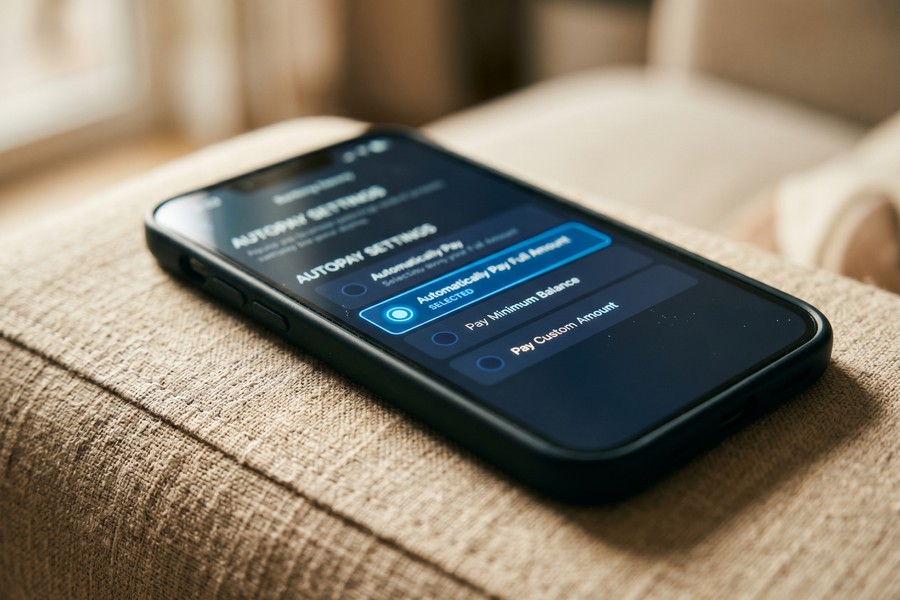
Set autopay to “statement balance”, not minimum payment, not current balance. Statement balance autopay pays exactly what appeared on your most recent bill, preserves your grace period, and generates an on-time payment every single cycle without you touching anything. This single change eliminates the risk of carrying a balance accidentally and removes the temptation to pay less than the full amount in a tight month.
Experian confirms that carrying a balance will not help your score, will cost you in interest, and can actively hurt you if the balance drives up your utilization ratio. Setting autopay to statement balance removes all three risks at once.
If you are newer to building credit from scratch, the strategies in our piece on building a lendable score from no credit history pair well with this approach, same principle, applied at an earlier stage of the credit journey.
Where This Recommendation Falls Short
The honest concession here is that “pay in full every month” is advice that assumes cash flow exists to pay in full. For a meaningful share of cardholders, that assumption fails, and telling someone in a genuine financial squeeze to just pay the full balance is not advice, it is a platitude.
The tradeoff is real: if you cannot pay in full, carrying a balance is sometimes unavoidable. The goal in that situation is damage control, not optimization. Keep the balance below 30% of your credit limit, the score impact above that threshold becomes significantly more punishing. Pay as much over the minimum as possible. And if you have multiple cards with balances, prioritize paying down the card with the highest utilization ratio first, not necessarily the one with the highest APR, because score impact is calculated per card as well as across all cards.
The catch with 0% introductory APR cards deserves its own callout. Carrying a balance during a promotional period costs nothing in interest, which makes it genuinely useful for large purchases you cannot cover in one billing cycle. But the credit score calculation does not care that your APR is 0%, the reported balance still counts toward your utilization ratio. Someone maxing out a 0% card to pay for a medical bill may see a 30–50 point drop in their score while the balance exists, even if they pay it off before the promotional period ends. That score drop can affect loan approvals or rates during that window.
There is also a drawback for the “never touch my credit” crowd. A card you never use at all can be closed for inactivity by the issuer, which reduces your available credit and can spike your utilization ratio on other cards. The fix is easy, one small purchase every few months, paid in full immediately. But it means even the “pay in full” strategy requires a minimum level of ongoing engagement with the account.
This recommendation is not for everyone in the same form. Readers who carry balances out of necessity, not belief, should focus on avoiding the credit mistakes that compound damage after a financial setback rather than feeling guilty for not paying in full during a genuine hardship. The goal is always the lowest balance achievable, not perfection in a month when the money is not there.
What clients often miss: The utilization ratio resets every month. A high balance in March that you pay down fully by April’s statement date does far less long-term damage than people fear. Scores can recover quickly from utilization spikes, often within one or two billing cycles, which is why the focus should always be on the next statement, not the last one.
How We Sourced This
This article draws primarily from Consumer Financial Protection Bureau (CFPB) public guidance pages, myFICO’s official credit education blog, and Experian’s credit education and State of Credit Cards research. Supporting statistics on utilization ratios and consumer behavior come from Experian’s Q3 2024 consumer credit data (published in 2025) and the Federal Reserve’s May 2025 Report on the Economic Well-Being of U.S. Households in 2024, covering data through Q4 2024. All CFPB source pages and myFICO claims were verified as of January 2026. The FICO Score 10T mortgage requirement reflects Fannie Mae and Freddie Mac guidelines adopted in Q4 2025. No statistics were fabricated or estimated; all figures are cited with direct links to their source documents.
Frequently Asked Questions
Does carrying a small balance actually help your credit score?
No. Both the CFPB and myFICO explicitly call this a myth. Carrying a balance raises your credit utilization ratio, which is the second-largest factor in your FICO score, and a higher utilization ratio works against your score, not for it. You can demonstrate healthy credit usage by spending on your card and paying in full every month.
What is the ideal credit utilization ratio for the best credit scores?
The sweet spot is generally 1–9% utilization. Consumers with exceptional FICO scores (800–850) average about 7.1% utilization, according to Experian Q3 2024 data. You can achieve this without carrying a balance, simply let your statement close with a small balance and pay it in full by the due date.
Will paying my credit card in full every month hurt my score because my utilization shows 0%?
Not necessarily, and this is a common misunderstanding. If you use your card during the month, your statement closing balance will reflect that spending, giving you a non-zero utilization ratio even if you pay in full afterward. A true 0% utilization (a card you never touch) is marginally less optimal than 1–9%, but the fix is using the card occasionally, not carrying a balance.
What happens to my grace period if I carry a balance?
You lose it immediately. Once any balance is carried past the due date, new purchases on that card begin accruing interest from the transaction date, not from the next due date. Most issuers require two full billing cycles of complete statement balance payments to restore the grace period, meaning the total cost of a single carried balance is higher than the APR on that balance alone suggests.
Is it ever smart to carry a balance on a 0% introductory APR card?
It can be a useful tool for large purchases you cannot cover immediately, since there is no interest cost during the promotional period. The tradeoff is that the balance still counts toward your credit utilization ratio, which can lower your score during that period. The key risk is failing to pay off the balance before the promotional period ends, at which point the regular APR applies.
How does the FICO Score 10T affect the carry balance vs pay in full question?
FICO Score 10T looks at 24 months of payment trend data. Consistently paying down or paying off balances is rewarded; maintaining a steady carried balance over time is penalized. This model is now required for mortgage applications, meaning the “carry a balance” approach is increasingly counterproductive for borrowers planning to apply for a home loan.
If I can only afford the minimum payment this month, what should I focus on?
Pay the minimum to avoid a late payment, which is the most damaging credit event of all. Then focus on keeping your balance below 30% of your credit limit, and pay it down as aggressively as possible over the next few months. Your score can recover from a utilization spike within one or two billing cycles once the balance is reduced. You can also explore the rights you have as a borrower if the situation involves a billing dispute or error on your account.
Sources
- Consumer Financial Protection Bureau, Credit Score Myths That Might Be Holding You Back
- Consumer Financial Protection Bureau, How Do I Get and Keep a Good Credit Score?
- Consumer Financial Protection Bureau, How to Rebuild Your Credit
- myFICO (Fair Isaac Corporation), The Myth About Carrying a Credit Card Balance
- Experian, Will Carrying a Balance on My Credit Card Help My Credit Score?
- Experian, State of Credit Cards Report (2025)
- Experian, What Is a Credit Utilization Rate?
- Federal Reserve, Report on the Economic Well-Being of U.S. Households in 2024: Banking and Credit
- Debt.org, Credit Utilization Ratio (citing Experian Q3 2024 data)