

Fact-checked by the onlinepaydaynews.com editorial team
Most borrowers glance at the APR on a loan offer and assume they understand what they’ll pay. It feels like a clear number — a percentage, easy to compare. But here’s the problem: APR and the actual dollars leaving your wallet are two very different things, and lenders know most people never make that connection. The gap between APR vs total loan cost is where a lot of financial pain quietly hides.
According to the Consumer Financial Protection Bureau, millions of borrowers consistently pay more on loans than they initially anticipated — often because they focused on the rate rather than the repayment reality. The difference can run into thousands of dollars over the life of a loan.
In this guide, you’ll learn exactly how APR is calculated, why it can be misleading without context, and — most importantly — how to calculate and compare total loan cost so you can walk into any lender negotiation with clear eyes. No jargon, no guesswork.
Key Takeaways
- APR includes interest plus fees, but it does not show you the actual dollar amount you’ll pay over the loan term.
- A 24-month loan at 20% APR can cost you significantly more in total dollars than a 12-month loan at 25% APR — loan term is critical.
- The Truth in Lending Act (TILA) requires lenders to disclose APR, but total repayment cost disclosure is often buried in fine print.
- Payday loans can carry effective APRs of 400% or higher, but their short terms mask how extreme that cost is per dollar borrowed.
- On a $10,000 personal loan at 18% APR over 5 years, you’ll repay approximately $15,232 — more than $5,000 beyond what you borrowed.
- Comparing APR vs total loan cost across at least 3 loan offers before signing is one of the highest-value financial moves you can make.
In This Guide
- What APR Actually Means — and What It Leaves Out
- Total Loan Cost: The Number That Actually Matters
- Why APR vs Total Loan Cost Can Tell Completely Different Stories
- How Loan Term Quietly Multiplies Your Costs
- The Fees That Inflate Total Cost Without Moving the APR
- Short-Term Loan Math: Where APR Gets Most Misleading
- How to Calculate Total Loan Cost Before You Sign
- What Lenders Don’t Highlight — and Why
- Making Smarter Loan Comparisons in Practice
What APR Actually Means — and What It Leaves Out
Annual Percentage Rate (APR) is a standardized way to express the yearly cost of borrowing money. It includes the interest rate plus most mandatory fees, expressed as a single percentage. This makes it easier to compare offers across lenders — at least in theory.
The key word is “annual.” APR is always expressed on a per-year basis, even if your loan runs for 3 months or 7 years. That annualization is where things start to get tricky for borrowers.
What APR Includes
Depending on the loan type, APR typically bundles together the base interest rate, origination fees, broker fees, and certain closing costs. For mortgages, the list is longer and more standardized. For personal loans and payday products, what’s included can vary.
The Federal Reserve and the Truth in Lending Act (TILA) set minimum standards for APR disclosure. But those standards still leave room for lenders to present APR in ways that flatter their product.
What APR Does Not Include
APR generally excludes optional fees like credit insurance, late payment penalties, prepayment penalties, and certain add-on products. These can add meaningfully to what you actually pay. It also doesn’t account for compounding frequency, which affects real cost on some products.
Two loans can legally advertise the same APR while having very different total repayment amounts — because APR doesn’t capture loan term or compounding effects in a way that reflects real out-of-pocket cost.
Understanding what APR leaves out is the foundation of smarter borrowing. It’s a useful starting metric, but it’s never the finish line.
Total Loan Cost: The Number That Actually Matters
Total loan cost is the complete amount of money you’ll pay to a lender from the first payment to the last — including every dollar of interest, every fee, and every charge built into the loan agreement. It’s the real cost of borrowing, in plain dollars.
This number tells you something APR never can: the actual financial damage (or reasonable expense) of taking this loan. Two loans with identical APRs can have total costs that differ by thousands of dollars.
Total Cost vs Principal
The difference between total loan cost and the original loan principal (what you borrowed) is called the finance charge. On a $5,000 loan, your finance charge might be $800 — or it might be $2,400. That gap is the price of time and risk.
Lenders are required by TILA to disclose the finance charge and total of payments in your loan paperwork. The problem is that many borrowers skip past those numbers and focus on the monthly payment instead. That’s a costly shortcut.

On a $10,000 personal loan at 18% APR with a 5-year term, the total repayment is approximately $15,232 — meaning you pay $5,232 in interest and fees beyond the original loan amount.
Why APR vs Total Loan Cost Can Tell Completely Different Stories
Here’s where borrowers get genuinely misled. A lower APR does not always mean a cheaper loan. The comparison of APR vs total loan cost reveals that loan term — the number of months you’re repaying — can override the rate entirely.
Consider two borrowers: one takes a $10,000 loan at 12% APR for 5 years. Another takes the same $10,000 at 15% APR for 2 years. The first loan has a lower APR. But the first borrower pays more total interest — because the loan runs three years longer.
A Direct Comparison
| Loan Scenario | APR | Term | Monthly Payment | Total Repaid | Total Interest Paid |
|---|---|---|---|---|---|
| Loan A | 12% | 60 months | $222 | $13,347 | $3,347 |
| Loan B | 15% | 24 months | $485 | $11,641 | $1,641 |
| Loan C | 20% | 12 months | $927 | $11,124 | $1,124 |
Loan A has the lowest APR but costs the most in total dollars. Loan C has the highest APR but costs the least. This is why comparing APR vs total loan cost is not optional — it’s essential.
Always ask lenders for the “total of payments” figure in writing before you sign. This single number — required under TILA — lets you compare any two loans on equal footing, regardless of APR, term, or fee structure.
How Loan Term Quietly Multiplies Your Costs
Loan term is one of the most powerful variables in borrowing — and one of the least discussed. Lenders often advertise lower monthly payments by extending the repayment period. It feels generous. It isn’t.
Every extra month you carry a balance is another month of interest accruing. The math compounds against you slowly but steadily. A longer term almost always means a higher total loan cost, even if the APR stays the same.
The Monthly Payment Trap
Lenders know that most borrowers focus on the monthly payment. A $300/month payment feels manageable. What you’re really agreeing to could be 48 or 60 months of $300 — a total of $14,400 or $18,000 before fees.
This is sometimes called the monthly payment trap. You optimize for what fits your budget today without calculating what you’ll spend in total. Our guide on whether to pay off a short-term loan early covers exactly how much this difference can cost you.
Refinancing Risk
Longer loans also carry more refinancing risk. Circumstances change. If you end up needing to refinance or extend the loan again, you reset the interest clock. Your total cost can balloon well beyond the original projection.
“Borrowers who focus exclusively on monthly payment — rather than total cost — are essentially letting lenders set the terms of the deal. A slightly higher monthly payment over a shorter term almost always wins mathematically.”
The Fees That Inflate Total Cost Without Moving the APR
Not every cost shows up in APR. Some fees are technically excluded from APR calculations under current regulations, yet they absolutely increase what you pay. Knowing where these fees live is half the battle.
Common excluded fees include late payment charges, NSF (non-sufficient funds) fees, loan renewal or rollover fees, and optional add-ons like debt protection insurance. These can add hundreds — or thousands — to your total loan cost without ever appearing in the APR figure you were quoted.
Origination Fees: A Closer Look
Origination fees are charged upfront for processing the loan. Some lenders include them in APR; others don’t. A 3% origination fee on a $10,000 loan is $300 out of your pocket before you’ve made a single payment.
Always ask: “Is the origination fee included in the APR you’re quoting me?” If the answer is no, add it manually to your total cost calculation. You can also learn more about spotting these tactics in our breakdown of how to compare short-term loan offers without being fooled by low APR claims.
Prepayment Penalties
Some loans penalize you for paying off early. This is the opposite of what you’d expect — but it exists because lenders profit from interest. Paying off a loan in month 6 of a 36-month term eliminates 30 months of interest income for the lender.
A prepayment penalty of 2-3% of remaining balance can eliminate any savings from early payoff. Always check the fine print for this clause before signing.

Some lenders advertise “no hidden fees” while still charging origination fees, administration fees, or credit insurance premiums that are technically disclosed — but only in the fine print. Always read the full loan agreement, not just the summary sheet.
Short-Term Loan Math: Where APR Gets Most Misleading
Short-term loans — including payday loans, cash advances, and some online installment products — are where the APR vs total loan cost gap becomes most extreme. The annualized rate sounds astronomical. But the actual dollar cost for a two-week loan looks small until you roll it over.
A typical payday loan charges $15 per $100 borrowed. On a two-week term, that’s a 390% APR. But to the borrower, it looks like $75 on a $500 loan. The APR figure is technically accurate but psychologically disconnected from how the product is used.
The Rollover Problem
The real danger with short-term products is rollover — extending the loan because you can’t repay in full. Each rollover adds another round of fees. A $500 payday loan rolled over four times becomes a $500 loan that has generated $300 in fees without reducing the principal by a dollar.
According to the CFPB’s research on payday lending, more than 80% of payday loans are rolled over or followed by another loan within 14 days. The total cost in these cases is radically higher than what any single APR number suggests.
When Short-Term Loans Are Compared Fairly
A short-term loan can sometimes have a lower total cost than a longer installment loan — if you repay it on schedule and only once. The issue is that the design of many short-term products makes single repayment difficult. If you’re evaluating these products, our comparison of cash advance apps vs emergency personal loans breaks down the true cost differences in practical terms.
A $500 payday loan rolled over just 3 times at $75 per rollover generates $300 in fees — 60% of the original loan amount — while leaving the principal completely untouched.
How to Calculate Total Loan Cost Before You Sign
You don’t need a finance degree to calculate total loan cost. You need three numbers: the monthly payment, the loan term in months, and any upfront fees paid separately. The math is simple multiplication followed by addition.
Total Loan Cost = (Monthly Payment × Number of Months) + Upfront Fees Not Rolled Into Loan
Using Free Online Calculators
The CFPB’s loan calculator tools let you plug in rate, term, and loan amount to generate a total cost estimate. Many banks and credit unions offer similar tools on their websites. Use at least two calculators to cross-check your result.
When comparing offers, build a simple spreadsheet with three columns: monthly payment, total repaid, and total interest paid. Line up every offer side by side. The pattern becomes obvious almost immediately.
Reading the Loan Estimate or Disclosure
Federal law requires lenders to provide a Loan Estimate (for mortgages) or a Truth in Lending disclosure (for personal loans). Both documents contain a line labeled “Total of Payments” — the exact dollar figure you’ll pay if you make every scheduled payment. This is the number to compare.
If a lender hesitates to show you this disclosure before you commit, that hesitation is a signal. Transparent lenders make this information easy to find. If you ever need help evaluating lender behavior, the CFPB Complaint Database is a powerful research tool before you sign anything.
Under the Truth in Lending Act (TILA), lenders must disclose the “Total of Payments” figure before you sign. This number — not the APR — is your single most reliable guide to comparing loan offers.
What Lenders Don’t Highlight — and Why
Lenders are businesses. Their incentive is to close deals, not to optimize your financial outcome. That creates a structural misalignment between what they emphasize and what you most need to know.
Most loan marketing leads with monthly payment or APR — whichever looks most attractive for that product. Total cost rarely appears in ads. It’s almost never in the headline. This isn’t accidental.
The Psychology of Framing
Research in behavioral economics consistently shows that people respond to smaller numbers even when the total outcome is worse. A “$299/month” framing is more compelling than “$17,940 total” — even if they’re the same loan. Lenders understand this. They’ve built entire sales processes around it.
This is also why teaser rates exist. A “0% APR for 12 months” offer sounds free — until the deferred interest kicks in retroactively, or the standard rate of 26.99% applies to any remaining balance. Our guide on predatory vs fair lending practices covers more of these framing tactics in detail.
Regulatory Gaps
While TILA requires APR and total payment disclosure, it doesn’t require those numbers to be prominently displayed. A lender can technically comply by burying the total cost figure on page 4 of a disclosure in 8-point font. Compliance and transparency are not the same thing.
“The gap between what lenders are required to disclose and what they’re required to make easy to understand is where consumer harm most often occurs.”
Making Smarter Loan Comparisons in Practice
Knowing that APR vs total loan cost is the key comparison is useful. Knowing how to act on that in a real borrowing situation is what changes outcomes. Here’s how to approach any loan offer with the right framework.
Start by refusing to negotiate around monthly payment. Monthly payment is a tool lenders use to control the conversation. Redirect every discussion toward total repayment cost. Ask for that number in writing before you engage further.
Getting Multiple Offers
Getting at least three competing offers is the single most effective way to understand what fair pricing looks like for your credit profile. With multiple total cost figures in hand, the outliers become obvious. You can also leverage competing offers to negotiate better terms.
If you’re dealing with existing debt and want to borrow more, it’s worth understanding how your current obligations affect your position. Our article on short-term loans after medical bills and existing debt walks through how lenders evaluate that situation.
What to Do With the Information
Once you have total cost figures from multiple lenders, rank them — not by APR, but by total dollars paid. Choose the lowest total cost offer that fits your budget. If a lower-cost offer has a higher monthly payment, run the math to see if you can make it work before defaulting to the more expensive option.
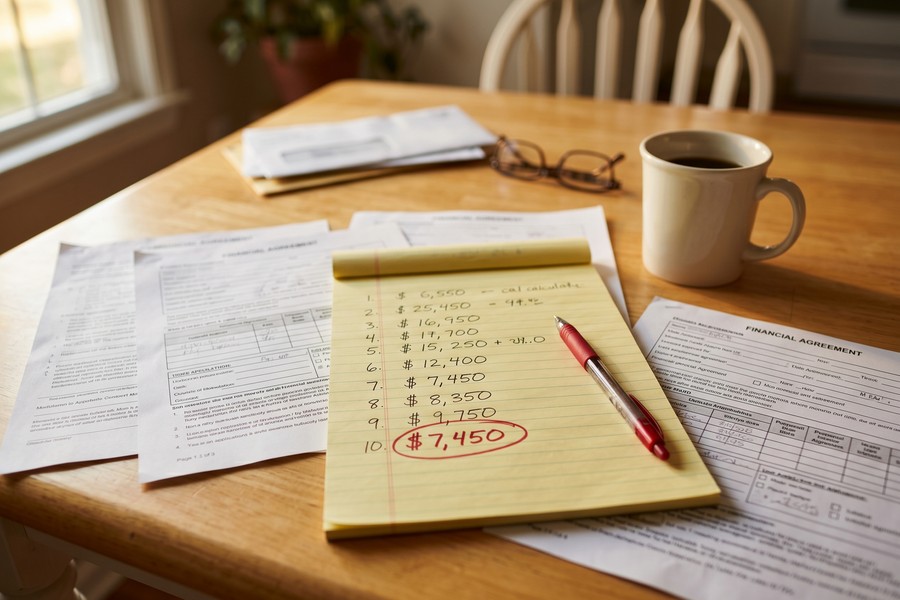
Before accepting any loan, calculate the “cost per borrowed dollar” — total interest and fees divided by the amount borrowed. This ratio strips away loan size and term, giving you a pure apples-to-apples comparison across any loan product.
Borrowers who comparison-shop across at least 3 lenders save an average of $1,500 in interest on a typical personal loan, according to research from the Pew Charitable Trusts on consumer lending markets.
Your Action Plan
-
Request the “Total of Payments” figure from every lender
Before you discuss APR, monthly payment, or terms, ask each lender to give you the total of payments figure in writing. This is legally required under TILA and immediately tells you the real cost of the loan.
-
Build a simple comparison spreadsheet
Create a basic spreadsheet with columns for lender name, APR, loan term, monthly payment, total repaid, and total interest paid. Fill it in for every offer you receive. The differences will be immediately visible.
-
Calculate the cost per borrowed dollar
Divide the total interest and fees by the loan principal. This single ratio lets you compare a 12-month loan, a 36-month loan, and a payday product on the same scale — regardless of size or term.
-
Identify and add any fees excluded from APR
Ask specifically whether origination fees, administration fees, and insurance premiums are included in the quoted APR. If any are excluded, add them to your total cost calculation manually.
-
Check for prepayment penalties
Before signing, read the loan agreement for any penalty for early repayment. If one exists, factor it into your total cost estimate — especially if you plan to pay the loan off ahead of schedule.
-
Get at least three competing offers
Use at least three lenders — including a bank, a credit union, and an online lender — to establish a range of total costs for your situation. This gives you negotiating power and a realistic benchmark.
-
Choose the lowest total cost that fits your cash flow
Rank all offers by total dollars repaid, not by APR or monthly payment. Select the lowest total cost option where the monthly payment is genuinely manageable — not just technically possible.
-
Review the full disclosure document before signing
Read every page of the TILA disclosure, not just the summary. Look for the finance charge line, the total of payments line, and any conditions that could alter those numbers (like variable rates or balloon payments).
Frequently Asked Questions
What is the difference between APR and total loan cost?
APR is an annualized percentage that represents the yearly cost of borrowing, including the interest rate and most fees. Total loan cost is the actual dollar amount you’ll pay from start to finish — principal plus all interest and fees over the entire loan term. APR helps you compare rates; total loan cost tells you the real financial impact.
Can two loans have the same APR but different total costs?
Yes — this is one of the most important things to understand about APR vs total loan cost. If two loans have the same APR but different repayment terms, the longer loan will almost always cost more in total dollars because interest accrues over a longer period. Always compare total repayment figures, not just APR.
Is a lower APR always the better deal?
Not necessarily. A lower APR loan with a longer term can cost more total money than a higher APR loan with a shorter term. The monthly payment may be lower, which feels better — but you pay more over time. Run the full total cost calculation for any offer before concluding which is “better.”
What fees are not included in APR?
Common exclusions include late payment fees, NSF fees, optional credit insurance, some types of prepayment penalties, and certain closing costs depending on the loan type. These can meaningfully increase your total loan cost without appearing in the APR you were quoted. Always ask the lender directly what is and isn’t included.
How do I calculate total loan cost myself?
Multiply your monthly payment by the number of months in the loan term. Then add any upfront fees that were not rolled into the loan. The result is your total loan cost. If you have access to your Truth in Lending disclosure, look for the “Total of Payments” line — it’s already calculated for you.
Why do lenders emphasize APR instead of total loan cost?
APR is required by law and provides a standardized comparison metric — but it doesn’t capture the full financial picture. Lenders also know that a percentage is often easier to accept than a large dollar figure. Showing a 14% APR feels different than showing $4,200 in total interest. Both are accurate; one is more emotionally compelling for the lender’s goals.
Does APR include origination fees?
It depends on the lender and loan type. For mortgages, origination fees are typically included in APR. For personal loans and short-term products, practices vary. Always ask your lender explicitly whether the origination fee is reflected in the APR they’ve quoted you, and add it to your total cost calculation if it’s not.
How does loan term affect total loan cost?
Loan term is one of the biggest drivers of total cost. A longer term lowers your monthly payment but extends the period during which interest accrues. Even at a lower APR, a 5-year loan will typically cost significantly more than a 2-year loan for the same amount. The difference can easily run into thousands of dollars.
Are short-term loan APRs misleading?
APR for short-term loans can be extremely high — 300% to 400% for payday products — but that annualized figure is applied to a loan that only runs for days or weeks. The per-transaction dollar cost may seem small at first glance. The real risk comes from rollovers, where fees compound without reducing principal. Total cost, not APR, is the metric that reveals that risk.
Where can I find a reliable loan cost calculator?
The CFPB offers free loan calculator tools at consumerfinance.gov. Many credit unions also offer calculators on their websites. When using any calculator, input the exact loan amount, the exact APR, and the exact term in months. Then add any excluded fees manually for an accurate total cost estimate.
Sources
- Consumer Financial Protection Bureau — CFPB Finds One in Five Auto Loan Borrowers Pay More Than Expected
- Consumer Financial Protection Bureau — Payday Loans and Deposit Advance Products Research Report
- Federal Reserve — Financial Accounts of the United States (Z.1 Release)
- Consumer Financial Protection Bureau — Auto Loan Calculator and Consumer Tools
- Federal Trade Commission — Truth in Lending Act: Business Guidance
- Pew Charitable Trusts — Research on Consumer Lending and Payday Loan Markets
- Federal Reserve — Consumer Information: Understanding Credit and Borrowing Costs
- Consumer Financial Protection Bureau — Loan Estimate Explainer
- FDIC — Consumer News: Understanding Payday Loans and Their True Costs
- U.S. Code — Truth in Lending Act (15 U.S.C. § 1601), Congressional Research Service