
Fact-checked by the onlinepaydaynews.com editorial team
Marcus works the floor at a big-box retailer in Memphis, pulling roughly 32 hours a week at $15.40 an hour. Two years ago, a medical bill he couldn’t cover and a car repair that hit the same month sent two credit card accounts into default. Both were eventually charged off. His score bottomed out near 530. Eighteen months later, after a deliberate sequence of moves that cost him almost nothing up front, he crossed 660. That is not a miracle. It is what happens when someone knows exactly which levers to pull and in what order, because the path to rebuild credit after charge-off is more mechanical than most people realize.
Charge-offs are far more common than the financial media suggests. According to data from the National Creditors Bar Association citing Federal Reserve figures, the credit card charge-off rate at U.S. commercial banks hit 4.65% in Q3 2024, the highest level since Q3 2011. Millions of people are starting from the same damaged baseline right now, and most of the guides written for them skip the hard parts.
By the end of this guide, you will know exactly what a charge-off does to your report, how to sequence your response when you have two of them, what paying off a charge-off actually accomplishes (and what it does not), and how to build enough new positive history to reach a functional 660 on a retail worker’s budget inside 18 months.
Key Takeaways
- A charge-off can drop a credit score by 100–150 points, but the biggest single-month hit usually comes from the first 30-day late payment, not the charge-off event itself.
- Two charge-offs sold to separate collectors can produce four derogatory tradelines on your report simultaneously, a compounding problem most single-charge-off guides never address.
- The 7-year FCRA removal clock starts from the date of first delinquency, not the charge-off date or sale date, so your actual removal date may be sooner than you think.
- Payment history accounts for 35% of your FICO Score, making zero new late marks the single non-negotiable requirement throughout your rebuilding window.
- Credit utilization is the only major FICO factor with no historical memory; dropping one maxed card to near zero can add 50–100 points within two billing cycles.
- Debt forgiven in settlement over $600 triggers a 1099-C form; that forgiven amount is taxable income and can produce a surprise tax bill in April.
In This Guide
- What a Charge-Off Actually Does to Your Credit
- Mapping the Starting Point: Reading Your Report First
- The Double-Entry Trap When You Have Two Charge-Offs
- The Pay-or-Wait Decision and What Settlement Really Costs
- Building New Positive History on a Retail Budget
- The Utilization Lever: Fastest Score Move Available
- The 18-Month Timeline: What Each Phase Looks Like
- What 660 Actually Gets You, and What Still Feels Blocked
- Staying Out of the Hole: Budget Moves That Prevent the Next Charge-Off
What a Charge-Off Actually Does to Your Credit
A charge-off is an accounting move, not debt forgiveness. After roughly 120 to 180 days of missed payments, a lender writes the balance off its books as a loss. From that lender’s perspective, it’s an internal bookkeeping event. From your perspective, the debt is still fully owed, and the lender can still pursue it or sell it to a collector who will.
The score damage is real, but the timing of it often surprises people. The largest single-month drop in most scoring histories occurs at the first 30-day late payment, not at the charge-off itself. By the time the formal charge-off shows up on your report, you have already absorbed five or six monthly late-payment hits in the months leading up to it. That is painful context, but it is also useful: if your score is already at 530, you have less incremental damage left to absorb, and you can redirect energy toward building new positive history rather than spending months trying to erase the past.
The Weight Charge-Offs Carry Over Time
Derogatory marks do not stay equally damaging for seven years. Scoring models weight negative items by recency. A charge-off from 2023 is far more damaging in 2025 than the same charge-off will be in 2029. That means time alone does some of the work, provided you stop adding new negative items. Under the Fair Credit Reporting Act (15 U.S.C. § 1681c), a charge-off can remain on your report for seven years from the date of first delinquency. After that date, it must be removed entirely.
The FTC’s FCRA furnisher rules require creditors who report charge-offs to notify the credit bureau of the exact month and year the delinquency started. That date, not the charge-off date, is what sets the 7-year removal clock.
Understanding that distinction matters because many consumers assume the clock starts when the account was officially charged off or when it was sold. It does not. The clock started when you first went delinquent, which means the item may be closer to its expiration date than your credit report makes it appear at first glance.
Mapping the Starting Point: Reading Your Report First
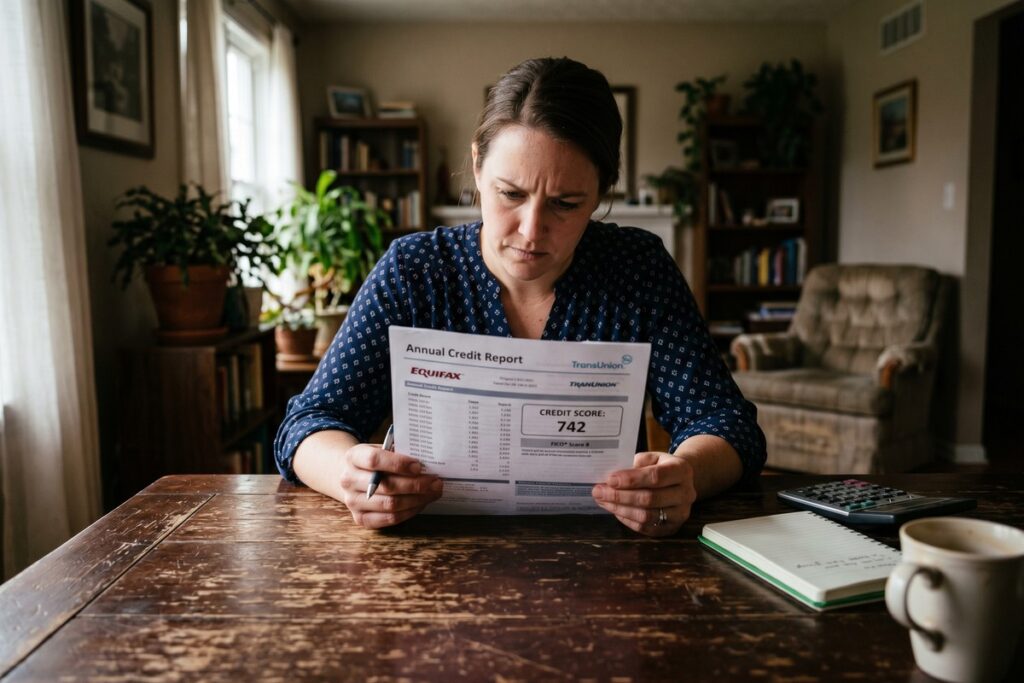
Before any action, pull all three bureau reports from AnnualCreditReport.com, which has offered free weekly reports since 2021. Do not rely on a single bureau. Charge-offs often appear differently across Equifax, Experian, and TransUnion, and lenders pull the bureau that shows them the most data, not the one that flatters you.
On each charge-off entry, find the date of first delinquency. This is the specific field the FCRA requires creditors to report, and it is the number you need to calculate when each item must be removed. Write it down. Then add seven years to it. That is your expiration date.
Spotting Clock-Restart Errors
One error worth specifically hunting for: a charge-off that was later sold to a collection agency may appear twice on your report, once from the original creditor and once from the collector. The collector’s entry should carry the same date of first delinquency as the original. Some collectors improperly use a newer “last updated” or “date opened” to make the account look fresher. That is illegal under the FCRA, and it is disputable. The CFPB’s dispute guidance instructs consumers to contact both the credit reporting company and the original furnisher in writing, and furnishers must investigate and respond within 30 days.
If you see a collection account with a date of first delinquency that is newer than the original charge-off by more than a few days, file a written dispute with both the bureau and the collector. That kind of error is worth catching early because it could artificially extend how long a negative item drags on your score. For a deeper look at how to exercise dispute rights correctly, this guide on what most borrowers get wrong about their right to dispute covers the procedural mistakes that cause disputes to fail.

The Double-Entry Trap When You Have Two Charge-Offs
Here is a gap most guides skip entirely: when you have two charge-offs that are both sold to collectors, you can end up with four separate derogatory tradelines on your reports. Two from the original creditors. Two from the collectors who purchased the debts. Each one is a distinct entry, and each one applies its own scoring penalty.
That four-tradeline problem changes both your dispute sequencing and your pay-off strategy. You need to verify the date of first delinquency on all four entries, confirm that the collector entries are not using newer dates to restart the clock, and decide whether each debt is owned by the original creditor or has been fully transferred. Calling the original creditors first to ask who currently holds the debt is not optional at this stage. It determines who you pay.
Sequencing When You Have Two to Resolve
Prioritize by age and amount. The newer charge-off carries more scoring weight and is more likely to still be with a collector who has enforcement options including lawsuit and wage garnishment. The older one, if it is five or six years in, is already fading in most scoring models and may be closer to falling off entirely. For a detailed breakdown of the pay-off-versus-wait tradeoff, the analysis at should you pay off collections or let them age off lays out the math clearly.
One more practical point: with two charge-offs in play, your debt-to-income picture is more complex, and it pays to understand how different types of debt are treated legally. If one of those charge-offs involves a medical bill, the protection framework differs from a credit card balance, as covered in detail at medical debt vs. personal loan debt: which has more legal protections.
Credit card issuers wrote off $46 billion in seriously delinquent loans in the first nine months of 2024 alone, a 50% jump from the same period in 2023, according to BankRegData figures reported by eMarketer. You are not alone in this situation.
The Pay-or-Wait Decision and What Settlement Really Costs
Paying a charge-off does not remove it. That point deserves its own sentence because it surprises almost everyone who hears it for the first time. You pay the balance, the account status changes from “charged off” to “paid charge-off,” and the entry stays on your report until the 7-year clock runs out. Under older FICO models (8 and below), which most lenders still use in mid-2025, a paid charge-off carries nearly the same scoring penalty as an unpaid one.
So why pay at all? Because certain lenders require it. Many mortgage underwriters and some auto lenders have manual review overlays that require all charge-offs to be resolved before approving a loan, regardless of your score. A 660 with an unpaid charge-off can still get rejected at the underwriting stage even if it passes automated approval. Paying tells those manual reviewers that you addressed the problem, even if the scoring model doesn’t reward you much for it.
When Settling Makes Sense Versus When It Doesn’t
If a charge-off is five or six years old, the scoring hit is already minimal and the item falls off within a year or two. Settling then produces little score benefit and costs you real money. If the charge-off is fresh, under two years old, settling can stop collection escalation: repeated calls, potential lawsuits, and wage garnishment. That is a concrete financial protection even before you consider the score.
Pay-for-delete is worth understanding, but you need to know who holds your debt before attempting it. Large original creditors like major banks almost never agree to delete because their contracts with the bureaus require accurate reporting under the FCRA. Smaller third-party debt buyers who purchased your balance at a discount have considerably more flexibility, especially on older or smaller balances. Always get any pay-for-delete agreement in writing, signed, before sending a single payment. A verbal promise means nothing once the money transfers.
When a collector forgives more than $600 of a charged-off balance, the IRS requires the creditor to issue a 1099-C form. That forgiven amount is treated as taxable income. For a retail worker on a tight budget, a surprise tax bill in April can itself trigger another missed-payment cascade. Paying the balance in full, when affordable, avoids this entirely.
Building New Positive History on a Retail Budget
The core two-tool strategy is a secured credit card combined with a credit-builder loan. These are not interchangeable. A secured card builds revolving credit history. A credit-builder loan (typically $300–$1,000, 12–24 months, no credit check required) builds installment history. FICO scoring models reward having both types, not just one.
A retail worker can start with a $49–$200 secured card deposit. Charge only one small recurring bill to it, a streaming subscription works well, and keep utilization below 10% on that card. Set autopay to the full balance so no interest accrues and no late marks appear. The goal at this stage is consistency, not activity. You want that card reporting on-time payments every single month without drama.
Free and Low-Cost Accelerators
Rent-reporting services like Rental Kharma or LevelCredit can add months or years of on-time rent payments to your Experian and TransUnion files for a small monthly fee, sometimes as low as $7. Experian Boost lets you add utility and phone payment history directly to your Experian file for free. Neither of these is a substitute for a real tradeline, but both can thicken a thin file quickly and cost almost nothing.
Becoming an authorized user on a trusted family member’s card is worth considering if their account has a long, clean payment history and low utilization. The account’s history can appear on your file immediately. The main risk is on their end: if you misuse the card, or if the account later goes delinquent, it damages your file too. This only works with someone whose credit habits you can genuinely trust.
For a direct comparison of which tools move the needle faster when you’re starting from scratch, the breakdown at credit builder loans vs. secured cards: which one works faster runs through the timeline differences clearly.
A CFPB-backed study found that credit-builder loan participants without existing debt saw scores rise an average of 60 points more than those who carried other balances when they opened the loan. Before adding any new credit product, pay down whatever open balances you have first. The order matters.

The Utilization Lever: Fastest Score Move Available
Credit utilization accounts for 30% of your FICO Score and is the only major scoring factor with no historical memory. Pay a card balance from 90% down to zero, and within one or two billing cycles, that improvement shows up fully in your score. No waiting years for the positive mark to accumulate. The effect is immediate.
Most people understand the 30% overall utilization rule. Fewer know that scoring models also penalize any single card above 30%, even if your total across all cards looks fine. One maxed-out card with a $300 limit drags your score even if you have three other cards sitting at zero. The fix is per-card, not aggregate. Keep each individual card below 30%, and aim for below 10% on the card you want to show the strongest positive signal.
How to Work the Utilization Lever When Cash Is Tight
If you cannot pay a balance all the way down, even partial payments help. The scoring model reads whatever balance is reported on the statement date, so paying before the statement closes is more effective than paying after. Ask your card issuer when the statement cuts and target a payment a few days before that date.
On a retail income where cash flow is irregular, this requires a bit of calendar awareness rather than a financial overhaul. The key point: for someone rebuilding after a charge-off, utilization is the only lever that can show real score movement in weeks, not months. Use it actively. This is also relevant if you are considering common mistakes people make with this lever, which this breakdown of credit-building mistakes after paying off a collection addresses directly.
According to Experian, payment history accounts for 35% of your FICO Score, the single largest factor. Utilization is second at 30%. Together, these two factors make up 65% of your score, which means controlling just these two things drives the majority of your rebuilding outcome.
The 18-Month Timeline: What Each Phase Looks Like
Reaching 660 from a post-charge-off low of 500–580 is realistic in 12 to 24 months. Eighteen months is a reasonable midpoint target if you start all the right moves early and make no new mistakes. The path breaks into three phases.
Months 1–6: Pull all three reports. Dispute any errors, particularly clock-restart errors on your collection accounts. Open one secured card if you do not already have one. Reduce utilization on any existing open accounts. Expect minimal visible score movement. You are clearing debris and laying foundation, not yet posting gains.
Months 6–12: Six months of consistent on-time payments start registering as a pattern. Scores often rise 50–100 points from this baseline if utilization stays below 30% and no new late marks appear. This is when the effort starts to feel visible. Add a credit-builder loan during this phase if your budget allows.
The One-Miss Rule
Months 12–18: Charge-offs age another year and lose more weight in scoring models. A second credit product can be added. Some secured cards graduate to unsecured products after 12 months of clean history. A 660 becomes achievable here, sometimes earlier, depending on starting score and whether any items have rolled off.
The hardest rule in this timeline is also the simplest: zero new late payments. A single 30-day miss creates a brand-new derogatory mark with a new 7-year clock. It does not just slow momentum. It resets it. Autopay at the minimum balance is not ideal financially, but it is insurance. A missed paycheck should never translate into a missed credit payment if autopay is set up correctly. The average U.S. FICO score sat at 715, per FICO data reported by CNBC Select. A 660 puts you back in functional lending territory, below average but no longer in subprime.
What 660 Actually Gets You, and What Still Feels Blocked
A 660 score is a re-entry score, not a destination. It unlocks approval for most unsecured credit cards, though often at lower limits and higher APRs than someone in the 720 range would see. It qualifies you for many auto loans, though again, not at the best rates. It meets the minimum credit score threshold for many FHA mortgage programs, which currently require a minimum 580 score with a 3.5% down payment.
What 660 does not fix is worth naming explicitly. Some landlords and property management companies run credit checks and manually review derogatory accounts regardless of score. A charge-off from 2023 can get a rental application rejected even if the score looks acceptable. Certain lenders have hard overlays: “no charge-off in the last 24 months,” full stop. A 660 score cannot override a policy underwrite.
The Occupational Hazard Most Guides Never Mention
Here is something almost no credit guide covers: certain employers in finance, property management, and government positions run credit checks and can decline candidates who have unresolved charge-offs even after the score has recovered. If you are a retail worker hoping to move into a bank teller role, a property leasing office, or a government agency position, a 660 score with visible charge-offs can still block that transition. That is a concrete career consequence, not just a loan consequence, and it is worth factoring into your timeline for resolving those accounts rather than waiting for them to age off.
One more nuance worth understanding: FICO 9 and VantageScore 3.0 no longer penalize paid collection accounts. That sounds like great news until you realize that most mortgage lenders, auto lenders, and landlords still use FICO 8 or even older models as of mid-2025. A paid charge-off that looks clean under FICO 9 may still carry nearly full penalty weight in the lender’s actual underwriting model. The scoring model the specific lender uses matters enormously, and you have to ask them directly which one they pull. This is not something you can assume.
The CFPB advises consumers rebuilding credit to keep utilization below 30%, pay balances in full each month, and avoid opening many new accounts at once. Disputing errors is equally emphasized. See the CFPB’s official credit rebuilding guidance for the full framework.
Staying Out of the Hole: Budget Moves That Prevent the Next Charge-Off
The single biggest threat to rebuilt credit is an unexpected expense with no cash buffer. A $400 car repair on a retail income, with no savings and maxed credit, restarts exactly the missed-payment spiral that produced the charge-offs in the first place. Building even a $500 emergency fund alongside the credit-rebuilding process is not a separate financial goal. It is credit protection.
On a variable retail income, the practical approach is to set up a separate savings account labeled specifically for credit bills, fund it a little each pay period before spending on anything discretionary, and treat autopay as a floor. Autopay set to the minimum balance guarantees no late mark even in a bad week. You can always pay more manually, but the minimum prevents disaster.
The New Credit Rule
Do not open new credit lines until your current ones have 12 months of clean history. Every new application creates a hard inquiry, drops the average age of your accounts, and adds a new minimum payment obligation. All of those move your score in the wrong direction in the short term. The temptation to grab every card offer that arrives is real, especially once scores start improving. Resist it.
One more boundary worth drawing: be careful about where you look for emergency funding if a cash shortfall does occur during your rebuilding window. Some lenders advertising to people with damaged credit are predatory, with fees structured to guarantee default. Before applying anywhere, check for red flags that identify fake or predatory loan companies before submitting any personal information.
If you are also watching for errors or abusive collector behavior during your rebuilding period, the CFPB Complaint Database is a free, searchable tool that shows how collectors have been reported by other consumers. A short guide on how to use it effectively is available at CFPB Complaint Database: a beginner’s guide.
Your Action Plan
-
Pull all three credit reports immediately
Go to AnnualCreditReport.com and download your Equifax, Experian, and TransUnion reports. Free weekly access is available. For each charge-off entry, locate and record the date of first delinquency, that is the number that determines when each item expires. Note whether any collection entries carry a newer date than the original charge-off, which is a disputable error.
-
Identify who currently holds each debt
Call the original creditors and ask whether the debt is still owned by them or has been sold. If sold, ask to whom. You need the current debt holder’s name and contact information before any payment or negotiation. Paying the wrong party does not resolve the debt and gives you nothing in writing.
-
Dispute any reporting errors in writing
If you find clock-restart errors or inaccurate dates, submit written disputes to both the credit bureau and the furnisher. Per CFPB guidance, furnishers must investigate and respond within 30 days. Keep copies of every dispute letter and every response. Certified mail with return receipt creates a paper trail that matters if you escalate.
-
Decide on pay-or-wait for each charge-off based on age and holder type
For charge-offs under two years old or where a lawsuit is a realistic threat, prioritize resolution. If a charge-off is four or more years old, run the math: how much score benefit will paying produce versus how much you would spend? For accounts held by third-party debt buyers, attempt a pay-for-delete negotiation in writing before sending any money. Get the agreement signed before any payment is made.
-
Open one secured card and one credit-builder loan
Apply for a secured card with a deposit you can afford, $49 to $200, and a credit-builder loan of $300 to $500 through a credit union or online lender. Use the secured card for one small recurring charge only. Set both to autopay. Your goal for the first six months is zero drama and consistent monthly reporting.
-
Drive utilization below 10% on each card you hold
Pay balances before the statement closing date, not just before the due date. Check what percentage of each card’s limit you are using individually, not just in aggregate. One card at 80% drags your score even if everything else is at zero. Attack the highest-utilization card first for the fastest point gain.
-
Build a $500–$1,000 emergency fund before adding more credit products
Open a dedicated savings account and automate a fixed amount from each paycheck into it. Do not draw on this unless an expense would otherwise trigger a missed credit payment. This is your protection against restarting the late-payment cycle. Even $25 per paycheck builds $600 in a year.
-
Review your reports again at 6 months and 12 months
Track whether paid accounts have been correctly updated, whether any new errors have appeared, and whether your date-of-first-delinquency records match what you noted originally. At 12 months, assess whether you qualify for a secured card graduation to unsecured. At 18 months, evaluate whether your score and account standing support applying for a second credit product.
Frequently Asked Questions
Does paying off a charge-off remove it from my credit report?
No. Paying a charge-off changes the account status from “charged off” to “paid charge-off,” but the entry stays on your report until the 7-year FCRA clock expires. The 7 years run from the date of first delinquency, not the payment date. Paying does not restart or shorten the removal timeline. The only way to get a charge-off removed before that date is a successful pay-for-delete agreement, a successful dispute of an error, or a goodwill deletion request accepted by the furnisher.
What does “date of first delinquency” mean and why does it matter?
The date of first delinquency is the month and year you first missed the payment that eventually led to the charge-off. It is the starting point for the FCRA’s 7-year reporting clock, not the date the account was charged off, sold, or settled. This distinction matters because many people assume the clock starts at charge-off, which would mean a longer wait. In reality, since you were 120–180 days late before the charge-off was recorded, the clock has been running for months longer than the charge-off date suggests.
Will a paid charge-off actually improve my credit score?
Marginally, under most circumstances, and primarily in newer scoring models. Under FICO 8 (still the most commonly used model for lending decisions as of mid-2025), a paid charge-off carries nearly the same scoring weight as an unpaid one. FICO 9 treats paid collections more favorably, but most lenders have not yet adopted it for underwriting. The practical benefit of paying is not primarily the score bump; it is the change in account status that some mortgage and auto lenders require before they will approve a loan manually.
How do I know if my debt has been sold to a collection agency?
Check your credit reports first. If the same debt appears under both the original creditor’s name and a separate collection company’s name, the debt has likely been sold. You can also call the original creditor’s customer service line and ask directly whether they still own the balance. Get the answer in writing, or at minimum note the representative’s name, date, and what was said. Paying the original creditor after the debt has been sold does not satisfy the collection account.
What is the double-entry problem and does it apply to me?
If you have two charge-offs that were both sold to collection agencies, you may have four separate derogatory tradelines on your report: two from the original creditors and two from the collectors. Each entry carries its own scoring penalty. This is worse than the single-charge-off scenario that most guides describe. To confirm whether this applies to you, check all three bureau reports and count how many distinct entries reference each original debt. Dispute any collector entry that carries a newer date of first delinquency than the original creditor entry for the same debt.
Is a 660 score good enough to rent an apartment or buy a car?
It depends on the specific landlord or lender. For car loans, 660 qualifies for most loan approvals but typically not the best rates, which usually require 720 or above. For rentals, many property management companies accept 620 to 660 but will also review your full report manually. A visible charge-off, especially a recent one, can override a 660 score at the landlord’s discretion. For FHA mortgages, the minimum score requirement is 580, so 660 clears that bar, though lenders often have their own stricter overlays.
What happens if I settle a debt for less than I owe?
Any forgiven amount above $600 is considered taxable income by the IRS. The creditor is required to send you a 1099-C form reporting that amount, and you must declare it on your tax return. For a retail worker, this can mean an unexpected tax bill the following April. The size of that bill depends on how much was forgiven and your effective tax rate. If you settle a $2,000 balance for $800, the $1,200 forgiven is income. This is not a reason to never settle, but it is a cost that needs to be factored into the decision before you agree to any settlement amount.
Can I use Experian Boost to counteract charge-off damage?
Experian Boost adds positive payment history from utilities, phone bills, and streaming services directly to your Experian file, and it can raise your Experian-based scores by a meaningful amount for some people. However, it only affects Experian scores, not TransUnion or Equifax. It also does not remove or diminish the charge-off entries themselves. Think of it as a supplement, not a solution. It works best for people who have thin files alongside their negative marks, because it adds tradelines that were previously invisible to scoring models.
How many new credit accounts should I open during rebuilding?
Start with one, specifically a secured card. After six months of on-time payments, add a credit-builder loan if your budget allows. Wait until both products have 12 months of clean history before considering anything else. Opening multiple accounts quickly generates multiple hard inquiries, lowers your average account age, and adds minimum payment obligations, all of which work against a rebuilding timeline. The CFPB explicitly advises against opening many new accounts at once during the rebuilding period.
What are the biggest mistakes people make when trying to rebuild after a charge-off?
The most common ones: paying off a charge-off without getting anything in writing about status change or deletion; opening several new credit cards quickly to “build” history; missing even one payment on a new account; ignoring utilization and focusing entirely on the charge-off entry; and assuming a score improvement means a lender will automatically approve them without a manual review of their full report. The subtler mistakes include not verifying who holds the debt before paying, and not accounting for the tax consequence of settling for less than the full balance. Reading through the specific mistakes people repeat at this guide on credit-building mistakes after paying off a collection can help avoid the most costly ones.
Sources
- Consumer Financial Protection Bureau, How to Rebuild Your Credit
- Consumer Financial Protection Bureau, How to Dispute an Error on Your Credit Report
- Federal Trade Commission, Consumer Reports: What Information Furnishers Need to Know
- Federal Trade Commission, Fair Credit Reporting Act (15 U.S.C. § 1681)
- National Creditors Bar Association, Credit Card Charge-Offs and Delinquencies Hit 13-Year High
- eMarketer, Credit Card Charge-Offs Totaled $46 Billion in 2024
- CNBC Select, The Average Credit Score in the U.S. in 2025 (FICO Data)
- Experian, What Affects Your Credit Scores?
- OnlinePaydayNews, Should You Pay Off Collections or Let Them Age Off Your Credit Report?
- OnlinePaydayNews, Credit Builder Loans vs Secured Cards: Which One Works Faster for a Thin File?
- OnlinePaydayNews, 5 Credit Building Mistakes People Make After Paying Off a Collection