

Fact-checked by the onlinepaydaynews.com editorial team
You’re staring at a $400 shortfall with rent due in three days, and two options keep flashing in your mind: walk into a payday loan store or sign a rent-to-own agreement for the laptop your kid needs for school. Both feel like lifelines. Both carry hidden costs that most borrowers never calculate until it’s too late. The debate around payday loans vs rent-to-own financing isn’t just academic — it’s a decision that can quietly drain hundreds or even thousands of dollars from families already stretched to the limit.
According to the Consumer Financial Protection Bureau, the typical payday loan borrower takes out eight loans per year, paying $520 in fees to repeatedly borrow $375. Meanwhile, the rent-to-own industry generates over $8.5 billion in annual revenue from roughly 4.8 million customers, with the average customer paying two to three times the item’s retail price before they own it outright. These aren’t edge cases — they represent a systemic pattern of high-cost financing that disproportionately affects households earning under $40,000 per year.
This guide breaks down both options with real numbers, side-by-side comparisons, and an honest look at which product does more damage — and under what circumstances. By the end, you’ll know exactly how each product works, what it truly costs, what alternatives exist, and how to make a smarter decision when your budget is already under pressure.
Key Takeaways
- The average payday loan carries an APR of 391%, with some state-level rates exceeding 600% annually.
- Rent-to-own customers typically pay 2 to 3 times the retail price of an item — a $500 TV can cost $1,200 to $1,500 total.
- 80% of payday loans are rolled over or renewed within 14 days, trapping borrowers in a cycle of fee accumulation.
- A typical $300 payday loan renewed four times generates $240 in fees — nearly equal to the original loan amount.
- Rent-to-own agreements average 18 months, meaning a $700 laptop could require 78 weekly payments of $25 each — totaling $1,950.
- Only about 25% of rent-to-own customers actually complete the full payment term and take ownership of the product.
In This Guide
- How Payday Loans Work — And What They Really Cost
- How Rent-to-Own Financing Works — The Fine Print
- True Cost Comparison: Payday Loans vs Rent-to-Own
- Who Uses These Products and Why
- The Debt Trap Mechanics Behind Each Model
- Credit Score Impact: Which Hurts More?
- Regulation and Consumer Protections
- Smarter Alternatives to Consider First
- When Each Option Might Actually Make Sense
- Payday Loans vs Rent-to-Own: The Final Verdict
How Payday Loans Work — And What They Really Cost
Payday loans are short-term, unsecured loans typically ranging from $100 to $1,000, designed to be repaid on the borrower’s next payday — usually within 14 days. The lender requires either a post-dated check or authorization to debit the borrower’s bank account on the due date. No credit check is required, and approval can happen within minutes.
The fee structure is deceptively simple on the surface. Most lenders charge $15 to $30 per $100 borrowed. That sounds manageable until you translate it into an annualized percentage rate. A $15 fee on a $100, two-week loan equals an APR of 391%. A $30 fee on the same loan pushes the APR to 782%.
The Rollover Trap
The real danger isn’t the original loan — it’s the rollover. When borrowers can’t repay in full at the due date, they pay another fee to extend the loan. The CFPB found that four out of five payday loans are rolled over or renewed within two weeks. Each rollover adds another full fee without reducing the principal.
A borrower who takes a $300 loan and rolls it over four times pays $240 in fees while still owing the original $300. That’s an 80% premium just in fees — and they still owe the principal. This mechanic is central to understanding the payday loans vs rent-to-own debate: payday loans charge for time, while rent-to-own charges for possession.
State-by-State Variation
Payday loan laws vary significantly by state. Fourteen states and the District of Columbia effectively ban payday lending through rate caps. States like Texas and Utah impose no rate caps, enabling APRs above 600%. States like Colorado have reformed their laws to cap rates and require installment repayment terms. Understanding your state’s rules is the first step before ever setting foot in a payday loan store.
In states with no rate cap, payday loan APRs average 664%, according to the Center for Responsible Lending’s 2023 state-by-state analysis. Borrowers in these states pay an estimated $3.3 billion in fees annually.
How Rent-to-Own Financing Works — The Fine Print
Rent-to-own agreements (also called rent-to-own contracts or RTO agreements) let consumers take home furniture, electronics, appliances, and even jewelry for a weekly or monthly rental fee. At the end of the rental term — typically 12 to 24 months — the consumer owns the item. No credit check is required, and early ownership options are often available.
The model is dominated by large chains like Rent-A-Center and Aaron’s, which together control a significant share of the market. A $500 laptop might rent for $25 per week over 78 weeks — totaling $1,950 before any ownership is transferred. That’s a markup of 290% over retail price.
Hidden Costs in Rent-to-Own Contracts
Beyond the inflated total cost, RTO contracts frequently include additional fees. Loss damage waiver (LDW) fees, processing fees, and club membership fees can add $5 to $15 per week on top of the rental rate. Many customers don’t realize these are optional until after signing.
Early purchase options exist but are rarely advertised prominently. Most chains offer a “same-as-cash” window during the first 90 to 120 days, where customers can buy the item at near-retail price. After that window closes, the total cost increases dramatically with each passing payment.
Rent-to-own agreements are classified as leases in most states, not credit transactions. This means the Truth in Lending Act (TILA) — which requires APR disclosure — does not apply to most rent-to-own contracts, leaving consumers without standardized cost comparisons.
Product Categories and Typical Markups
| Product Category | Average Retail Price | Typical RTO Total Cost | Markup Percentage |
|---|---|---|---|
| Laptop / Computer | $500–$700 | $1,400–$1,950 | 180–290% |
| 55″ Television | $400–$600 | $1,100–$1,800 | 175–300% |
| Washer / Dryer Set | $700–$1,000 | $1,800–$2,800 | 157–280% |
| Living Room Furniture Set | $800–$1,200 | $2,000–$3,200 | 150–266% |
| Smartphone | $300–$500 | $900–$1,500 | 200–300% |
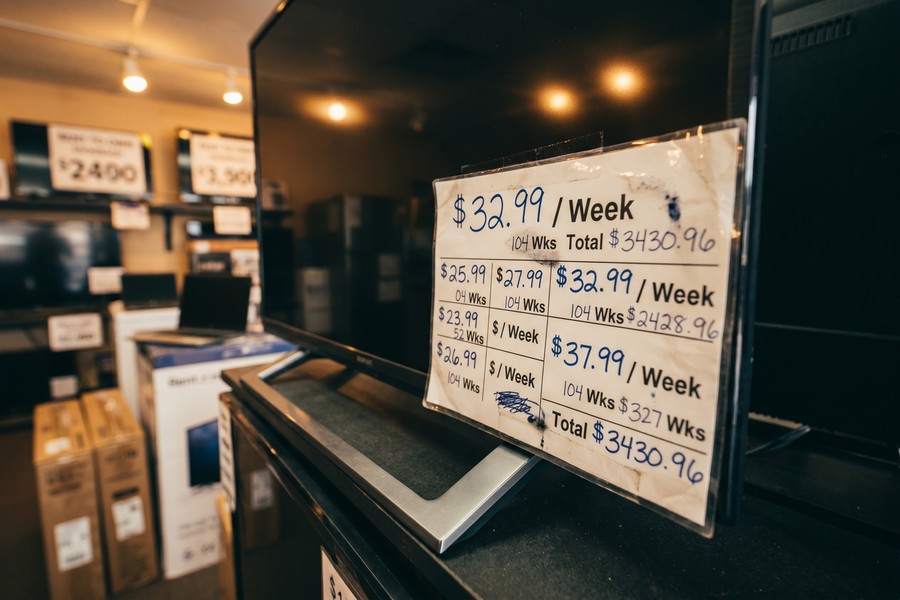
True Cost Comparison: Payday Loans vs Rent-to-Own
Comparing these two products directly is tricky because they serve slightly different needs. Payday loans deliver cash; rent-to-own delivers goods. But when a consumer’s underlying goal is the same — accessing something they can’t currently afford — the cost comparison becomes critical. In the payday loans vs rent-to-own debate, the numbers tell a stark story.
Consider a $500 need. A payday loan for $500 at $15 per $100 costs $75 in fees for a two-week term. If rolled over four times (two months), total fees reach $375. The borrower still owes the $500 principal — total outlay: $875. A rent-to-own agreement for a $500 item costs roughly $1,250 to $1,500 over the full term, but the consumer gets to use the item throughout.
APR Equivalent for Rent-to-Own
Because rent-to-own contracts aren’t required to disclose APRs, consumers often don’t know the true annualized cost. Consumer researchers have calculated implicit APRs ranging from 100% to 300% for typical RTO contracts — significantly lower than payday loans, but still far above any conventional financing product.
The critical difference: payday loan costs compound rapidly over weeks, while rent-to-own costs are spread over months or years. For a short-term, one-time cash need, a payday loan that’s repaid on time is cheaper in absolute dollars than a rent-to-own agreement for the equivalent value. The problem is most borrowers don’t repay on time.
If you roll over a payday loan just three times, its total cost often exceeds what you’d pay through a 12-month rent-to-own agreement for the same dollar amount. The rollover is where payday loans become catastrophically more expensive than any alternative.
Cost Comparison at Different Repayment Timelines
| Scenario | Payday Loan ($500) | Rent-to-Own ($500 Item) | Winner |
|---|---|---|---|
| Repaid in 2 weeks | $575 total ($75 fee) | N/A — item still leased | Payday Loan |
| 2 rollovers (6 weeks) | $725 total ($225 fees) | ~$150 paid, item still leased | Depends on goal |
| 4 rollovers (10 weeks) | $875 total ($375 fees) | ~$250 paid, item still leased | RTO (if you need the item) |
| Full term (18 months) | Debt likely escalated further | ~$1,500 paid, item owned | RTO (by default) |
Who Uses These Products and Why
Both payday loans and rent-to-own products disproportionately serve low-to-moderate income households. The FDIC’s National Survey of Unbanked and Underbanked Households found that payday loan use is highest among households earning $15,000 to $30,000 annually, with Black and Hispanic households using payday products at roughly twice the rate of white households.
Rent-to-own customers skew similarly. Research by the Association of Progressive Rental Organizations found that 70% of RTO customers have annual household incomes below $40,000, and nearly 60% are renters rather than homeowners. These customers often lack access to credit cards, personal loans, or retail financing programs.
The Access Gap Problem
The core reason consumers turn to these products isn’t recklessness — it’s access. When a refrigerator breaks down and a household has no savings, no credit card, and no family support, the choice isn’t between a payday loan and a bank loan. The choice is between a payday loan and going without food storage. That context matters enormously when evaluating these products.
For cash emergencies — a car repair, a utility bill, an unexpected medical co-pay — payday loans provide something rent-to-own cannot: actual money. If you’re considering which emergency funding options to explore before committing, our breakdown of how fast emergency money actually arrives by funding source can help you compare timing alongside cost.
“Payday borrowers aren’t financially irresponsible — they’re financially excluded. When you lack access to $400 in an emergency, a 391% APR isn’t a choice you’re making carelessly. It’s the only door that’s open.”
Demographics Side by Side
| Demographic Factor | Payday Loan Users | Rent-to-Own Users |
|---|---|---|
| Median Annual Income | $22,000–$30,000 | $24,000–$38,000 |
| Housing Status | ~55% renters | ~60% renters |
| Credit Profile | Subprime or no credit | Subprime or no credit |
| Primary Use Case | Cash for bills / emergencies | Household goods / electronics |
| Banking Status | Banked but limited options | Banked or underbanked |
The Debt Trap Mechanics Behind Each Model
Both products are engineered — whether intentionally or structurally — to extract maximum fees from borrowers who remain in the product the longest. Understanding the mechanics of each trap helps consumers recognize warning signs before they’re already caught.
With payday loans, the trap is the two-week deadline. Lenders know that most borrowers won’t have an extra $375 in two weeks if they didn’t have it when they borrowed. So the rollover fee becomes the de facto business model. The CFPB has reported that 75% of all payday loan fees come from borrowers who take out 10 or more loans per year — the chronically trapped, not the occasional user.
How the Payday Cycle Compounds
Here’s the math on a $300 payday loan at $45 fee (a typical $15/$100 rate), rolled over six times over three months:
- Original loan: $300
- Fee per rollover: $45
- Total fees after 6 rollovers: $270
- Total cost to repay: $570 — 90% more than the original loan
- Effective APR over 3 months: 391%+
This is why payday loan reform advocates push for extended payment plans. When borrowers can spread repayment over 60 to 90 days, default and rollover rates drop significantly.
How the Rent-to-Own Cycle Traps Customers
Rent-to-own traps work differently. Most customers who stop making payments lose the item entirely with no credit toward ownership. They’ve paid $300 in rental fees on a $500 TV, returned the item, and walk away with nothing. The store re-rents the same item to the next customer.
Industry research suggests that rent-to-own stores refurbish and re-rent the same item an average of 3 to 4 times before it’s finally purchased or retired — each rental cycle generating close to 100% markup on the original retail cost.
There’s also a psychological trap in rent-to-own. Because customers use the item daily — sleeping on the mattress, watching the TV — walking away feels like losing something they already have. This “endowment effect” keeps many customers paying long past the point where it’s financially rational to do so.
“The rent-to-own industry has built a business model where the best customer is the one who never quite finishes paying. That customer generates the most revenue, and the industry’s retention strategies are specifically designed to keep them in that position.”
Credit Score Impact: Which Hurts More?
One of the most surprising aspects of the payday loans vs rent-to-own comparison is how each product interacts with your credit score. Neither typically helps your credit. But they can hurt it in very different ways.
Most payday lenders do not report on-time payments to the three major credit bureaus — Equifax, Experian, and TransUnion. This means successfully repaying a payday loan does nothing for your credit score. However, if you default and the lender sends the debt to a collections agency, that collection account can appear on your credit report and cause significant damage — typically a 100-point drop or more.
Credit Reporting in Rent-to-Own
Similarly, most rent-to-own agreements do not report to major credit bureaus. Paying consistently for 18 months on a $1,500 RTO contract won’t improve your credit file at all. However, some newer rent-to-own companies — particularly online platforms — have begun reporting to alternative credit bureaus like PRBC or Experian RentBureau, which have limited but growing integration with mainstream scoring models.
If you’re actively trying to build credit while managing tight finances, neither product is your best tool. For strategies that actually move the needle, the comparison of credit builder loans vs secured cards for thin files offers a much more effective path forward.
A single payday loan default sent to collections can drop a 680 credit score to approximately 570–590, according to FICO score simulation data. Recovery to the original score can take 12 to 24 months of consistent positive behavior.
The Invisible Credit Damage
There’s a subtler form of credit damage: repeat payday loan applications. Many payday lenders perform soft pulls, which don’t affect scores. But online lenders and some storefront operators perform hard inquiries, and multiple hard inquiries in a short period can reduce a score by 5 to 10 points each. For borrowers already in subprime territory, this adds up fast.
Understanding your rights when something goes wrong with a loan — including disputing incorrect reporting — is essential. Our guide to what most borrowers get wrong about their right to dispute a loan walks through this process step by step.
Regulation and Consumer Protections
The regulatory landscape for both products is fragmented and inconsistent, leaving many consumers without meaningful protection. Federal regulation has increased in recent years, but enforcement gaps remain significant.
The CFPB issued its Payday Lending Rule in 2017, requiring lenders to assess borrowers’ ability to repay before issuing loans. The rule was gutted in 2020 but partially reinstated through subsequent legal action. As of 2024, the rule’s mandatory underwriting provisions remain in legal limbo, with state-level protections doing most of the heavy lifting.
State-Level Payday Loan Protections
States fall into three broad categories on payday lending:
- Prohibition states: Arkansas, Connecticut, Georgia, Maryland, Massachusetts, New Jersey, New York, North Carolina, Pennsylvania, Vermont, West Virginia, and D.C. effectively prohibit payday loans through usury caps.
- Reform states: Colorado, Ohio, and Virginia have capped rates at 36% APR and require installment repayment structures.
- Permissive states: Texas, Utah, Nevada, and Wyoming impose little or no rate cap, enabling triple-digit APRs.
Rent-to-Own Regulation Gaps
Rent-to-own contracts operate under a legal gray area. The Federal Trade Commission classifies them as consumer rental agreements rather than credit transactions in most states. This exemption from TILA means retailers have no obligation to disclose APR equivalents or total cost of ownership in standardized terms.
Forty-seven states have specific RTO legislation, but these laws primarily govern disclosure requirements rather than pricing limits. Only a handful of states impose any meaningful cost caps on rent-to-own contracts. The result is a product that can be three times the retail price with no federal requirement to disclose that fact clearly.
Before signing any rent-to-own contract, ask the store manager for the “total of all payments” figure in writing. They are legally required to provide this in most states. Divide that number by the item’s retail price to calculate your true cost — if the ratio exceeds 2.0, walk away and explore alternatives first.
If you suspect a lending or leasing company is operating deceptively, the CFPB’s complaint database is a powerful resource. Our beginner’s guide to using the CFPB complaint database before you borrow can help you research a company’s track record before you sign anything.

Smarter Alternatives to Consider First
Before committing to either a payday loan or a rent-to-own agreement, most consumers have at least a few alternatives worth exploring. The key is matching the alternative to the specific need — cash vs. goods — and the specific timeline available.
For cash emergencies, credit union payday alternative loans (PALs) are among the strongest options available. Offered by federally chartered credit unions, PALs cap interest at 28% APR and allow borrowing up to $2,000 with repayment terms of 1 to 12 months. The NCUA reports over 600 federally chartered credit unions currently offer PAL products.
Alternatives for Cash Needs
- Paycheck advance apps (Earnin, Dave, Brigit): Access $100–$500 of earned wages before payday with no interest, though some charge subscription fees.
- Employer emergency loans: Many larger employers offer 0% interest advances against earned wages — often faster than any lender.
- Community assistance programs: Local nonprofits, religious organizations, and state agencies often provide emergency utility, rent, or food assistance.
- Credit union PALs: 28% APR maximum, installment repayment, no rollover allowed.
When evaluating cash advance apps as a payday loan alternative, the comparison is nuanced. Our analysis of paycheck advance apps vs traditional payday loans by the numbers breaks down when each option is actually the better financial move.
Alternatives for Goods Needs
- Buy now, pay later (BNPL) platforms: Affirm, Klarna, or Afterpay often offer 0% APR for short-term splits on electronics and furniture, though late fees and longer plans carry interest.
- Retailer financing: Many major retailers offer 12-month same-as-cash financing for qualified customers — a far better deal than RTO if you qualify.
- Facebook Marketplace / Craigslist: Used furniture and electronics at 40–70% below retail prices can eliminate the need for financing entirely.
- Nonprofit furniture banks: Organizations like the Furniture Bank Association of North America provide free or low-cost furniture to qualifying households.
Credit union PAL loans cost borrowers an average of $29 in total interest on a $500 loan repaid over 3 months — compared to $225 in fees for the same amount borrowed via payday loan with two rollovers. That’s a savings of $196 on a single borrowing event.
When Each Option Might Actually Make Sense
A truly honest guide doesn’t just condemn high-cost products — it acknowledges that in specific, narrow circumstances, each product can be the least-bad option available. Understanding those circumstances helps consumers use these tools strategically rather than habitually.
A payday loan makes the most sense when: you have a genuine one-time emergency, you have a specific paycheck or windfall arriving within 14 days, and you have a written plan to repay the full amount — including fees — from that specific income. The keyword is “one-time.” The product becomes destructive the moment you expect to need a second loan.
When a Payday Loan Is the Least-Bad Option
- The alternative is a utility disconnection fee exceeding the loan cost
- The alternative is a vehicle repossession or late fee exceeding the loan cost
- No PAL-eligible credit union is accessible within a reasonable time frame
- You can verify you’ll repay in full on the first due date
When Rent-to-Own Is the Least-Bad Option
Rent-to-own makes sense in a narrower set of circumstances. It’s most justifiable when you genuinely need a functional household item — not a luxury — and have no access to financing, no credit card, and no ability to save up within a reasonable timeframe. A working washer-dryer for a family with young children might meet this threshold. A gaming console does not.
The key question with rent-to-own is always: will you actually complete the contract? If there’s significant doubt — due to income instability, other debt burdens, or a history of returning items — you’ll lose hundreds in rental fees with nothing to show for it. Before signing, research the early buyout option during the same-as-cash window and factor it into your plan.
Under the FTC Act, rent-to-own customers retain the right to return items at any time without penalty beyond the current rental period. You can walk away — but you forfeit all rental payments made to date. Knowing this exit option exists can be important when financial circumstances change.
Payday Loans vs Rent-to-Own: The Final Verdict
After examining the mechanics, costs, risks, and consumer demographics of both products, the payday loans vs rent-to-own comparison doesn’t produce a clean winner. It produces a more nuanced truth: both products are expensive, both have traps built into their structure, and both are most dangerous for the people who can least afford the mistakes.
On raw cost, a payday loan that’s rolled over multiple times is dramatically more expensive than rent-to-own on an annualized basis. Payday loan APRs of 391% to 600%+ dwarf the 100% to 300% implicit APR of RTO contracts. But payday loans have a shorter time horizon, meaning a disciplined borrower who repays on time can escape with a smaller absolute fee.
Rent-to-own commits you to a longer engagement with higher absolute costs, but distributes those costs over time — making each individual payment feel manageable. That psychological framing is precisely what makes it dangerous for consumers who underestimate total cost. For a direct comparison with another rising category of short-term financing, our analysis of BNPL vs short-term loans when you’re stretched thin adds another dimension to this decision.
If you’re choosing between the two, use this framework: for a cash emergency you can repay within two weeks, a single-use payday loan with no rollover may cost less in absolute dollars. For a household necessity you need to use daily for months, rent-to-own spreads cost more manageably — but only if you have a realistic path to completing the contract.
Real-World Example: Maria’s $600 Problem — Two Paths, Two Outcomes
Maria is a 34-year-old home health aide earning $2,100 per month in a state with no payday loan rate cap. In November, her refrigerator breaks down. She has $80 in savings and no credit card. She faces a choice: a $600 payday loan to cover a used refrigerator purchase from a neighbor, or a rent-to-own refrigerator at $29.99 per week for 78 weeks.
Path A — Payday Loan: Maria takes the $600 loan at $15 per $100, creating a fee of $90 due in 14 days. She intends to repay from her next paycheck, but a car repair the same week leaves her $150 short. She rolls the loan over twice, adding $180 in fees. She repays in full after six weeks — total cost: $870. She spent $270 in fees. The refrigerator cost her $870 in total, 45% above its value.
Path B — Rent-to-Own: Maria takes the refrigerator home from a local RTO store. She pays $29.99 per week for the first six months ($780 total) before missing two payments during a slow work period. The store arranges a payment deferral, but she resumes at a slightly higher weekly rate. After 18 months and a total of $2,199 in payments, she owns the refrigerator. She paid 3.6 times its retail value of $600. The refrigerator cost her $1,599 more than its sticker price — spread over 18 months, but far greater in absolute terms than the payday loan path.
The lesson: Maria’s payday loan path was cheaper in absolute dollars — because she had a refrigerator she could buy, not just rent. But if she had rolled over the payday loan for four months instead of six weeks, her costs would have eclipsed the RTO total. Neither outcome was good. The real solution — which she discovered afterward — was a credit union PAL that would have cost $38 in interest over three months on the same $600. She qualified. She just didn’t know it existed.

Your Action Plan
-
Calculate your true need before borrowing anything
Before approaching a payday lender or rent-to-own store, write down the exact dollar amount you need, what it’s for, and when you’ll have the money to repay. If you can’t answer the repayment question specifically, you’re not ready to borrow. An unclear repayment plan is the single biggest predictor of debt trap entry.
-
Check for a credit union PAL in your area first
Visit the NCUA’s credit union locator at mycreditunion.gov and search for federally chartered credit unions near you. Call and ask specifically whether they offer Payday Alternative Loans (PALs). Membership eligibility is often broader than people expect — many allow anyone who lives or works in the county to join.
-
Request the total cost disclosure in writing before signing
For a payday loan, ask for the total repayment amount including all fees on a single piece of paper — don’t rely on verbal quotes. For a rent-to-own agreement, ask specifically for the “total of all payments” figure before signing. Compare that to the retail price and calculate the markup percentage. If a company refuses to provide this, leave immediately.
-
Explore whether a paycheck advance app covers your cash need
Apps like Earnin, Dave, or Brigit allow access to $100 to $500 of earned wages before payday with no interest. These won’t cover large amounts, but they can bridge small gaps without triggering the fee structures of traditional payday lending. The subscription fees on these apps ($1 to $10 per month) are far lower than even a single payday loan rollover fee.
-
For goods needs, exhaust the secondary market first
Before signing any rent-to-own contract, spend 30 minutes checking Facebook Marketplace, Craigslist, OfferUp, and local thrift stores for the item you need. Used appliances and electronics routinely sell for 50 to 70% below retail. A $500 washing machine can often be found for $150 to $200, eliminating the need for any financing at all.
-
If you take a payday loan, set a hard rule against rolling over
Before you borrow, decide in writing that you will not roll over the loan. If repayment in full isn’t possible on the due date, contact the lender immediately to request an extended payment plan — many states require lenders to offer these at no additional charge. Having this conversation before missing the due date dramatically improves outcomes.
-
If you sign an RTO contract, use the same-as-cash window
Most rent-to-own stores offer a 90 to 120-day same-as-cash window where you can buy the item at or near retail price. If you can access any form of low-cost financing — a PAL, a family loan, or a 0% BNPL offer — within this window, you can get the item at a fraction of the full RTO cost. Buying out within 90 days can save $500 to $1,000 on a single item.
-
Start building an emergency fund immediately, even if small
The underlying problem behind most payday loan and rent-to-own usage is the absence of any financial cushion. Setting up an automatic transfer of $10 to $25 per week to a separate savings account — even a basic one — begins to create the buffer that prevents emergency borrowing. Three months of $20 weekly transfers creates a $260 emergency fund that covers many of the situations that drive people to payday lenders.
Frequently Asked Questions
Which is worse for your finances — payday loans or rent-to-own?
In terms of annualized cost, payday loans are typically worse — APRs of 391% to 664% compared to 100% to 300% implicit APRs for rent-to-own. However, if a payday loan is repaid on time with no rollovers, the absolute dollar cost is often lower than a full rent-to-own contract. The key variable is rollover behavior: every rollover makes payday loans significantly more expensive than rent-to-own alternatives.
Can payday loans or rent-to-own help build credit?
Neither product reliably builds credit. Most payday lenders and rent-to-own companies do not report on-time payments to major credit bureaus. However, defaults and collections from either product can severely damage your credit score. If building credit is a goal, products like secured credit cards or credit builder loans are far more effective tools. Our comparison of credit builder loans vs secured cards for thin files explains both options in detail.
Are rent-to-own agreements considered loans?
In most states, rent-to-own agreements are classified as consumer rental contracts, not loans or credit transactions. This distinction is legally significant: it exempts RTO contracts from the Truth in Lending Act, meaning retailers are not required to disclose APR equivalents or total finance charges in standardized format. Some states have passed specific RTO disclosure laws, but federal protections applicable to credit products do not apply.
What happens if I can’t repay my payday loan on time?
If you can’t repay on time, you typically have three options: roll over the loan (paying a new fee and extending the term), request an extended payment plan (available free of charge in some states by law), or default. Default leads to bank overdraft fees if the lender attempts to debit your account, potential collection agency involvement, and eventual credit reporting of the debt. Always contact the lender before the due date — not after — to discuss options. Before you even apply, research the lender by checking whether they’ve generated complaints, as outlined in our guide to spotting red flags before you apply for a loan.
Can I return an item rented through a rent-to-own store?
Yes. Under federal law and most state RTO statutes, you can return an item at any time by the end of the current rental period. You will not be penalized beyond the fees already paid during that period. However, you forfeit all payments made to date — you do not receive a refund or credit toward future purchases. This no-penalty return feature is one of the few consumer-friendly aspects of rent-to-own agreements.
What is a payday alternative loan (PAL) and how do I get one?
PALs are short-term installment loans offered by federally chartered credit unions under NCUA guidelines. They cap interest at 28% APR, allow borrowing up to $2,000, and require repayment terms of 1 to 12 months. To access one, you must be a member of a participating credit union — but credit union membership is often easier to obtain than people assume. Use the NCUA’s credit union locator and call ahead to confirm PAL availability before visiting.
Are online payday lenders safer than storefront lenders?
Not necessarily. Online payday lenders operate under the same state regulations as storefront lenders, but enforcement is often weaker for online operators, particularly those claiming tribal affiliations to avoid state law. Online lenders also gain direct access to your bank account through ACH authorization, making unauthorized debits easier to execute and harder to dispute. Always verify a lender’s state license before providing any bank information.
Is the payday loans vs rent-to-own question different if I have bad credit?
Having bad credit doesn’t change the math significantly — both products are designed for consumers with limited or poor credit, and neither requires a credit check for approval. However, bad credit does mean you likely have fewer alternatives available. This makes it even more important to explore credit unions, nonprofit lenders, and community assistance programs before signing with either type of provider.
How do I know if a rent-to-own price is too high?
Ask for the total of all payments figure and divide it by the item’s retail price (look it up on Amazon, Best Buy, or Walmart’s website for current retail pricing). If the ratio exceeds 2.0 — meaning you’ll pay more than twice the retail price — the deal is expensive but within the typical industry range. If the ratio exceeds 3.0, you’re in the highest-cost tier and should look hard for alternatives before signing.
What state laws offer the best protection against payday loan traps?
States with 36% APR caps — including Colorado, Ohio, and Virginia — offer the strongest payday loan protections. These caps don’t eliminate payday lending but force lenders to offer installment repayment terms instead of balloon-payment structures, dramatically reducing rollover rates. If you live in a permissive state, federal credit unions remain the best source of low-cost emergency credit through the PAL program.
“The single most important variable in determining whether a payday loan or rent-to-own contract becomes a financial crisis is whether the consumer had any alternatives at the time of signing. Expanding access to affordable small-dollar credit is not a luxury — it’s a public policy imperative.”
Sources
- Consumer Financial Protection Bureau — Payday Loans and Deposit Advance Products: A White Paper of Initial Data Findings
- Consumer Financial Protection Bureau — CFPB Finds Four Out of Five Payday Loans Are Rolled Over or Renewed
- Federal Deposit Insurance Corporation — National Survey of Unbanked and Underbanked Households
- National Credit Union Administration — Payday Alternative Loans (PALs) Rule
- Federal Trade Commission — FTC Facts for Consumers: Rent-to-Own Transactions
- National Consumer Law Center — High-Cost Small Loans
- Center for Responsible Lending — State-by-State Payday Loan Interest Rates
- National Center on Poverty Law — Rent-to-Own Industry Fact Sheet
- MyCreditUnion.gov — NCUA Credit Union Locator Tool
- Consumer Financial Protection Bureau — Payday, Vehicle Title, and Certain High-Cost Installment Loans: Final Rule (2017)
- Pew Charitable Trusts — Payday Lending in America: Who Borrows, Where They Borrow, and Why
- U.S. Government Accountability Office — Consumer Finance: Rent-to-Own Programs
- Consumer Financial Protection Bureau — Debt Collection Resources for Consumers