
Fact-checked by the onlinepaydaynews.com editorial team
Caregivers are quietly facing one of the most severe financial crises in modern America, and most of the world has no idea. The average family caregiver spends $7,242 out of pocket every year on caregiving expenses, according to AARP, while simultaneously watching their own income erode from reduced work hours and missed promotions. When you are already living paycheck to paycheck while managing someone else’s medical bills, equipment costs, and daily care needs, a single unexpected expense can feel like a detonation. Understanding emergency finance options for caregivers is not a luxury, it is survival knowledge.
The scale of this problem is staggering. The National Alliance for Caregiving estimates that 53 million Americans currently provide unpaid care to a family member, with 61% of those caregivers also holding down a job. Meanwhile, the AARP Public Policy Institute found that 28% of caregivers have dipped into retirement savings to cover care costs, and 23% have taken on debt. Caregivers are 2.5 times more likely to live in poverty than non-caregivers, according to a 2022 study published in The Gerontologist. These are not isolated stories, they are a systemic financial emergency affecting tens of millions of households.
This guide maps every realistic funding option available to caregivers facing a financial crisis, from government benefits and nonprofit grants to personal loans, employer resources, and community programs. You will find specific dollar amounts, eligibility thresholds, application timelines, and side-by-side comparisons so you can make fast, informed decisions. Whether you need money in 24 hours or you are building a longer-term financial buffer, this is your complete emergency finance roadmap.
Key Takeaways
- The average family caregiver spends $7,242 per year out of pocket on caregiving costs, with 28% raiding retirement accounts to cope.
- Over 53 million Americans provide unpaid care, 61% are also employed, creating a dual financial squeeze that increases emergency borrowing risk by nearly 40%.
- Medicaid waiver programs can reimburse caregivers directly, in some states paying $10–$20 per hour for services that would otherwise cost $25–$35 per hour commercially.
- Nonprofit emergency caregiver grants (such as those from the Caregiver Action Network) can deliver $500–$5,000 within 2–4 weeks with no repayment required.
- Emergency personal loans for caregivers with fair credit (580–669 FICO) typically carry APRs of 18–36%, compared to payday loan APRs of 300–400%, making lender selection critical.
- Employer-sponsored Employee Assistance Programs (EAPs) provide free counseling and sometimes emergency cash grants up to $1,500, yet fewer than 12% of eligible employees ever use them.
In This Guide
- Understanding the Caregiver Financial Crisis
- Government Benefits and Programs for Caregivers
- Nonprofit Grants and Emergency Assistance Programs
- Emergency Loan Options for Caregivers
- Employer and Workplace Financial Resources
- Medical Cost Reduction and Negotiation Strategies
- Community and Local Financial Resources
- Income-Generating Options for Caregivers
- Protecting Your Credit While Caregiving
- Building an Emergency Finance Buffer as a Caregiver
Understanding the Caregiver Financial Crisis
Caregiving creates a financial squeeze unlike almost any other life situation. You are absorbing costs that would otherwise fall to the healthcare system, and doing so without a salary, benefits, or expense reimbursement in most cases.
The Double Income Hit
Most caregivers face a simultaneous income reduction and cost increase. A 2020 study by MetLife found that women who leave the workforce to provide full-time care lose an average of $324,000 in lifetime wages, pension benefits, and Social Security income. Even part-time caregivers working reduced hours lose an average of $11,000 annually in foregone wages.
The direct costs compound quickly. Monthly expenses for a caregiver supporting a parent with dementia average $2,800–$4,200 per month in out-of-pocket costs, according to the Alzheimer’s Association. This includes medications, home modifications, and transportation to medical appointments.
Why Traditional Financial Advice Fails Caregivers
Standard financial guidance, “build a 3-month emergency fund,” “contribute 15% to your 401(k)”, is nearly impossible to follow when a significant portion of your income flows directly to another person’s care. Many caregivers are also dealing with credit score damage caused by missed payments during high-stress periods, which limits their access to affordable credit when emergencies strike.
Credit damage during caregiving is extremely common, and it is not a moral failure. Understanding what lenders actually evaluate can open doors that feel closed right now.
Family caregivers provide an estimated $470 billion in unpaid care annually in the U.S., nearly 10 times the total Medicaid spending on home and community-based care, according to the AARP Public Policy Institute.
Government Benefits and Programs for Caregivers
Government programs represent the most significant, and most underutilized, source of financial relief for caregivers. Many families leave thousands of dollars on the table each year simply because they are unaware of what exists.
Medicaid Home and Community-Based Services Waivers
Medicaid HCBS waivers are state-administered programs that allow caregivers to be paid for services they provide to a Medicaid-eligible family member. Payment rates typically range from $10 to $20 per hour, depending on the state and the type of care provided. In California, the In-Home Supportive Services (IHSS) program alone serves over 650,000 recipients and has paid family caregivers since 1978.
Eligibility is based on the care recipient’s income and medical need, not the caregiver’s finances. Most states have waiting lists, but many also have expedited pathways for individuals with urgent medical needs. You can explore your state’s specific waiver programs through the Medicaid.gov HCBS resource center.
One real limitation worth naming: HCBS waivers are not a fast solution. Processing times run 30–90 days, and in high-demand states the waiting list can stretch to months or longer. This program should be applied for immediately, but it cannot cover a crisis happening this week.
SNAP, Utility Assistance, and Housing Programs
Caregivers who have reduced their work hours may qualify for SNAP (food assistance), LIHEAP (energy bill assistance), and Section 8 housing vouchers based on their own reduced income. A caregiver household earning under 130% of the federal poverty line, $36,075 for a family of three in 2024, is eligible for SNAP benefits that average $6.22 per person per day.
LIHEAP grants average $400–$900 per household per year and do not need to be repaid. Applications open seasonally, typically in fall for heating assistance and spring for cooling. Contact your state’s energy office or call 211 to find your local Community Action Agency.
VA Caregiver Support Program
Caring for a post-9/11 veteran? The VA’s Program of Comprehensive Assistance for Family Caregivers (PCAFC) provides a monthly stipend of approximately $500–$2,400 depending on the veteran’s disability rating and care needs. The program also includes health insurance for the caregiver if they are not otherwise covered, plus mental health services and respite care funding.
, the PCAFC has been expanded to cover veterans of all eras under certain conditions. The application requires a VA clinical assessment, typically completed within 45–60 days of filing.
| Government Program | Monthly Benefit Range | Eligibility Basis | Avg. Processing Time |
|---|---|---|---|
| Medicaid HCBS Waiver | $800–$3,200 | Care recipient income/need | 30–90 days |
| VA PCAFC Stipend | $500–$2,400 | Veteran disability rating | 45–60 days |
| SNAP Benefits | $186–$744 (family of 3) | Household income under 130% FPL | 7–30 days |
| LIHEAP Energy Assistance | $400–$900/year | Income under 60% state median | 2–6 weeks |
| Social Security SSDI (caregiver) | Avg. $1,537/month | Own disability, work history | 3–6 months |
The National Family Caregiver Support Program (NFCSP), funded through the Older Americans Act, provides free supplemental services including respite care, counseling, and limited cash assistance. Contact your local Area Agency on Aging to access it, find yours at eldercare.acl.gov.
Nonprofit Grants and Emergency Assistance Programs
Nonprofit grants are the most overlooked form of emergency finance for caregivers. Unlike loans, these funds do not need to be repaid, but they require a proactive application and documentation.
National Caregiver Grant Organizations
The Caregiver Action Network (CAN) and the Family Caregiver Alliance both maintain directories of emergency grant programs. Individual grants typically range from $300 to $5,000, with most landing between $500 and $1,500. Processing times are generally 2–4 weeks, though some organizations have emergency fast-track options for crisis situations.
Disease-specific nonprofits often have their own caregiver emergency funds. The Alzheimer’s Association, the American Cancer Society’s Hope Lodge program, and the National Multiple Sclerosis Society all offer financial assistance programs. Apply to every relevant organization at the same time, there is no penalty for submitting to multiple sources simultaneously.
Faith-Based and Community Organization Assistance
Local churches, synagogues, mosques, and community service organizations often maintain discretionary funds for families in crisis. These programs rarely advertise widely, but a direct call to a local congregation or community center can unlock $200–$2,000 in assistance with minimal bureaucracy and very fast turnaround, sometimes within 48 hours.
The United Way’s 2-1-1 helpline connects callers to local emergency assistance programs. In 2022, 2-1-1 handled over 19 million requests for help, and food, rent, and utility assistance were the top three categories requested by caregiver households.
Disease-specific nonprofits are the single biggest missed opportunity for caregivers in financial crisis. Most people never think to call the Alzheimer’s Association or the American Heart Association for money, but these organizations have discretionary emergency funds sitting unused every year because applicants do not know to ask. This point is consistent across financial counselors who work specifically with caregiver populations.
Hospital and Healthcare System Financial Assistance
Most nonprofit hospitals are legally required to offer charity care programs under the Affordable Care Act. These can reduce or eliminate medical bills for both the care recipient and the caregiver. For care recipients, income thresholds typically go up to 200–400% of the federal poverty line, that is up to $60,000 for a single person in 2024.
Ask the hospital’s financial counselor specifically about “financial assistance” or “charity care”, not just payment plans. Many hospitals will also retroactively apply these programs to bills already incurred.

Emergency Loan Options for Caregivers
When grants and government benefits cannot cover an immediate shortfall, emergency loans become necessary. Choosing the wrong product at the wrong moment can make a financial crisis far worse.
Personal Loans from Online Lenders
Personal loans from online lenders are often the fastest and most affordable debt-based option for caregivers with fair to good credit. Lenders like LightStream, Upgrade, and Avant offer loans from $1,000 to $50,000 with APRs ranging from 6.99% to 35.99%. Funding can happen within 1–3 business days of approval.
A caregiver with a 620 credit score seeking a $5,000 loan can typically expect an APR of 22–28%, resulting in monthly payments of roughly $140–$160 on a 36-month term. That is manageable compared to payday loan structures that can trap borrowers in cycles costing 300–400% annualized. If you want to understand how fast different funding sources actually deliver cash, this breakdown of emergency money speed by funding source is essential reading before you apply.
Credit Union Emergency Loans
Federal credit unions are legally capped at 18% APR on most loans, making them one of the most affordable borrowing sources for members. Many credit unions also offer Payday Alternative Loans (PALs), short-term loans up to $2,000 at a maximum 28% APR with repayment terms of 1–12 months.
Membership in a credit union is often broader than people realize. Many employer, school-district, or community-based credit unions are open to anyone living within a certain geographic area. Opening an account before a crisis hits is ideal, but emergency membership is also possible at many institutions.
Cash Advance Apps and BNPL
Cash advance apps like Earnin, Dave, and Brigit can provide $50–$750 of your next paycheck early, often with no mandatory fees (though optional “tips” function as de facto interest). These are best for very small, short-term gaps, not for covering major caregiving expenses. For a detailed cost comparison, see this analysis of cash advance apps vs. emergency personal loans.
Buy Now, Pay Later (BNPL) services can split specific purchases, medical equipment or home modification supplies, into four interest-free installments. This works well for discrete, predictable costs but should not be used as revolving credit for ongoing caregiving expenses.
Payday loans targeting caregivers advertise fast cash but carry APRs of 300–400%. A $500 payday loan repaid in two weeks costs approximately $575–$600 in most states, and rolling it over even once can push total costs above $700. Avoid this product entirely if any alternative exists.
| Loan Type | Loan Range | Typical APR | Funding Speed | Credit Requirement |
|---|---|---|---|---|
| Online Personal Loan | $1,000–$50,000 | 6.99%–35.99% | 1–3 days | 580+ recommended |
| Credit Union PAL | $200–$2,000 | Up to 28% | 1–3 days | Membership required |
| Bank Personal Loan | $1,000–$100,000 | 7%–30% | 3–7 days | 640+ typical |
| Cash Advance App | $50–$750 | 0%–15% effective | Same day | None |
| Payday Loan | $100–$1,000 | 300%–400% | Same day | None |
Before applying for any loan, verify the lender is legitimate. Caregivers under financial stress are disproportionately targeted by predatory lenders. Learn to spot fake loan companies before you apply, the red flags are specific and learnable.
Employer and Workplace Financial Resources
Your employer may be a far more powerful financial resource than you realize, and nearly all of these benefits are free to access if you are currently employed.
Employee Assistance Programs (EAPs)
Most employers with 100 or more employees offer an Employee Assistance Program that provides free counseling, legal advice, and sometimes direct financial assistance. According to the Society for Human Resource Management, 79% of large employers offer EAPs, but fewer than 12% of eligible employees use them. Some EAPs include emergency funds of up to $1,000–$1,500 in no-repayment grants for employees facing qualifying hardships.
EAP services are confidential. Using them does not affect your employment status or benefits. Contact your HR department and ask specifically about “hardship assistance” or “caregiver support resources”, the terminology varies by employer.
FMLA, Paid Leave, and Flexible Work Arrangements
The Family and Medical Leave Act (FMLA) allows eligible employees up to 12 weeks of unpaid, job-protected leave per year to care for a qualifying family member. While unpaid, FMLA prevents the income loss from termination and preserves your health insurance during the leave period.
, 13 states and the District of Columbia offer paid family leave programs. California’s SDI program pays up to 60–70% of weekly wages (up to $1,540/week in 2024) for employees on qualifying caregiving leave. For caregivers in a paid-leave state, this can be a significant emergency income bridge.
Ask your HR department about “intermittent FMLA”, you do not have to take all 12 weeks at once. You can use FMLA leave in increments as small as one hour to attend medical appointments or manage care crises, without using all your paid time off.
Dependent Care FSAs and Employer Caregiver Benefits
A Dependent Care Flexible Spending Account (DCFSA) allows you to set aside up to $5,000 pre-tax per year to cover qualifying adult care expenses. For someone in the 22% tax bracket, this saves approximately $1,100 in taxes annually. Eligible expenses include adult day care centers, in-home care services, and respite care.
Some larger employers have begun offering dedicated caregiver support benefits, including backup care programs (emergency in-home care arranged by the employer), caregiver coaching services, and subsidized referral networks. Check your benefits portal specifically for the words “caregiver” or “eldercare.”
One caveat on DCFSAs: the funds are use-it-or-lose-it. Money not spent by the plan year deadline is forfeited. Contribute only what you are confident you will spend within the year.
Medical Cost Reduction and Negotiation Strategies
Reducing what you spend is functionally equivalent to receiving emergency cash. Caregivers often overpay for medical services and medications because they do not know the negotiation levers available to them.
Prescription Drug Assistance Programs
The majority of major pharmaceutical manufacturers offer Patient Assistance Programs (PAPs) that provide free or deeply discounted medications to qualifying households. Income thresholds are often set at 200–400% of the federal poverty line, covering many caregiver households. GoodRx and NeedyMeds are free tools that can identify the cheapest available price for any prescription within seconds.
Medicare Extra Help (Low Income Subsidy) can reduce Part D drug costs to near zero for eligible beneficiaries. In 2024, Medicare beneficiaries who qualify for full Extra Help pay no more than $4.50 per generic drug and $11.20 per brand-name drug per month. Apply through SSA.gov or 1-800-MEDICARE.
Medical Bill Negotiation and Forgiveness
Medical bills are among the most negotiable debts in existence. Hospitals routinely settle uninsured bills at 40–60 cents on the dollar when patients proactively request a reduction. Even insured patients can negotiate the out-of-pocket portions of their bills, particularly for services rendered at out-of-network rates.
Request an itemized bill and review it for errors. Studies show that up to 80% of hospital bills contain billing errors, and the average overcharge exceeds $1,000. Dispute errors in writing and ask specifically for the hospital’s “financial counselor”, not just the billing department.
Under the No Surprises Act (effective January 2022), patients cannot be billed more than in-network cost-sharing amounts for most emergency services, even when treated by out-of-network providers. If you have received a surprise bill for emergency care, you may be entitled to a full or partial refund.
Community and Local Financial Resources
Local resources are often faster and less bureaucratic than federal programs, and significantly underutilized by caregivers who assume they will not qualify.
Area Agencies on Aging (AAAs)
The Eldercare Locator (eldercare.acl.gov) connects caregivers to their local Area Agency on Aging, which coordinates a network of services including meal delivery, transportation, home modification grants, and emergency financial assistance. AAAs serve adults 60+ and their caregivers, and most services are free or income-tiered. Call 1-800-677-1116 to reach a specialist who can identify every program available in your zip code.
Many AAAs also administer SNAP applications, utility assistance applications, and emergency housing support on behalf of state agencies. A single call can trigger referrals to six or more simultaneous assistance applications.
211 and Community Action Agencies
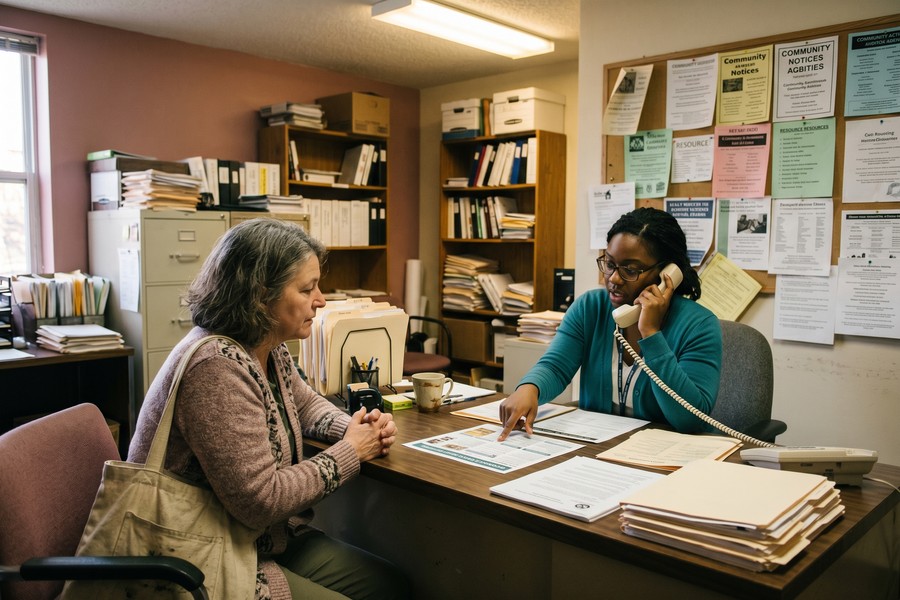
Dialing 2-1-1 connects callers to a specialist who can identify local emergency assistance programs for rent, utilities, food, and caregiving support. Community Action Agencies, there are approximately 1,000 across the U.S., offer emergency cash assistance of $100–$500 for immediate crises, along with longer-term case management.
Many communities also have caregiver-specific resource centers, often affiliated with hospitals or hospice organizations, that offer free financial counseling, legal document assistance, and emergency care coordination. Search “[your city] caregiver resource center” to find local options.
Income-Generating Options for Caregivers
When expenses outpace available assistance, generating additional income, even modest amounts, can close a critical gap. Several strategies are specifically compatible with the unpredictable schedule of caregiving.
Flexible and Remote Work Options
Remote work roles in customer service, data entry, and transcription are well-suited to caregivers because they allow work during a care recipient’s sleeping or therapy hours. Platforms like FlexJobs, Upwork, and Amazon Mechanical Turk offer income opportunities ranging from $10 to $45 per hour depending on skills.
Gig economy work with fully flexible scheduling, survey platforms (Swagbucks, Survey Junkie), task apps (TaskRabbit), or print-on-demand stores, can generate $100–$800 per month with zero schedule commitment. This is not a replacement for primary income, but it can fund specific emergency costs.
Monetizing Caregiving Skills
Caregivers develop highly marketable skills: medication management, personal care assistance, dementia behavior management, and care coordination. Many caregivers are unaware that they can be formally compensated for these skills through private-pay clients, home care agencies, or state-funded programs while still providing care to their family member.
Adult day care centers, senior living facilities, and home health agencies actively recruit experienced family caregivers for part-time roles. Hourly rates range from $14 to $22 per hour for personal care aide positions and $18 to $28 per hour for certified nursing assistants (CNAs), a credential that can be earned in 75–175 hours of training.
A family member who has managed a parent’s congestive heart failure for three years has clinical knowledge and practical competency that home health agencies are desperate for. Consistent with what financial counselors who work with caregiver populations report, many caregivers can earn supplemental income through agency part-time work while arranging care coverage for their own family member, though this requires coordinating overlapping schedules and is not realistic for every caregiving situation.
Protecting Your Credit While Caregiving
Credit damage during caregiving is extremely common, and extremely costly. A drop from 720 to 620 can increase the APR on a $10,000 personal loan by 10–15 percentage points, costing an additional $3,000–$5,000 over the loan term.
Preventing Credit Damage During Crisis
When cash is short, prioritize payments strategically. Secured debts (mortgage, car loan) and utility bills that can trigger disconnection should come first. Unsecured debts like credit cards have more flexibility, call your issuer and ask for a hardship plan before missing a payment. Most major issuers offer temporary interest rate reductions or payment deferrals for customers in documented hardship.
Set up minimum automatic payments on all credit accounts even when cash is tight. A single 30-day late payment can drop a score by 60–110 points. Prevention is far cheaper than repair. To catch issues you may not realize are dragging your score down, review this guide on hidden credit score killers, and if you suspect errors, see this resource on your rights as a borrower to dispute them.
Rebuilding Credit While Caregiving
Rebuilding a damaged credit score is possible even on a caregiver’s constrained budget. Secured credit cards and credit-builder loans are the two most accessible tools. A $200 secured deposit on a Capital One or Discover secured card, used for one small recurring purchase monthly and paid in full, can rebuild 60–100 points over 12–18 months.
For caregivers with very thin or damaged credit, this comparison of credit builder loans vs. secured cards for thin files explains exactly which path moves the needle faster in your specific situation.
A credit score difference of just 100 points (from 580 to 680) can reduce the interest rate on a $10,000 personal loan by 8–12 percentage points, saving $2,500–$4,000 in total interest on a 36-month repayment term.
Building an Emergency Finance Buffer as a Caregiver
The most effective emergency finance strategy for caregivers is building even a modest buffer before a crisis hits. This does not require large income, it requires a specific system.
The Micro-Savings Approach
Apps like Qapital, Acorns, and Chime’s round-up feature automatically move small amounts, often $1–$5 per transaction, into a dedicated savings account. Caregivers who use these tools consistently report accumulating $400–$1,200 over a 12-month period without feeling the impact in their daily budget.
Opening a high-yield savings account (HYSA) separate from your checking account creates a psychological and practical barrier against spending your emergency fund., the best HYSAs pay 4.5–5.25% APY, meaning a $1,000 balance earns approximately $45–$53 per year in interest, effectively growing your buffer passively.
Using Benefits to Fund Your Buffer
Tax refunds, SNAP savings, energy assistance credits, and any month where caregiving costs run lower than average are all opportunities to add to an emergency buffer. Even directing $25 per month consistently into a dedicated account builds a $600 reserve in 24 months. That amount, modest as it sounds, covers most small emergency expenses without any borrowing at all.
Caregivers who receive Medicaid waiver payments should treat a portion of each payment as emergency reserve rather than immediate spending. A 10% reserve rate on a $1,200/month HCBS payment builds a $1,440 buffer in one year. That reserve dramatically reduces the need for high-cost borrowing when an unexpected expense hits.
The Consumer Financial Protection Bureau (CFPB) offers free financial coaching resources specifically designed for people in caregiving situations. You can access these tools, plus use the CFPB complaint database before choosing any financial product, through the CFPB’s official website. Before selecting any lender, it also helps to know how to use the CFPB complaint database to vet lenders.
| Emergency Buffer Strategy | Monthly Contribution | 12-Month Reserve | Best For |
|---|---|---|---|
| Round-Up App | $15–$40 (automatic) | $180–$480 | Minimal active management |
| HYSA Auto-Transfer | $25–$100 | $300–$1,200 | Disciplined savers |
| HCBS 10% Reserve | $80–$320 (from waiver) | $960–$3,840 | Medicaid waiver recipients |
| Tax Refund Deposit | Annual lump sum | $800–$2,000 | Those with annual refunds |
| Gig Income Reserve | $50–$200 | $600–$2,400 | Caregivers with flex work hours |
| Emergency Type | Best First Option | Backup Option | Avoid |
|---|---|---|---|
| Medical Bill Spike | Hospital charity care | Personal loan | Payday loan |
| Rent/Mortgage Shortfall | 211 emergency assistance | Credit union loan | Cash advance apps |
| Medication Gap | Manufacturer PAP / GoodRx | Credit card | Any high-APR loan |
| Equipment Repair | Nonprofit grant | BNPL / 0% card | Payday loan |
| Utility Shutoff | LIHEAP / utility hardship | EAP emergency grant | Revolving credit |
Emergency preparedness for caregivers is not about having six months of expenses saved, most caregivers cannot achieve that. It is about knowing the first three phone calls to make when a crisis hits. That knowledge is worth more than savings, because the right call can deliver free money faster than any loan application.

Real-World Example: Maria’s $9,400 Caregiver Crisis, and How She Navigated It
Maria, a 47-year-old retail manager in Phoenix, was supporting her mother with Parkinson’s disease while working 32 reduced hours per week, down from 40 after her mother’s condition worsened. Her monthly caregiving costs had reached $1,800: $900 for a part-time home health aide, $450 in medications not covered by Medicare Part D, and $450 in transportation and supplies. Then her mother’s hospital stay generated a $6,200 out-of-pocket bill, and Maria’s car, her essential transport to both her job and her mother’s appointments, needed $3,200 in repairs. Total crisis amount: $9,400, with $440 in her savings account.
Maria’s first move was calling the hospital’s financial counselor within 48 hours of receiving the bill. The hospital offered a 60% charity care reduction under its financial assistance policy, bringing the bill to $2,480. She simultaneously applied for the Arizona Alzheimer’s Association’s caregiver emergency fund and received a $750 grant in 11 days. Her employer’s EAP provided a $500 hardship grant and connected her to an attorney who helped her apply for Arizona’s ALTCS (Medicaid HCBS) waiver, which, once approved at 60 days, began paying her $14.50 per hour for 20 hours per week of care she was already providing, or roughly $1,160 per month.
For the car repair, Maria used a credit union personal loan, she had been a member for 12 years, at 16.9% APR for $3,200 over 24 months, producing a $158/month payment. She also discovered that GoodRx reduced her mother’s most expensive medication from $180/month to $62/month at a nearby pharmacy. In total, Maria resolved a $9,400 crisis with $1,250 in non-repayable grants, a $3,720 hospital reduction, $118/month in medication savings, and a single manageable loan, while establishing an ongoing income stream of $1,160/month through the Medicaid waiver program.
Within 18 months, Maria had paid off the credit union loan and was directing $200/month from her HCBS waiver payments into a high-yield savings account. Her emergency buffer reached $3,600, enough to cover most single-incident crises without any borrowing. Her credit score, which had dipped to 601 during the crisis, recovered to 668 through consistent payment history on the personal loan. The key takeaway: Maria did not need to resolve everything at once, she prioritized, stacked multiple smaller solutions, and avoided high-cost debt entirely.
Your Action Plan
-
Map Your Current Expenses Within 24 Hours
List every caregiving-related expense from the past 30 days. Separate them into categories: medical, personal care, transportation, housing modifications, and supplies. This baseline reveals where the largest savings and assistance opportunities exist, and it is required documentation for almost every grant and assistance application.
-
Call 2-1-1 and Your Local Area Agency on Aging Immediately
These two calls cost nothing and can trigger multiple simultaneous assistance applications. The AAA specialist will identify every program for which you and your care recipient may qualify, including programs you have never heard of. Document the date, the representative’s name, and every referral you receive.
-
Apply for Medicaid HCBS Waiver If Care Recipient Is Medicaid-Eligible
This is the single highest-value action most family caregivers never take. Contact your state’s Medicaid office and ask specifically about the HCBS waiver or “self-directed care” program that allows family caregivers to be paid. Apply immediately, waiting lists are real, and earlier applications get earlier placement.
-
Contact the Hospital Financial Counselor About Every Outstanding Medical Bill
Do this within 30 days of receiving any bill. Ask specifically about charity care, financial assistance, and interest-free payment plans. Request an itemized statement and review it carefully. Dispute any line item you cannot identify. Most hospitals have significant flexibility to reduce or eliminate bills for qualifying households.
-
Access Your Employer’s EAP and Review All Benefits
Call HR and ask about your EAP, caregiver support benefits, backup care programs, DCFSA, and FMLA eligibility. Review your benefits portal for eldercare resources. Ask specifically whether your employer offers hardship grants, many do, and they are rarely publicized. This step takes less than 30 minutes and can yield $500–$5,000 in benefits.
-
Apply to Three or More Nonprofit Emergency Grant Programs Simultaneously
Identify organizations relevant to your care recipient’s condition, disease-specific nonprofits often have emergency funds. Apply to general caregiver organizations like the Caregiver Action Network and your state’s Family Caregiver Support Program at the same time. Being awarded one grant does not disqualify you from others.
-
If Borrowing Is Necessary, Start With Credit Unions and Online Personal Lenders
Compare at least three lenders before accepting any offer. Pre-qualification checks at most online lenders use soft credit pulls that do not affect your score. Only proceed to formal application once you have identified the best available rate. If you are denied, review this guide on what to do after an emergency loan denial, there are specific next steps that can change the outcome.
-
Begin Building a Micro-Emergency Fund Immediately After the Crisis Passes
Set up an automatic transfer of even $25 per week to a separate high-yield savings account. Use a round-up app to accelerate accumulation. After 12 months, evaluate whether you can increase the contribution. The goal is not perfection, it is having $500–$1,500 available without borrowing the next time an unexpected expense hits.
Frequently Asked Questions
Can I be paid to care for my own family member?
Yes, in many states. Medicaid HCBS waiver programs allow family caregivers, including spouses in some states, to receive payment for qualifying care services, typically at $10–$20 per hour. If your care recipient has long-term care insurance, that policy may also authorize payment to family caregivers. The VA’s PCAFC program pays stipends to caregivers of qualifying veterans regardless of state residency.
What is the fastest way to get emergency money as a caregiver?
Faith-based or community organization emergency funds are typically fastest, delivering cash in 24–72 hours. Employer EAP hardship grants follow at 2–5 days, and online personal loans can fund within 1–3 business days of approval. Cash advance apps provide same-day advances up to $750 with no credit check, but amounts are small. For a complete breakdown of timing across all funding types, review this emergency funding speed comparison.
What credit score do I need to qualify for a caregiver emergency loan?
Most online personal lenders accept applicants with credit scores of 580 or above, though the best rates typically require 660+. Credit unions may have more flexible standards for existing members. Below 580, your options shift to co-signed loans, secured personal loans, credit union PALs, or focusing exclusively on grant-based assistance until your credit recovers.
Are there grants specifically for caregivers, not just the people receiving care?
Yes. The Caregiver Action Network, the National Alliance for Caregiving, state family caregiver support programs (funded under the Older Americans Act), and many disease-specific nonprofits offer grants directed specifically to the caregiver. These grants typically cover respite care, transportation, equipment, and personal expenses, not just medical costs for the care recipient.
Do these programs work for long-distance caregivers who don’t live with the person they’re supporting?
Most do, with some variation. Medicaid HCBS waivers generally require the caregiver to live with or provide a minimum number of care hours to the recipient, so long-distance arrangements may not qualify for paid caregiver programs. However, nonprofit grants, 211 referrals, and AAA services are accessible to any caregiver regardless of living arrangement. The care recipient’s local AAA is the most useful starting point for identifying programs available in their geographic area.
How can I reduce medical costs for someone I’m caring for?
Start by requesting a charity care application from the hospital’s financial counselor, most nonprofit hospitals are required to offer this program. Use GoodRx or NeedyMeds to reduce prescription costs, or apply directly to the pharmaceutical manufacturer’s patient assistance program. Apply for Medicare Extra Help (Low Income Subsidy) if the care recipient is on Medicare. Request an itemized bill and dispute any errors or duplicate charges. These four steps can reduce medical expenses by 30–70% in many cases.
Does using FMLA leave affect my ability to get loans?
FMLA leave itself does not appear on your credit report and does not directly affect your credit score. However, if FMLA results in reduced income, your debt-to-income ratio increases, which can affect loan approval. Document your return-to-work date and current employment status clearly when applying for loans during or immediately after FMLA leave.
What if I’ve already taken on too much debt from caregiving?
Contact a nonprofit credit counseling agency (look for NFCC members at nfcc.org) for free or low-cost debt management guidance before missing any payments. Ask your existing lenders about hardship programs. Separately, review whether you are accessing all available government and nonprofit assistance, reducing monthly expenses through grants and programs can free up cash for debt repayment without additional borrowing.
Can I get emergency financial help if I have no income of my own?
Yes. Several programs do not require the caregiver to have employment income. Medicaid waiver programs create income for eligible caregivers. Nonprofit emergency grants assess financial need, not employment status. Community Action Agencies, 211, and AAAs can identify additional safety-net programs based on household need alone. A caregiver with no outside income may actually qualify for more assistance programs than one with part-time employment.
Is this approach realistic for caregivers in rural areas with fewer local services?
Partly. Federal programs like Medicaid HCBS waivers, SNAP, LIHEAP, and VA caregiver stipends are available nationally regardless of geography. The gap tends to be in local and community-based assistance, rural areas often have fewer Community Action Agencies, caregiver resource centers, and faith-based emergency funds. The 211 line still functions in most rural areas and remains worth calling, but the referral list will be shorter. Online personal lenders and national nonprofit grant programs are fully accessible regardless of location.
How do I protect my credit score during a caregiving financial crisis?
Prioritize secured debts and utility payments to avoid foreclosure, repossession, or service shutoffs. Call unsecured creditors before missing payments and request hardship programs, most major issuers offer temporary rate reductions or payment deferrals. Set up autopay for minimum payments on all accounts even when cash is very tight. See this guide on hidden credit score killers for less-obvious factors that may be affecting your score during caregiving.
Is emergency finance for caregivers different from standard emergency borrowing?
The fundamental financial products are the same, but caregivers have access to specialized resources that are not available to the general public: Medicaid caregiver compensation, VA caregiver stipends, caregiver-specific nonprofit grants, DCFSA accounts, and employer caregiver benefits. The key difference is search order, caregivers should exhaust these specialized, often free resources before turning to traditional borrowing. The same $5,000 need looks very different depending on whether you start with a grant application or a loan application.
Sources
- Medicaid.gov, Home and Community-Based Services
- U.S. Administration for Community Living, Eldercare Locator
- U.S. Department of Labor, Family and Medical Leave Act (FMLA)
- IRS Publication 503, Child and Dependent Care Expenses (DCFSA)
- NeedyMeds, Patient Assistance Programs Database
- Society for Human Resource Management, Employee Benefits Survey
- Caregiver Action Network, Financial Assistance Resources for Caregivers