

Fact-checked by the onlinepaydaynews.com editorial team
You signed for an emergency loan at 11 PM on a Tuesday, heart pounding, car broken down, rent overdue. You read the big number, $1,500, and the monthly payment, and you clicked “Accept.” What you did not read were the four additional fee categories buried in sections 8, 12, 14, and 19 of the agreement. That is not an accident. Emergency loan hidden fees are systematically designed to be overlooked, and millions of borrowers pay dearly for that oversight every single year.
According to the Consumer Financial Protection Bureau, the typical payday or short-term emergency borrower pays $520 in fees alone on a $375 loan, a cost that dwarfs the principal. A 2023 study by the Center for Responsible Lending found that predatory lending strips more than $9.8 billion annually from working-class American households. Origination fees, prepayment penalties, ACH return fees, and insurance add-ons routinely inflate the true cost of a loan by 40% to 300% beyond the advertised rate.
This guide pulls back the curtain on every major hidden fee category lurking inside emergency loan agreements. You will learn exactly what each fee is called, how lenders disguise it, what it typically costs in dollar terms, and how to negotiate or avoid it before you sign anything. By the end, you will be able to decode any loan agreement in under 10 minutes and spot the clauses that cost borrowers the most.
Key Takeaways
- The average short-term borrower pays $520 in fees on a $375 loan, a 138% fee-to-principal ratio that regulators have flagged repeatedly.
- Origination fees on personal emergency loans range from 1% to 12% of the loan amount, adding up to $600 on a $5,000 loan before interest accrues.
- ACH return fees, charged when a payment fails, average $25 to $35 per occurrence and can trigger cascading bank overdraft charges of an additional $35 each.
- Prepayment penalties can lock borrowers into paying 60 to 90 days of additional interest even after repaying the principal in full.
- Credit insurance add-ons, often presented as optional but defaulted to “yes,” cost borrowers an average of $2.47 per $100 of insured balance each month.
- Loan renewal or rollover fees average $15 to $30 per $100 borrowed and are the single largest driver of long-term debt traps for emergency borrowers.
In This Guide
- Origination Fees: The First Dollar You Lose Before Spending Any
- ACH Return and Payment Processing Fees
- Prepayment Penalties and Early Payoff Traps
- Rollover and Renewal Fees: The Debt Trap Engine
- Credit Insurance and Add-On Product Fees
- Late Fee Structures and Grace Period Illusions
- Administrative, Document, and Verification Fees
- How Emergency Loan Hidden Fees Distort the True APR
- Lender Type Fee Comparison: Who Charges the Most
- How to Negotiate, Waive, or Avoid These Fees
Origination Fees: The First Dollar You Lose Before Spending Any
An origination fee is charged the moment a lender approves and disburses your loan. It is typically deducted directly from your loan proceeds, meaning you receive less money than you borrowed. On a $5,000 loan with a 6% origination fee, you receive $4,700, but your repayment schedule is based on the full $5,000.
How Lenders Disguise Origination Fees
Lenders label this charge an “administrative fee,” a “processing fee,” or an “underwriting fee” depending on which term tests better with borrowers. The name changes, but the mechanism is identical. According to Federal Reserve consumer credit data, origination fees on personal loans range from 1% to 12% depending on the lender and the borrower’s credit profile.
Online lenders who target emergency borrowers with poor credit tend to cluster at the 5% to 12% range. That means on a $2,000 emergency loan, you could pay up to $240 before you even make one payment. Lenders are required to disclose this in the APR calculation, but many bury the fee disclosure in paragraph-length footnotes using the phrase “financed amount” rather than anything that plainly says you receive less than you borrowed.
Flat-Fee vs. Percentage Origination Structures
A flat origination fee (for example, $75 regardless of loan size) favors borrowers taking larger loans. The percentage structure punishes small-dollar borrowers disproportionately. If you borrow $300 with a $45 flat origination fee, you have effectively paid 15% of your principal before any interest.
| Loan Amount | Origination Fee (6%) | Amount You Actually Receive | You Repay |
|---|---|---|---|
| $500 | $30 | $470 | $500 + interest |
| $1,500 | $90 | $1,410 | $1,500 + interest |
| $3,000 | $180 | $2,820 | $3,000 + interest |
| $5,000 | $300 | $4,700 | $5,000 + interest |
| $10,000 | $600 | $9,400 | $10,000 + interest |
The Truth in Lending Act (TILA) requires lenders to include origination fees in the APR calculation, but it does NOT require them to show the fee as a separate dollar amount on the front page of the agreement. Most lenders take full advantage of this loophole.
ACH Return and Payment Processing Fees
When a lender cannot collect a scheduled payment from your bank account, the failed transaction triggers an ACH return fee. Most emergency loan agreements authorize lenders to attempt the same payment multiple times, each attempt counting as a separate return event with a separate fee.
The Double-Fee Trap: Lender and Bank Both Charge You
A single failed payment can generate two separate charges: the lender’s ACH return fee (typically $25 to $35) and your bank’s non-sufficient funds (NSF) fee (typically $25 to $36). According to the CFPB’s 2022 supervisory highlights, certain lenders were found to attempt collections up to six times on a single delinquent payment, generating up to $210 in lender fees alone, plus bank charges on top.
This practice was common enough that the CFPB issued updated guidance in 2023 requiring lenders to obtain new authorization after two failed consecutive collection attempts. Enforcement varies, and many online lenders operating outside strict state oversight continue the practice. If you are unsure whether your lender complies, you can check the CFPB complaint database before you borrow to see how many complaints a specific lender has received.
Processing Fees Hidden in Repayment Methods
Paying by debit card, credit card, or over the phone often triggers a convenience fee ranging from $3 to $15 per transaction. If your loan has 12 monthly payments and each incurs a $10 processing fee, you pay an additional $120 over the life of the loan. That cost does not appear in the APR because it is technically optional, even if it is the only viable payment method available to you.
The CFPB found that 50% of payday loan borrowers incurred bank overdraft fees as a direct result of lender-initiated ACH collection attempts, costing those borrowers an average of $185 in additional bank charges per loan cycle.

Prepayment Penalties and Early Payoff Traps
Most borrowers assume paying off a loan early is always good. In many emergency loans, it is not, at least not for your wallet. A prepayment penalty is a fee charged when you pay off your loan balance before the agreed-upon term ends. Lenders structure it as a flat dollar amount or as the equivalent of 60 to 90 days of interest you “would have paid.”
How Prepayment Penalties Are Structured
A common structure is the “Rule of 78s”, a front-loaded interest calculation method that assigns the majority of interest to the early months of the loan. Even if you pay off in month three of a 12-month loan, you may owe a disproportionate share of the total interest. This method is banned for loans longer than 61 months in most states, but it remains legal for short-term loans in many jurisdictions.
Another structure is a fixed-period penalty: you owe a penalty if you repay within the first three to six months of the loan. On a $5,000 loan at 28% APR, three months of interest equals roughly $350, money you pay simply for the privilege of paying early. If you are considering paying off collections or restructuring debt alongside an emergency loan, understanding how debt payoff timing affects your credit report is equally important.
One honest caveat worth naming: prepayment penalty clauses are not always bad for every borrower. If you have a very low fixed rate and no better use for extra cash, paying early may not be the right financial move regardless of penalties. The penalty becomes punishing specifically when you have found cheaper financing and want to refinance, which is precisely when lenders most benefit from keeping you locked in.
States That Restrict Prepayment Penalties
Federal law prohibits prepayment penalties on most federally regulated mortgage loans. For personal and payday loans, the rules differ by state. California, New York, and Texas all have restrictions on prepayment penalties for short-term consumer loans. Tribal lenders and lenders chartered in certain states can bypass these protections. Always check your state’s consumer finance laws before signing.
| Loan Term | Prepayment Scenario | Penalty Type | Estimated Cost |
|---|---|---|---|
| 12-Month Loan | Pay off at Month 3 | Rule of 78s | $280 to $420 |
| 18-Month Loan | Pay off at Month 4 | Fixed 3-Month Interest | $310 to $500 |
| 24-Month Loan | Pay off at Month 6 | 2% of Remaining Balance | $60 to $200 |
| 6-Month Loan | Pay off at Month 2 | Flat $150 Penalty | $150 flat |
“Prepayment penalty clauses in short-term consumer loans are one of the most financially damaging terms borrowers never notice. People think they are doing the responsible thing by paying early, and they get penalized for it. That is a fundamental betrayal of the borrower’s trust.”
Rollover and Renewal Fees: The Debt Trap Engine
A loan rollover occurs when a borrower cannot repay the full balance on the due date and instead pays a fee to extend the loan for another term. This is the mechanism responsible for the most catastrophic debt spirals in the short-term lending market. What appears to be a helpful “extension” is actually a recurring fee machine.
The True Cost of a Single Rollover
A standard two-week payday loan at $15 per $100 costs $60 on a $400 loan. If the borrower rolls over four times, common for borrowers using loans to cover recurring expenses, the total fee outlay reaches $240 on a $400 principal. The borrower still owes the original $400 at the end. According to the CFPB, 80% of payday loans are rolled over or renewed within 14 days of the original due date.
The renewal fee itself is typically not labeled as interest. It appears as a “renewal charge,” a “continuation fee,” or a “re-issue fee.” This disguise matters because many borrowers do not connect this fee to the APR they originally agreed to, effectively obscuring the compounding cost. For borrowers navigating these dynamics, understanding how lenders manipulate APR claims to obscure true costs is critical before agreeing to any rollover terms.
States Where Rollovers Are Limited or Banned
17 states and Washington D.C. have effectively banned triple-digit APR payday loans, which eliminates most rollover structures. Florida limits rollovers to one per loan cycle and requires a 24-hour cooling-off period. Texas and Nevada impose no rollover limits, allowing borrowers to roll indefinitely. If you live in a state with weak rollover protections, lenders know it, and some specifically market to residents of those states.
Some lenders automatically enroll borrowers in a “flexible repayment” program that functions exactly like a rollover, charging renewal fees each period, without using the word “rollover.” Read the repayment structure section of any agreement carefully before accepting any “flexibility” feature.
Credit Insurance and Add-On Product Fees
Credit insurance, also called loan protection insurance, payment protection insurance, or debt cancellation coverage, is sold alongside emergency loans as a way to cover payments if you lose your job, become disabled, or die. It sounds reasonable. In practice, it is one of the most aggressively marketed and poorly valued financial products in consumer lending.
How Lenders Make Credit Insurance Seem Mandatory
Online loan applications often pre-check the insurance add-on box by default. The monthly payment is sometimes presented with insurance already folded in, with no clear separation from the principal and interest portion. The Federal Trade Commission has taken action against several lenders for deceptive marketing of credit insurance as a condition of loan approval, when, legally, it cannot be.
The cost is significant. The Federal Trade Commission’s consumer credit guidance notes that credit insurance premiums average $2.47 per $100 of insured balance monthly. On a $3,000 loan with a 12-month term, that adds $88.92 per year, before you pay a dime of principal or interest.
Other Common Add-On Products
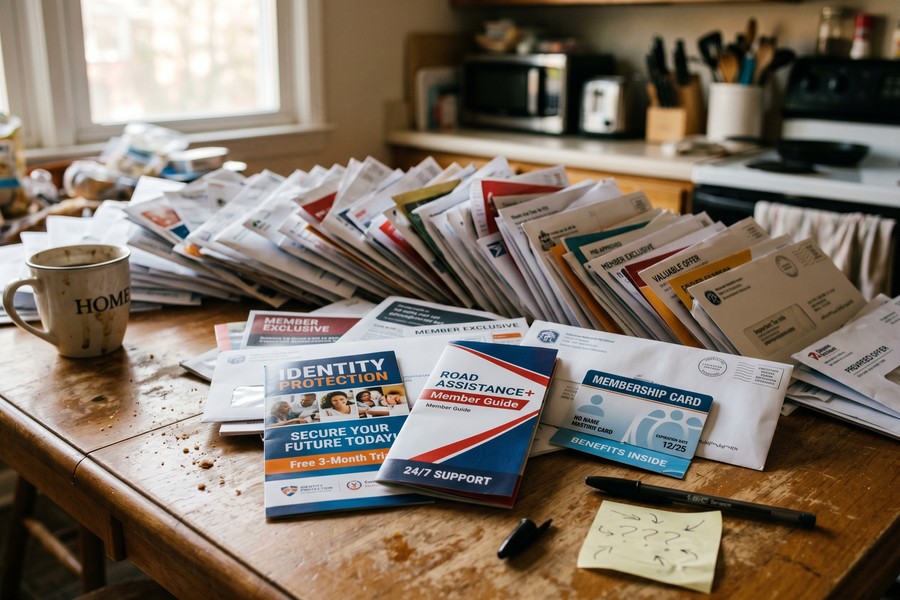
Beyond credit insurance, emergency loan agreements frequently include debt suspension agreements, roadside assistance plans, identity theft monitoring subscriptions, and “credit score tracking” services. Each costs between $5 and $30 per month and is often auto-enrolled. The combined effect can add $40 to $100 per month to a loan payment, a 20% to 50% cost increase on a typical emergency loan. To understand how these add-ons can also quietly damage your credit profile, read about the quiet credit score killers most borrowers never notice.
A 2019 Pew Charitable Trusts report found that lenders earn 70 cents for every dollar consumers pay in credit insurance premiums, far exceeding the payout ratio of almost any other insurance product. This makes it one of the most profitable loan add-ons in the industry.
Late Fee Structures and Grace Period Illusions
Every emergency loan agreement includes a late fee clause. What borrowers do not anticipate is how aggressively these fees compound when combined with a missed payment’s impact on the interest calculation. A late fee on a personal loan typically runs between $15 and $40, or 5% of the overdue payment amount, whichever is greater.
Grace Periods That Are Not Really Grace Periods
Many lenders advertise a “grace period” of 10 to 15 days before a late fee kicks in. What they do not advertise clearly is that interest continues accruing during that grace period at the original daily interest rate. On a $2,000 loan at 30% APR, every day of the grace period costs roughly $1.64 in additional interest. Ten days costs $16.40, nearly equivalent to the late fee they are “waiving.”
Some lenders also use the missed payment date to trigger a “default rate”, a higher interest rate that applies retroactively to the remaining balance. Default rates can be 5 to 10 percentage points higher than the original APR, and many agreements apply them after just one late payment. This is one of the most punishing emergency loan hidden fees because it affects every remaining payment, not just the one you missed.
How Late Fees Interact With Credit Reporting
A payment reported 30 or more days late to the credit bureaus can reduce your credit score by 60 to 110 points, according to FICO’s scoring impact data. That score drop increases the cost of your next loan, creating a feedback loop where one late payment on an emergency loan raises the cost of every future borrowing event. This is why understanding advanced strategies for spotting predatory loan terms before signing matters so much.
According to FICO data, a single 30-day late payment can drop a 780 credit score by up to 110 points and a 680 score by up to 80 points, and the damage stays on your report for 7 years, raising the cost of every loan you take in that window.
Administrative, Document, and Verification Fees
Below origination fees on the fee hierarchy sit a cluster of smaller charges that collectively add meaningful cost: document preparation fees, income verification fees, identity verification charges, and disbursement fees. Each one typically runs $10 to $50, but together they can add $50 to $200 to the cost of a single loan.
The Wire Transfer and Expedited Funding Fee
Borrowers in genuine emergencies often need funds same-day or within hours. Lenders charge a premium for this urgency. Expedited or same-day funding fees range from $15 to $50 on top of standard disbursement. On a $500 emergency loan, a $25 expedited fee represents 5% of the principal, added cost that never appears prominently in marketing materials.
The charge sometimes appears as a “wire transfer fee” rather than an expedited fee, implying it is a bank charge when it is actually a lender revenue line. If you can wait one to two business days for standard ACH transfer, you often avoid this charge entirely. Always ask specifically whether standard ACH is available at no additional charge before accepting expedited funding.
Document Storage and Account Maintenance Fees
A growing number of online lenders charge monthly “account maintenance” fees of $5 to $15, fees for keeping your loan account active in their system. These are most common in installment loan structures and are often buried in the monthly payment breakdown as a line item labeled “service fee.” Over a 24-month loan, a $10 monthly maintenance fee adds $240 in pure overhead cost to your borrowing.
| Fee Type | Typical Range | How It Is Labeled | How to Avoid It |
|---|---|---|---|
| Document Prep Fee | $25 to $75 | “Processing fee” | Ask for fee waiver or choose lender with no doc fee |
| Expedited Funding | $15 to $50 | “Wire transfer fee” | Accept standard ACH (1-2 days) |
| Account Maintenance | $5 to $15/month | “Service fee” | Compare lenders; credit unions rarely charge this |
| Identity Verification | $10 to $30 | “Verification charge” | Ask if it is included in origination fee |
| Paper Statement Fee | $2 to $5/month | “Statement fee” | Enroll in e-statements at account opening |
How Emergency Loan Hidden Fees Distort the True APR
The annual percentage rate (APR) is supposed to be the standardized number that makes loans comparable. In practice, not all fees are required to be included in the APR calculation under the Truth in Lending Act. This legal gap is where emergency loan hidden fees do the most damage to borrower decision-making.
Fees That Must Be Included in APR vs. Fees That Don’t Have To Be
Under TILA, lenders must include origination fees, discount points, and certain other finance charges in the APR. Late fees, return payment fees, and some insurance premiums are not always required in the APR calculation. This means two loans with identical advertised APRs can have dramatically different total costs based on what fees fall outside the APR.
A 36% APR loan with a 6% origination fee, $35 ACH return fee, and $15/month maintenance fee on a $3,000 two-year loan could carry an effective all-in APR above 55%. Borrowers comparing only the advertised rate would have no idea. Consumer advocates have pushed for broader all-in cost disclosure reforms precisely because of this gap.
The Finance Charge Box vs. the Total of Payments
TILA requires lenders to disclose the “finance charge” (total interest) and the “total of payments” (everything you will pay back). These boxes are often in small print and rarely computed to include add-on products that were separately agreed to. Always add up the finance charge, all disclosed fees, and any monthly add-on costs to calculate your true total repayment obligation before signing.
A Pew Charitable Trusts study on payday lending found that 76% of borrowers primarily rely on lenders for loan information, yet fewer than half of borrowers surveyed understood the APR of the loan they had just signed. This knowledge gap is the foundation on which hidden fees thrive.
Lender Type Fee Comparison: Who Charges the Most
Not all emergency lenders charge the same fees. The type of lender you choose, payday lender, online installment lender, credit union, or bank, has a dramatic impact on the fee landscape you face. Understanding the differences could save you hundreds of dollars on a single loan.
Where Payday Lenders Land on the Fee Spectrum
Payday lenders charge the highest effective fees in the emergency lending market. The typical fee structure of $15 to $20 per $100 borrowed translates to APRs of 391% to 521% on a 14-day loan. They rarely charge origination fees separately because the per-$100 fee already functions as an origination charge. Rollover fees compound these costs rapidly.
Online installment lenders occupy the middle of the spectrum. They typically charge 1% to 12% origination fees, APRs of 36% to 200%, and may add maintenance and insurance fees. They are more transparent about rates than payday lenders but carry their own hidden fee complexity. For rural borrowers with limited lender access, understanding all available options is especially important, and emergency finance options for rural borrowers covers this in depth.
Credit Unions and Banks: The Lower-Fee Alternatives
Credit union emergency loans, often called “payday alternative loans” (PALs), are federally capped at 28% APR with a maximum origination fee of $20. Banks offer personal loans starting at 7% to 12% APR for qualified borrowers. Neither type typically charges ACH return fees beyond $10 to $25, and both rarely include credit insurance add-ons by default.
The trade-off worth acknowledging: credit unions require membership, and approval for their emergency loan products often depends on an existing account relationship and a credit check. Borrowers with very low credit scores or no prior credit union membership may not qualify for PALs when the emergency actually arrives. That is not a reason to dismiss them, it is a reason to join a credit union before you need one.
| Lender Type | Typical APR Range | Origination Fee | Rollover Fees | Add-On Products |
|---|---|---|---|---|
| Payday Lender | 391% to 521% | Embedded in rate | $15 to $30 per $100 | Rare |
| Online Installment | 36% to 200% | 1% to 12% | Renewal fees common | Frequently auto-enrolled |
| Tribal Lender | 100% to 700% | Embedded or separate | Common, unregulated | Less common |
| Bank Personal Loan | 7% to 36% | 0% to 6% | Not offered | Rare |
| Credit Union PAL | Up to 28% | Max $20 | Not offered | Very rare |
Research from the Pew Charitable Trusts Small-Dollar Loans Project shows that credit unions consistently offer emergency borrowers the lowest all-in cost, often by a factor of three to five compared to online installment lenders and ten or more compared to payday lenders. The barrier is that people in crisis rarely take time to shop, and lenders know it.
How to Negotiate, Waive, or Avoid These Fees
Most borrowers assume loan fees are fixed. Many are not. Online installment lenders competing for customers often have discretion to waive or reduce certain fees for borrowers who ask directly and specifically. Knowing which fees are negotiable and how to ask changes the conversation entirely.
Which Fees Lenders Are Most Likely to Waive
Origination fees are frequently negotiable, especially for borrowers with steady income or a prior relationship with the lender. Expedited funding fees are almost always avoidable if you can wait for standard processing. Document and verification fees are often waived entirely for borrowers who apply through the lender’s direct website rather than a lead-generation aggregator. Account maintenance fees can sometimes be waived for the first 6 to 12 months as a promotional offer, simply ask.
If you want a deeper framework for this approach, the guide on how to negotiate repayment terms on a short-term loan before you sign anything walks through the exact conversation structure to use with lenders.
Reading the Agreement Strategically
Search the agreement document for these specific terms before signing: “returned payment fee,” “NSF fee,” “continuation fee,” “renewal charge,” “credit insurance,” “debt suspension,” “prepayment charge,” and “default rate.” Each of these terms signals a fee category you need to evaluate. Create a running total of every dollar amount you find associated with these terms across the full loan term.
Ask your lender for an itemized “total cost of credit” disclosure, not just the APR and monthly payment. Reputable lenders will provide this. If a lender refuses or cannot produce one, treat that as a red flag and compare alternatives before signing.
Consumer law attorneys at the National Consumer Law Center note that borrowers have far more room to negotiate than they realize, especially in the online lending market where competition for customers is intense. A borrower who asks clearly and specifically for a fee waiver, and who indicates they are comparing multiple offers, can often get 30% to 50% off certain fees before signing. The key is asking before you accept the offer, not after.
Real-World Example: Marcus’s $1,800 Emergency Loan That Cost $2,970
Marcus, a 34-year-old warehouse supervisor in Tennessee, needed $1,800 in October 2023 after his transmission failed and his employer required him to have transportation within 48 hours. He applied through a Google search result, found a lender offering “instant approval,” and signed the agreement in under 12 minutes. The advertised APR was 89%. What Marcus did not read was a 7% origination fee ($126), a $12.99 monthly “account protection” add-on he had not noticed was pre-checked, a $25 ACH return fee (triggered twice when his paycheck was delayed), and a $35 late fee.
By month four, Marcus had paid $892 in combined fees and had barely touched the principal. His total payment schedule, if he completed all 18 months, projected to $2,970 on an $1,800 loan. That is a total cost of $1,170 above principal, or a 65% premium on the money he originally borrowed. His effective all-in APR, once the add-on product was included, exceeded 130%.
When Marcus refinanced through his credit union’s emergency loan program in month five, he was offered $1,600 (his remaining balance) at 24% APR with a $20 origination fee and no add-ons. His new monthly payment dropped from $188 to $96, and his total remaining repayment cost dropped from $2,256 (projected remaining) to $1,152, a savings of $1,104 on the back half of the loan alone.
Marcus’s experience is not unusual. The Consumer Financial Protection Bureau estimates that borrowers who refinance high-fee emergency loans into credit union or bank products save an average of $700 to $1,400 in total interest and fees over the remaining loan term. The key step Marcus missed was checking the CFPB complaint database and comparing lenders before his first application, not after the damage was done.
Your Action Plan
-
Create a fee checklist before any application
List these eight fee categories: origination fee, ACH return fee, processing fee, prepayment penalty, rollover/renewal fee, credit insurance, maintenance fee, and late fee. Before submitting any application, confirm whether each category applies to that lender and what it costs.
-
Request the all-in total cost of credit in writing
Ask the lender to provide a written breakdown showing the total dollar amount you will repay over the full loan term, including all fees. If the lender quotes only APR and monthly payment, press for the dollar total. Reputable lenders will provide this readily.
-
Check the CFPB complaint database for your lender
Before signing with any lender, search for their name in the CFPB complaint database. Look specifically for complaints tagged “unexpected fees,” “charged fees not disclosed,” or “problems with repayment.” A pattern of these complaints is a reliable predictor of your own risk.
-
Uncheck all add-on products during the application
Scroll through every page of the online application and uncheck any pre-selected add-on products, including credit insurance, debt suspension, identity monitoring, or roadside assistance. Confirm your monthly payment updates to reflect the removal of these products.
-
Compare at least three lenders including a credit union
Emergency urgency pushes borrowers toward the first available option. Force yourself to compare at least three lenders, including your local or regional credit union. Credit union emergency loans are federally capped at 28% APR and $20 origination fees, dramatically lower than most online alternatives.
-
Choose standard ACH over expedited funding
Unless your situation is truly a same-day emergency, choose standard ACH transfer (1 to 2 business days) to avoid expedited funding fees of $15 to $50. Most genuine emergencies allow this window; most lenders will not volunteer the free option if you do not ask.
-
Negotiate origination fees and document fees before signing
Call the lender directly after receiving your approval offer. State that you are comparing multiple offers and ask whether the origination fee or any document fees can be reduced or waived. Many lenders will negotiate, especially if you have steady income or are borrowing above a minimum threshold.
-
Set up automatic payments from a funded account
ACH return fees are triggered by insufficient funds, not by intent to miss. Set up automatic payments and ensure your account has a buffer of at least one full payment amount before your due date each month. This alone eliminates the most common source of compounding fee damage.
Frequently Asked Questions
Are emergency loan hidden fees legal?
Yes, most emergency loan hidden fees are legal as long as they are disclosed somewhere in the loan agreement. The Truth in Lending Act requires lenders to disclose all finance charges, but some fee types, such as late fees, return payment fees, and optional add-ons, are not always required in the APR calculation. Legal does not mean visible or easy to find.
What is the maximum origination fee a lender can charge?
For federally regulated loans, limits vary by loan type. Mortgages regulated under RESPA have specific fee structures. For personal emergency loans, origination fee limits depend on state law and can range from uncapped (in some states) to 5% maximum (in others). Credit unions offering payday alternative loans (PALs) are federally capped at a $20 origination fee.
Can I cancel an emergency loan after signing to avoid fees?
The Federal Trade Commission’s “cooling-off rule” applies to certain door-to-door and some in-home sales, but it does not automatically apply to online or in-store emergency loan agreements. Some states have their own rescission rights for short-term loans, typically 24 to 72 hours. Check your state law or your loan agreement for any cancellation window, and act immediately if one exists.
Do credit unions charge the same fees as payday lenders?
No. Credit unions offering payday alternative loans (PALs) are regulated by the National Credit Union Administration (NCUA) and capped at 28% APR and a $20 origination fee. They do not charge rollover fees, and they rarely include add-on insurance products. The total cost of a credit union emergency loan is typically 60% to 85% lower than a comparable payday or online installment loan.
What happens if I miss a payment on an emergency loan?
A missed payment typically triggers a late fee ($15 to $40 or 5% of the payment, whichever is greater) and may trigger ACH return fees from both the lender and your bank. If the payment is more than 30 days late, it can be reported to credit bureaus, dropping your score by 60 to 110 points. Some agreements also trigger a higher “default” interest rate on the remaining balance after just one missed payment.
Is credit insurance on an emergency loan ever worth buying?
Rarely. Credit insurance premiums average $2.47 per $100 of insured balance monthly, and the payout conditions are often narrow, requiring job loss through no fault of your own, documented disability, or death. Most financial advisors recommend building a small emergency fund or relying on employer-provided disability insurance instead. If you want coverage, compare the cost against a standalone term life or disability policy, which typically offers far better value.
How do I find out if my lender is charging undisclosed fees?
Compare the fees listed in your loan agreement against every line item in your bank statement and loan portal. Any charge not explicitly listed in the agreement as a specific fee type may be unauthorized. You can file a complaint with the CFPB, your state attorney general’s consumer protection office, or your state banking regulator. Keep records of every communication with your lender and every charge you did not expect.
Can I get a refund on fees I already paid?
If a fee was not properly disclosed in your loan agreement, you may have grounds to demand a refund and, if the lender refuses, to file a regulatory complaint or pursue a small claims court action. TILA violations can result in lenders owing the borrower twice the amount of the undisclosed finance charge, plus attorney’s fees. Document everything and consult a consumer law attorney or a nonprofit credit counselor if you believe fees were improperly charged.
Do emergency loan fees affect my credit score directly?
Fees themselves do not appear on your credit report. However, the financial strain of high fees can cause missed payments, which do damage your credit score. Some lenders report utilization and payment history, meaning that a high total balance (inflated by fees) relative to your loan limit can affect credit utilization calculations if the lender reports to bureaus that track installment credit.
Are tribal lenders subject to the same fee disclosure rules?
Tribal lenders claim sovereign immunity from state consumer protection laws, which means they may not be subject to state-level fee caps or disclosure requirements. They are still theoretically subject to federal law, including TILA, but enforcement is complicated. Tribal lenders tend to have some of the highest APRs and least transparent fee structures in the emergency lending market. Extreme caution is advised before borrowing from any tribal lender.
What is the difference between an APR and the total cost of credit?
APR expresses your borrowing cost as an annualized percentage rate, but it does not always capture every fee. Total cost of credit is the actual dollar amount you will pay back above your principal, including every fee, every add-on product charge, and every interest payment across the full loan term. Always ask for the total cost of credit in writing. It is the only number that tells you the complete picture.
Which fee type causes the most long-term financial damage for emergency borrowers?
Rollover and renewal fees. A borrower who rolls over a $400 payday loan four times pays $240 in fees without reducing the principal at all. Combined with the debt trap effect, where borrowed funds cover recurring expenses rather than one-time emergencies, rollover fees are the primary reason the CFPB found that 80% of payday loans are renewed within 14 days of the original due date.
Can I negotiate fees on an emergency loan even after I have already been approved?
Yes, and borrowers rarely try. Approval is not acceptance. Before you sign, call the lender and ask directly whether the origination fee, document fees, or any add-on charges can be reduced. State clearly that you are comparing offers from other lenders. Lenders operating in competitive online markets have more flexibility than their agreements imply, and a direct ask before signing is far more effective than disputing a fee after the fact.
If you have already signed a loan and suspect you were not properly disclosed all fees, download and print your original loan agreement immediately. Some online lenders quietly update their agreement templates, having the version you signed is critical documentation for any dispute or complaint.
CFPB data shows that borrowers who file formal complaints against lenders receive monetary relief, including fee refunds and balance reductions, in approximately 25% of cases where the complaint involves undisclosed or unauthorized fees. Filing a complaint is worth the effort.
Emergency loan hidden fees are most dangerous when you are under financial stress, the exact state in which most borrowers sign loan agreements. Lenders know urgency reduces scrutiny. Slow down for 15 minutes before signing any agreement, even when your situation feels critical. Those 15 minutes can save you hundreds of dollars.